



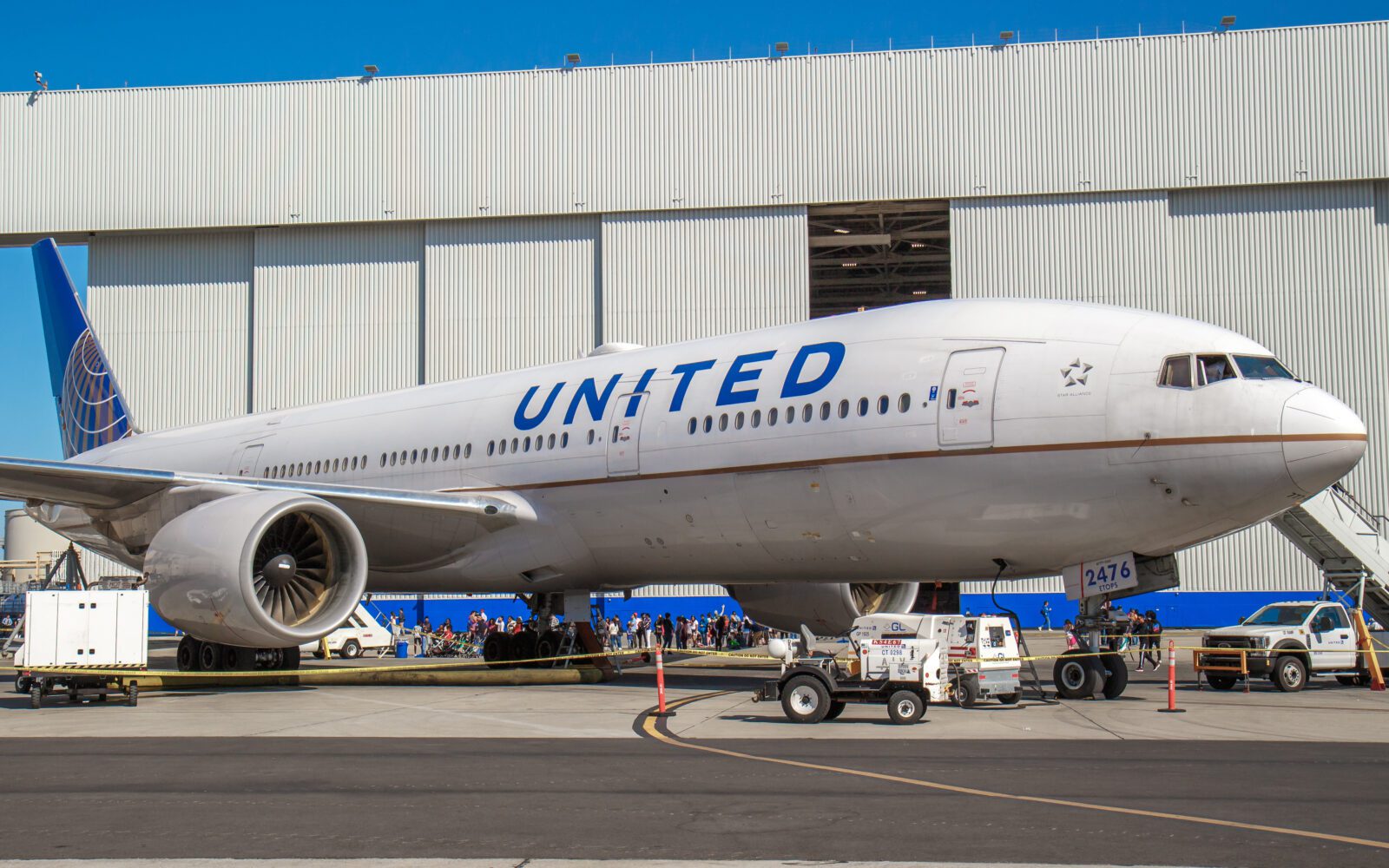
United Airlines’ chief executive, Scott Kirby, says the Chicago-based carrier has moved into the phase of its Starlink Wi-Fi rollout that he is most excited about – equipping widebody long-haul jets with the ultra-fast in-flight internet service.
Just before departing Rio de Janeiro, where Kirby had been attending the annual general conference of the International Air Transport Association (IATA), he dropped into United’s 60,000 square meter heavy maintenance base at Rio’s Galeão International Airport.
His reason for visiting the sprawling facility wasn’t just to press the flesh with staffers but to check out the work the team had just completed fitting Starlink on a United Boeing 777 – the first widebody aircraft in the United Airlines fleet to feature the system.
United Airlines started its Starlink rollout in March 2025 when the carrier equipped its first regional jet with the service. By October 2025, the airline had already moved on to rolling out Starlink on its mainline fleet, but United deliberately chose to start equipping its single-aisle aircraft first.
Given the size of United’s fleet, the rollout has been exceptionally fast. The airline has drawn up plans to equip more than one aircraft per day with the satellite internet service throughout 2026, with around 450 mainline aircraft to be retrofitted with Starlink by the end of this year.
In total, more than 1,000 United Airlines and United Express regional jets will have free Starlink internet installed, with the rollout expected to be complete by mid-2027.
Unfortunately, widebody, long-haul aircraft are the last to get the Starlink treatment.
“I was just with our great United team in Rio De Janeiro, where we completed the first prototype installation of Starlink on our first widebody (777),” Kirby wrote in a post on Instagram on Monday, moments before he boarded a flight out of Brazil.
“Our customers love Starlink on domestic routes, but the long international routes are the ones I’m most excited about… and I know it can’t come soon enough,” Kirby added.
“The United and Starlink teams are working hard to accelerate the installations as fast as possible.”
The core Starlink installation can be completed in as little as eight hours, which is around ten times faster than legacy Wi-Fi systems. The whole retrofit process does, however, take a little longer.
Up to four days, even for smaller regional jets. The reason is that engineers first have to rip out legacy systems and carry out tests before closing up the aircraft.
Although widebody aircraft pose more of a challenge, experience from other Starlink operators like Qatar Airways shows that the rollout can still be done very quickly. In fact, Qatar Airways managed to install Starlink on more than half of its Boeing 777 fleet in just four months.
Starlink uses a so-called ‘constellation’ (a vast network) of low-earth orbit satellites to provide high-speed, low-latency internet access around the world. In many use cases, Starlink provides faster connection speeds than traditional wired home broadband.
Other operators of Starlink in the United States, including Alaska and Hawaiian Airlines, and Southwest Airlines, although United remains far ahead of its rivals in rolling out the service.
American Airlines intends to equip around 500 single-aisle Airbus aircraft with Starlink beginning in early 2027, although that represents just a third of its total mainline and regional fleet.
Meanwhile, Delta Air Lines and JetBlue have signed up for rival satellite internet service Amazon Leo. Unfortunately, Amazon Leo is still in the initial launch phase of its satellite constellation, and the service won’t be available until mid-2027 at the earliest.
According to some reports, Delta had been considering Starlink, but a dispute arose over the branding for the portal that connects passengers to in-flight Wi-Fi. Delta wanted to incorporate the portal into its ‘Delta Sync’ experience, whereas Starlink insisted on a one-click connection.
Despite taking heavy criticism over its decision to partner with Amazon Leo, the airline insists that it will provide a better long-term experience for passengers.