



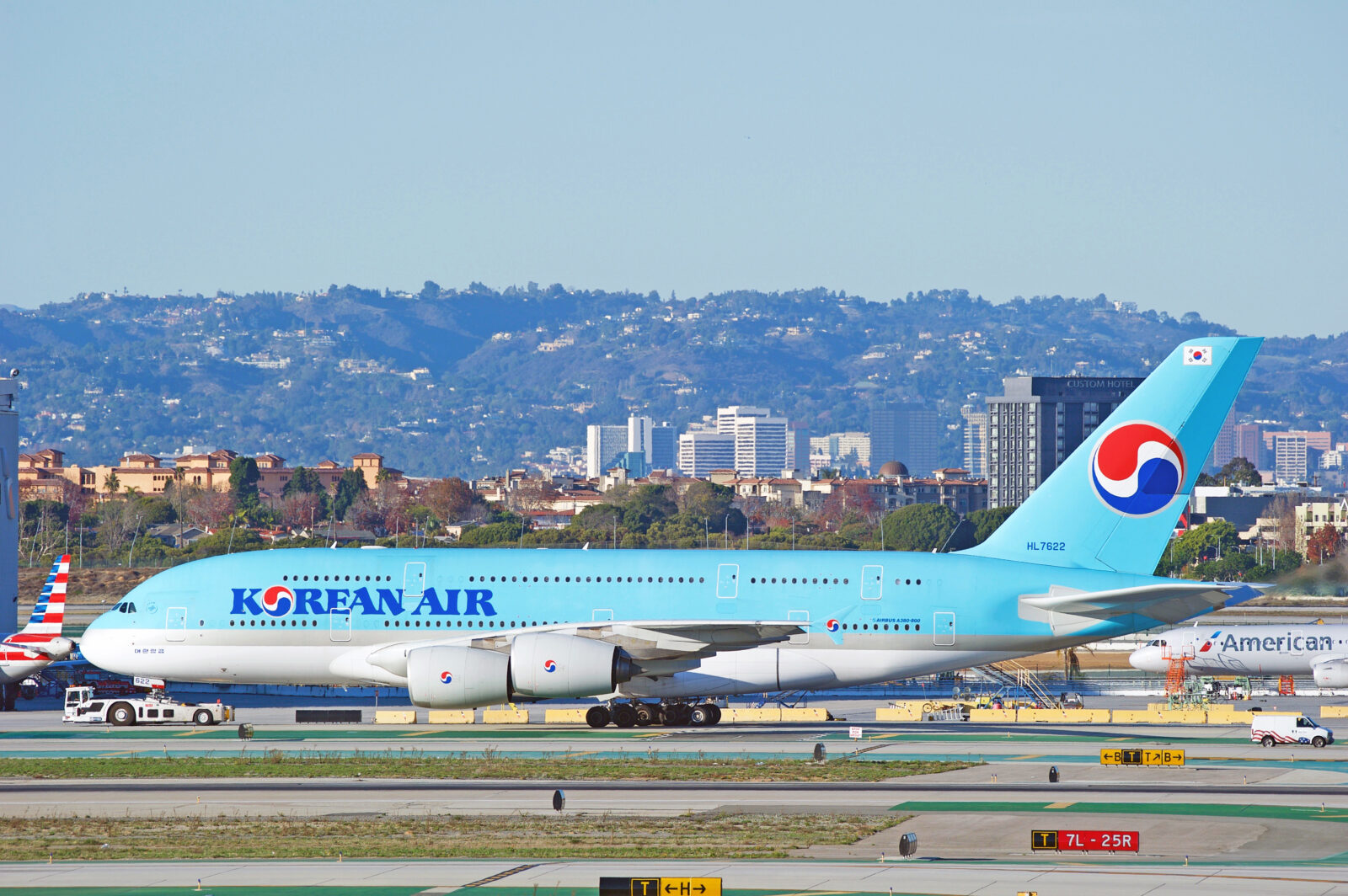
Passengers traveling between Seoul and several cities in the United States, including New York, Washington, D.C., and Boston, have received some bad news from Korean Air… the ultra-long-haul flights that ordinarily drag on for a grueling 13 hours are about to take even longer for a pretty alarming reason.
The reason, it has emerged, is that Russia plans to fire rockets in an area of the North Pacific measuring around 68,000 square miles – an area roughly the same size as Washington state or England and Wales.
The massive rectangular-shaped area is right in the middle of a very busy Oceanic corridor used by numerous airlines flying between Asia and the United States, meaning that it’s not just Korean Air’s passengers who are being affected by Russia’s military exercises in the Pacific.
In fact, most transpacific flights are going to be impacted in some way by this restriction, with many airlines having to make plans for 300+ mile detours around the restricted area.
The restrictions were put in place by the Federal Aviation Administration (FAA) in the form of a so-called NOTAM (Notice to Airmen), which was highlighted by aviation insider xJonNYC.
The NOTAM reads:
“THE RUSSIAN FEDERATION PLANS TO CONDUCT ROCKET FIRINGS. IMPACT AREA WI THE ANCHORAGE ARTCC OCEANIC FIR IS: WI AN AREA DEFINED AS 510700N1611700E TO 464423N1661638E TO 461725N1644611E TO 503630N1600800E TO POINT OF ORIGIN. FOR FLT SAFETY ATC WILL NOT CLEAR IFR FLT THRU THE IMPACT AREA. ALTN ROUTES WILL BE IDENTIFIED BY FURTHER NOTAMS.”
The plain English translation of this NOTAM would be something along the lines of: “Russia to conduct rocket firings and missile tests in international airspace, which is within the Anchorage Air Route Traffic Control Center’s oceanic flight information region.”
“The coordinates define a roughly rectangular area in the North Pacific, southeast of the Kamchatka Peninsula and southwest of Alaska. For safety reasons, Air Traffic Control will NOT clear any IFR (Instrument Flight Rules) flights to fly through this impact area during the rocket firing period.”
The NOTAM was originally issued on September 22 and is expected to remain in force until 6 pm UTC on September 24.
Korean Air had warned passengers that some flights to the United States could be delayed or canceled by the restrictions, but it appears that strong tailwinds have helped the airline to keep its schedule on track.
Ideally, airlines flying across the Pacific want to go as far north as possible to take advantage of the so-called Great Circle Distance – essentially the shortest possible distance which takes advantage of the earth’s curvature rather than flying in a straight line.
Many airlines are, however, either banned from using Russian airspace or choose not to use it, because of restrictions imposed following President Putin’s invasion of Ukraine.
That means that airlines have to fly further south to avoid the restricted zone, increasing the distance, even though, on a flat map, it looks like a more direct route.