



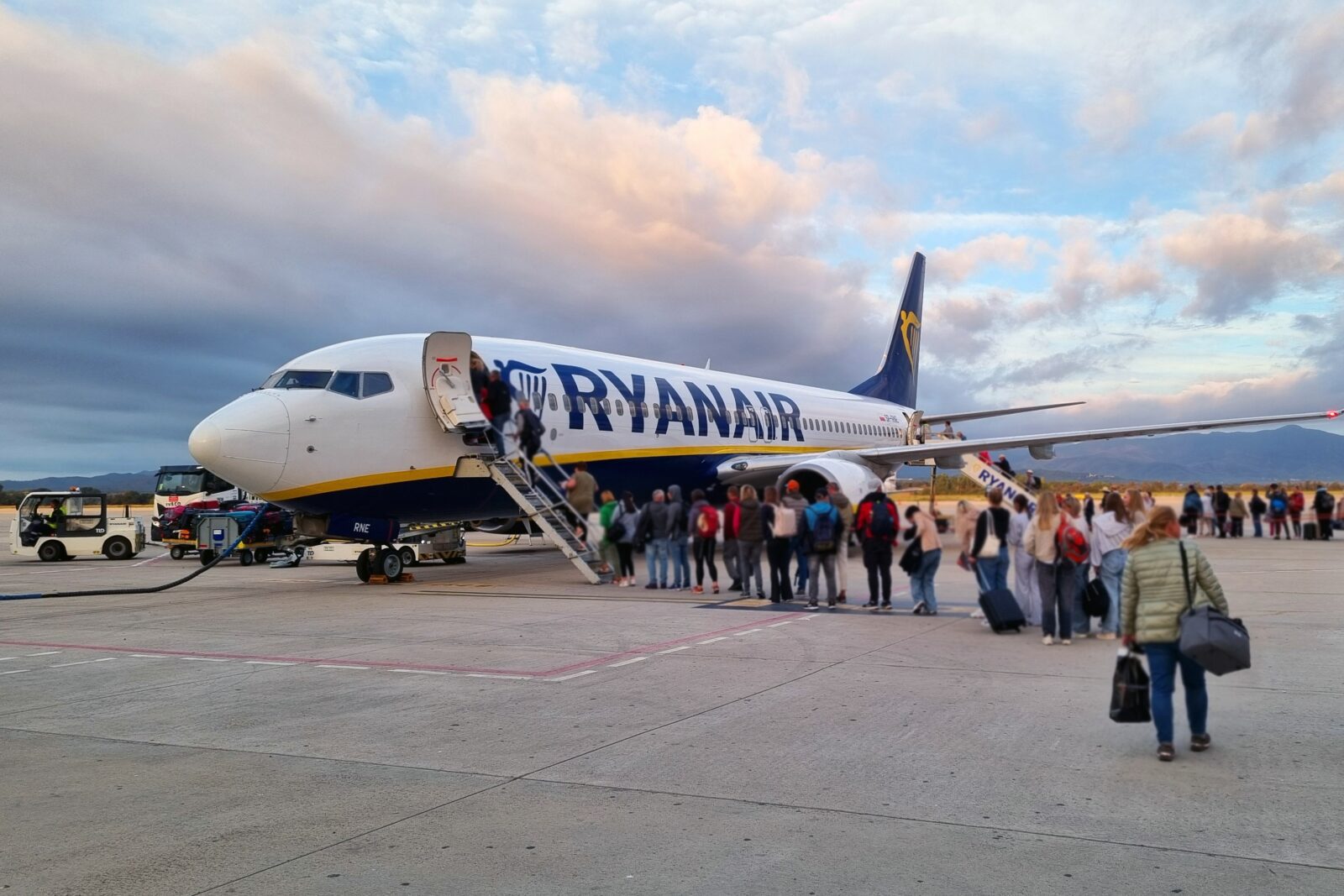
Europe’s largest low-cost airline, Ryanair, has been ‘schooled’ by Starlink over what Elon Musk has described as “misinformed” claims that the in-flight Wi-Fi service would add a 2% fuel penalty to its flights.
On Wednesday, Ryanair chief executive Michael O’Leary ruled out adding in-flight Wi-Fi to its flights because of the alleged fuel penalty, resulting in a quick rebuke from Starlink.
Ryanair rules out Starlink internet service
Elon Musk’s Starlink internet service is on a major roll at the moment. The broadband-quality satellite internet provider is winning more and more airline customers, including some of Europe’s largest carriers, such as Air France, British Airways, Iberia, and, most recently, German flag carrier Lufthansa.
In most of these cases, Starlink is being used to replace older, and much slower, in-flight Wi-Fi services, although the increasingly rapid adoption of Starlink raises the question of whether airlines that have, until now, rejected in-flight Wi-Fi altogether could now join the party.
Most notably, Ryanair has never offered in-flight Wi-Fi on any of its airplanes because, in its view, equipping planes with antennas and other equipment would add complexity and cost that its customers don’t want or need.
But could Starlink change that mindset? On Wednesday, we got the answer when Ryanair’s outspoken chief executive, Michael O’Leary, was asked by Reuters whether the airline was also considering adding the service.
O’Leary shot down that speculation, saying that the Wi-Fi antenna installed on the top of the aircraft fuselage would add unnecessary weight and drag.
You need to put an antenna on the fuselage, it comes with a 2% fuel penalty because of the weight and drag,” O’Leary commented. “We don’t think our passengers are willing to pay for WiFi for an average 1-hour flight.”
Starlink and Elon Musk fire back
Within hours of O’Leary’s comments being published, Starlink’s vice president of engineering, Michael Niccolls, fired back in a post on X, explaining that the Starlink antenna is a lot slimmer than some of its rivals. As a result, the drag on the aircraft is much reduced, and so too is the resulting fuel penalty.
“A 2% fuel impact might be true for legacy terminals, but Starlink’s terminal is much lower profile and more efficient. Our analysis shows that the fuel increase to a 737-800 (which burns 800 gallons/hour) with our current design is about 0.3%,” Niccolls explained.
He added: “Also beg to differ on whether passengers want great WIFI in flight.”
Elon Musk, the owner of Starlink, also waded into the debate in a follow-up post on X, saying O’Leary had been “misinformed.”
“He is being misinformed,” Musk wrote. “I doubt they can even measure the difference in fuel use accurately, especially for a one-hour flight, where the incremental drag is basically zero during the ascent phase due to a high angle of attack.”
Musk added that “compared to most other connectivity solutions, there would actually be gains in efficiency.”
Fast and free in-flight Wi-Fi fast becoming table stakes
Until now, at least in Europe, in-flight Wi-Fi has only been adopted by traditional ‘full service’ carriers, while low-cost airlines, which operate on even tighter margins, have rejected the additional expense of equipping their jets with internet service.
That, however, could be about to change.
Late last year, International Airlines Group (IAG), the owner of Aer Lingus, British Airways, and Iberia, announced it had chosen Starlink for a fleet-wide rollout, which will also include its budget units, the Spanish low-cost carriers, Vueling and LEVEL.
And on Monday, the Lufthansa Group announced it would install Starlink across all of its airline brands, which include the budget carrier Eurowings and Discover Airways.
The question is whether passengers will continue to prioritize the lowest fare above other amenities, like in-flight Wi-Fi.
What would be a game-changer is whether one of Rynair’s major low-cost rivals, like EasyJet or Wizz Air, decides to install in-flight Wi-Fi, even on a small number of aircraft.
What airlines in Europe have already signed deals with Starlink?
The concern that some Europeans have about Elon Musk’s politics has not dissuaded a growing number of airlines across the continent from signing major contracts with Starlink.
Latvia’s flag carrier, Air Baltic, was the first European airline to adopt Starlink, but more well-known airlines are quickly signing up to the service. These include:
- Air France – installations have already started
- International Airlines Group (IAG) – which includes Aer Lingus, British Airways, Iberia, LEVEL, and Vueling.
- Lufthansa Group – which includes Austrian Airlines, Brussels Airlines, Discover Airways, Eurowings, Lufthansa, and SWISS.
- SAS – Rollout began in late 2025.