



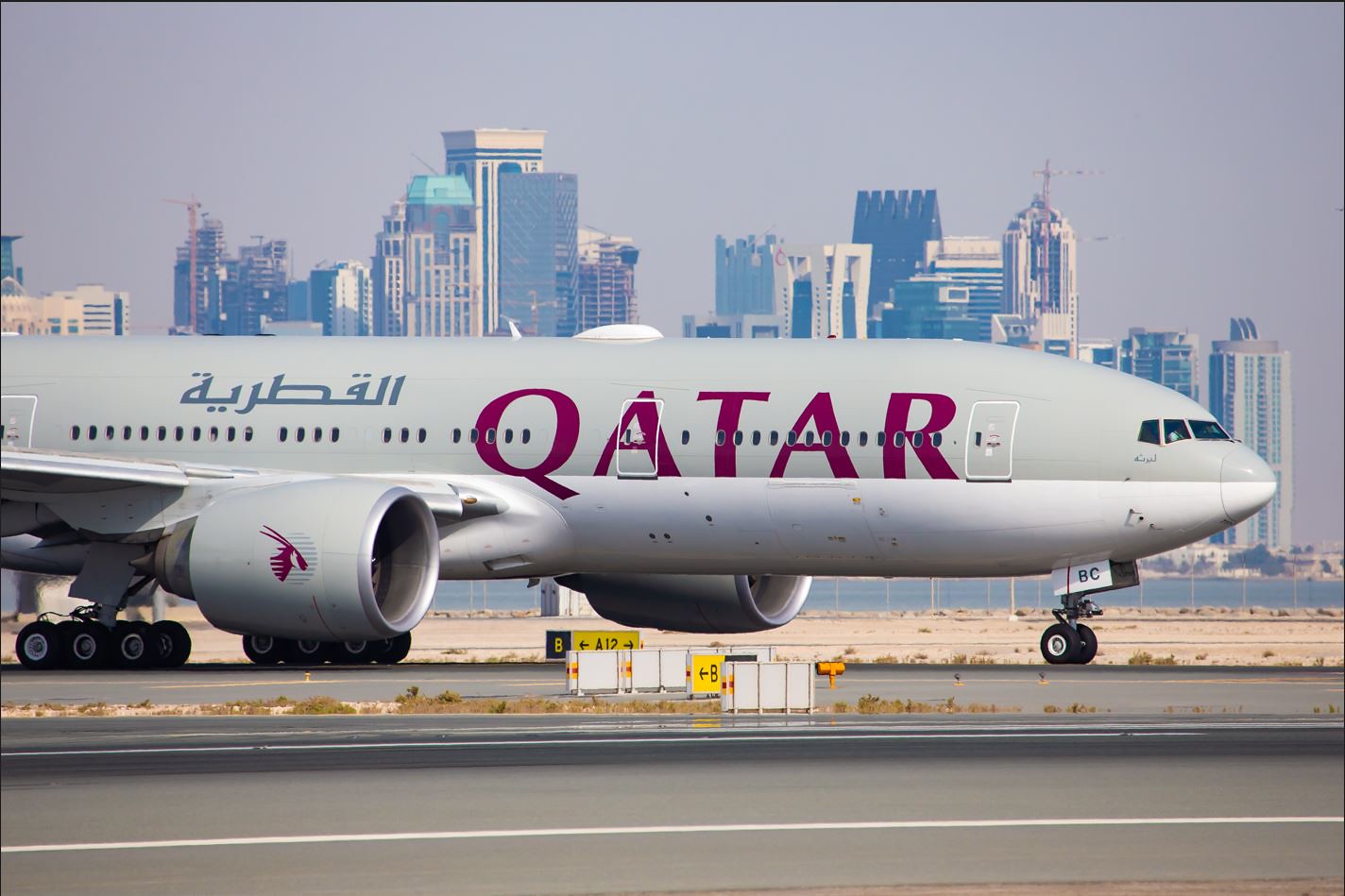
Exactly a week to the day that airspace was shuttered across the Middle East after the United States and Israel launched coordinated air strikes against Iran, the skies above the tiny but incredibly wealthy Persian Gulf state of Qatar are reopening its airspace with very “limited operational capacity.”
The news is important because Doha is the home hub of Middle Eastern superconnector Qatar Airways, whose operations have effectively been completely grounded since February 28.
To give a sense of just how badly Qatar Airways has been affected by the regional security situation, on Friday, the airline temporarily relocated some of its operations to Muscat in Oman and Riyadh, Saudi Arabia, to operate a small number of repatriation flights to Europe.
From Saturday, however, the Qatar Civil Aviation Authority (QCAA) has given permission for passenger flights to depart Doha Hamad International Airport for the first time since the start of the crisis via a special safe air corridor, which is being coordinated with the Qatari military.
For now, this safe air corridor will only be open to a handful of Qatar Airways flights to London Heathrow(LHR), Paris (CDG), Madrid (MAD), Rome (FCO), and Frankfurt (FRA).
In a statement, Qatar Airways said it was prioritizing “stranded passengers with families, elderly passengers, and those with urgent medical and compassionate travel needs” on these flights.
The airline said it would contact passengers directly and urged people not to travel to the airport unless they have been confirmed on a departing flight.
Unlike in the United Arab Emirates (UAE), where limited scheduled operations have resumed at rivals like Etihad Airways and Emirates, the flight operations in Qatar are only intended as repatriation services for thousands of stranded passengers.
The airline is not yet allowing new flight bookings on departures over the next few days, and its status as a major connections hub remains on hold.
Clarifying exactly what is happening, a spokesperson for Hamad International Airport said the flights were only intended “for the evacuation of stranded passengers and air cargo operations.”
“Hamad International Airport clarifies that the operation of additional flights in the coming days will remain subject to ongoing assessment of the security situation,” the statement added.
Meanwhile, Emirates is still operating a reduced flight schedule, but has opened up flight bookings to new passengers and is allowing connections at its hub in Dubai. The airline has also indicated that it could be in a position to return to 100% of its normal schedule in the coming days.
Although some Iranian missile and drone attacks continue against Qatar and the UAE, the regime’s capabilities appear to be severely diminished, and air defense systems across the region have been hugely successful in largely keeping Gulf states unscathed from attack.
Depending on the success of the first Qatar Airways repatriation flights from Doha on Saturday, we can expect the airline to expand the number of flights and destinations in the next few days, before resuming limited scheduled services.
The security situation does, however, remain fluid, and plans could be changed at very short notice.