



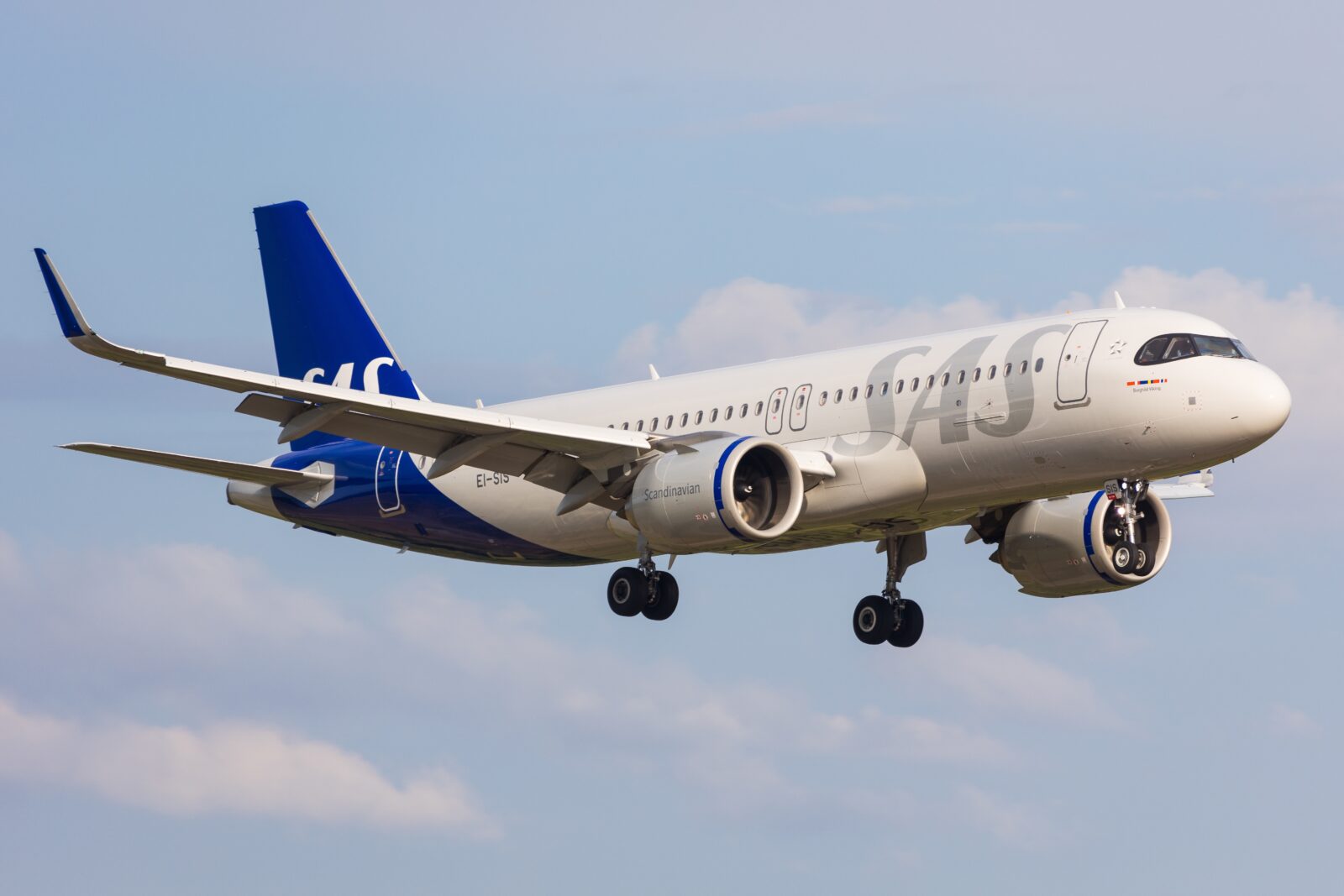
Passengers hauling “substantial” amounts of cabin bags onboard an SAS Scandinavian Airlines Airbus A320neo at Brussels Airport could have been a factor in a potentially catastrophic near miss when the pilots attempted to take off from a taxiway last month, it has now been revealed.
New details of the events leading up to the close call are now available after the Belgium Air Accident Investigation Unit (AAIU) released its preliminary report into the February 5 incident, and while a preliminary report doesn’t make any conclusions, it may give a good indication of where the investigation is heading.
The accident occurred at around 9:44 pm on February 5 when SAS flight SK-2590 from Brussels International Airport (BRU) to Copenhagen (CPH) was cleared by air traffic controllers in the airport control tower to take off from Runway 07R.
Rather than lining up to take off on Runway 07R, however, the pilots of the seven-year-old Airbus A320neo (registration: SE-ROM) attempted to take off from a much shorter taxiway that runs parallel to the runway.
The aircraft reached a maximum speed of 100 knots (115 miles per hour) before the pilots realized their mistake and initiated an emergency stop as the end of the taxiway and a fence quickly appeared in their line of sight.
The plane reached the very end of the taxiway before eventually coming to a stop after the pilots turned right into an intersecting taxiway. Noticing what was happening below, air traffic controllers in the tower dispatched the airport fire brigade, and the passengers were eventually bused back to the terminal.
In radio traffic between the tower and the cockpit, the Black Box voice data recorder captured one of the pilots telling air traffic control: “We are okay, but something went very wrong.”
While the preliminary report doesn’t conclude what exactly went so wrong, it does paint a picture of how the pilots were attempting to make up time due to mounting delays.
The aircraft was performing a return flight from Copenhagen to Brussels and back, but the first flight of the ‘rotation’ arrived more than an hour after its departure from Copenhagen, which was delayed due to severe winter weather and de-icing procedures.
The plane landed in Brussels at 9:01 pm, and Europe’s central air traffic control agency, Eurocontrol, assigned a departure ‘slot’ for the plane’s return to Copenhagen of 9:48 pm.
By the time the aircraft arrived at its assigned gate, there were just 42 minutes to deplane everyone from the first flight, clean the aircraft, and board everyone for the return flight to Copenhagen.
If the pilots missed this ‘slot’, then they might have to wait a substantial amount of time for clearance to depart, and, for context, Brussels Airport has a nighttime restriction that bans takeoffs after 11:00 pm.
The turnaround was not, however, a smooth process. Boarding proved “challenging due to a high number of passengers carrying substantial amounts of cabin baggage,” and the cabin crew had to make several announcements to “expedite the boarding process.”
It’s not known whether this apparent pressure to meet the slot restriction, along with the compounding issues of cabin baggage management, may have distracted the pilots to the point that they attempted to take off from a taxiway.
Unfortunately, the aircraft was not fitted with multiple safety systems that are designed to prevent exactly this kind of incident.
For example, Honeywell Aerospace Technologies has developed an optional system known as the Runway Awareness and Advisory System (RAAS), which uses GPS technology to detect if an aircraft is attempting to take off from a taxiway.
How Honey’s optional Runway Awareness and Advisory System works to prevent accidental takeoffs from a taxiway.
If the speed of the aircraft reaches 40+ knots, the system blares out “ON TAXIWAY! ON TAXIWAY!” alerting the pilots of their error before the airplane reaches a dangerous speed.