



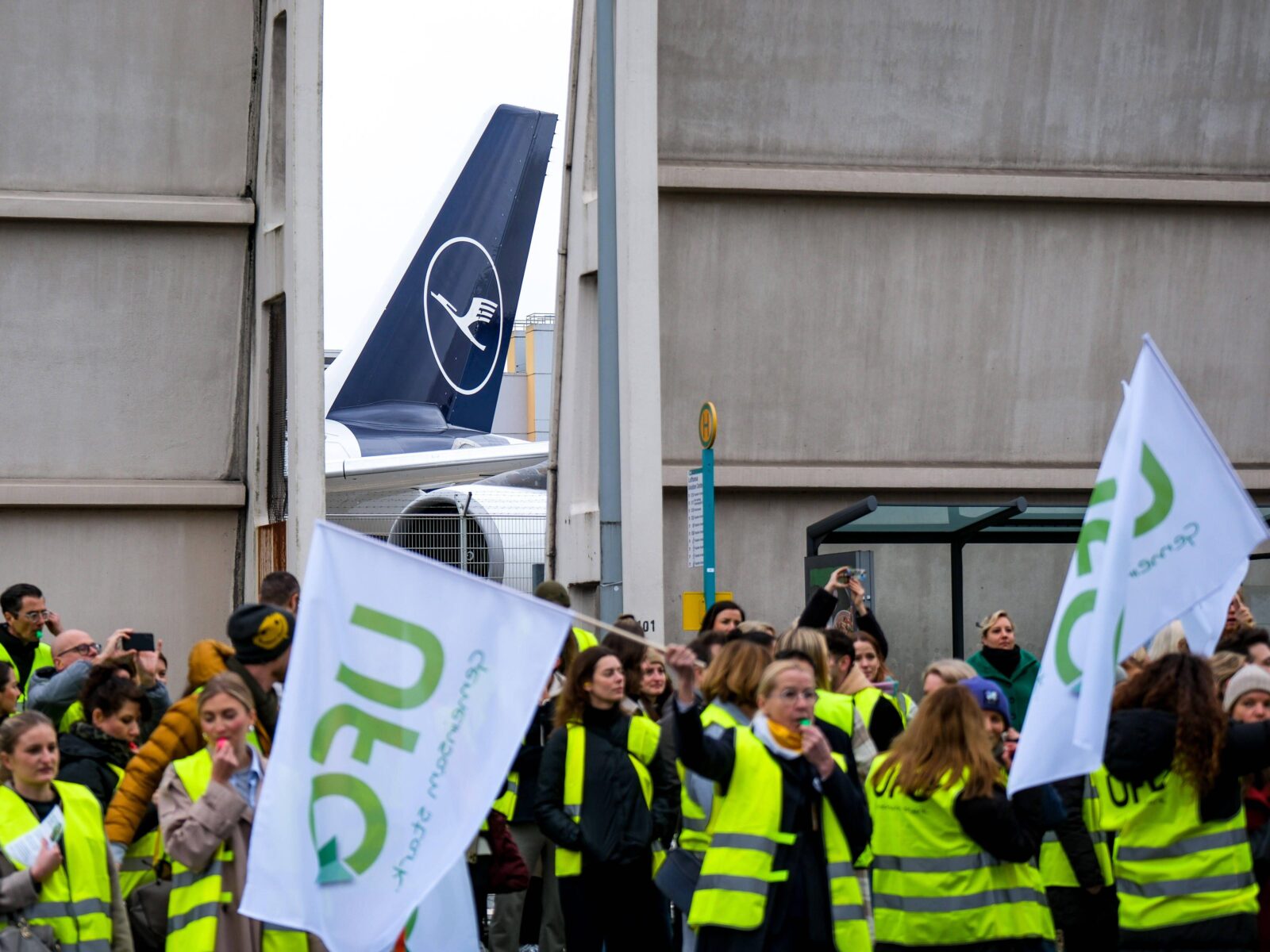
Yet another flight attendant strike could be on the horizon at German flag carrier Lufthansa after the airline reportedly demanded a “radical overhaul” of work rules as it seeks to slash costs and improve its dire operating margin.
The airline has been in talks with the main UFO flight attendant union on a new framework collective agreement, which covers rules of employment like working hours, rest periods, and sick pay provisions.
Known as the Manteltarifvertrag or MTV agreement for short, the two sides sat down late last week, where Lufthansa presented its proposals for a big shakeup of the collective agreement.
The union was quick to reject the proposal and says it will refuse to entertain any further negotiations unless Lufthansa “decisively” changes its demands.
“We have, in no uncertain terms, stood up and walked away, as they like to say in collective bargaining policy,” the union told its members in an internal memo reviewed by PYOK.
“There is nothing that could reasonably be negotiated at this point – our ideas about an MTV are simply light years apart,” the memo added.
Lufthansa flight attendants took part in a massive one-day ‘warning strike’ last month in protest at the airline’s plans to shutter a short-haul subsidiary known as Lufthansa CityLine because flight attendants have a contract that chief executive Carsten Sphor no longer thinks is competitive.
In its place. Lufthansa has already created a replacement subsidiary known as Lufthansa City Airlines, where cabin crew are paid significantly less and enjoy far fewer benefits.
Spohr has previously referred to the mainline Lufthansa brand as the “problem child” of the wider Lufthansa Group which includes a slew of airlines, including Austrian Airlines, Brussels Airlines, Eurowings, and SWISS.
For Spohr, the mainline brand has become outdated and inefficient, dragging down the airline’s financial performance, especially compared to other carriers in the Lufthansa Group.
In 2025, Lufthansa made €17.1 billion in revenues but only €148 million in profit. In comparison, SWISS made €6.48 billion in revenue but €600 million in profit, and Eurowings made €132 million in profit on revenues of €3.08 billion.
To look at it another way, Lufthansa’s operating margin was 0.9%, whereas SWISS reported an operating margin of 9.3%, and Eurowings 4.3%. Brussels Airlines also reported a higher margin at 1.7%, while Austrian’s operating margin was 3.2%.
Spohr has previously attempted to cut costs and improve efficiency at Lufthansa by siphoning off flying to cheaper-to-run subsidiaries like Lufthansa City Airlines, along with the likes of new leisure carrier Discover Airlines.
Now, it has come time for Lufthansa to try to overhaul the collective bargaining agreement for flight attendants at its largest and most expensive workforce, with changes that it says are designed to bring “genuine stability, smart productivity, and demand-driven seasonality.”
The union sees the proposal very differently, telling its members that “Lufthansa wants to be able to do more or less whatever it wants with you, whenever it wants.”
“What was presented to us today is a catalogue of horrors and a very harsh affront to you and to us,” the union added.
In 2024, coordinated strike action between flight attendants and ground staff over a new wage deal was estimated to have cost Lufthansa around €350 million, plus an additional in €100 million in additional wages that it didn’t initially want to pay.
In its centenary year, the airline is also facing the threat of further strikes by its pilots in a continuing dispute over pensions, while Spohr has already warned that Lufthansa’s turnaround program could be knocked off track by developments in the Middle East.
For now, no strike has been announced, but, unlike in some countries, it should be noted that walkouts in Germany can be organized with very little notice.