



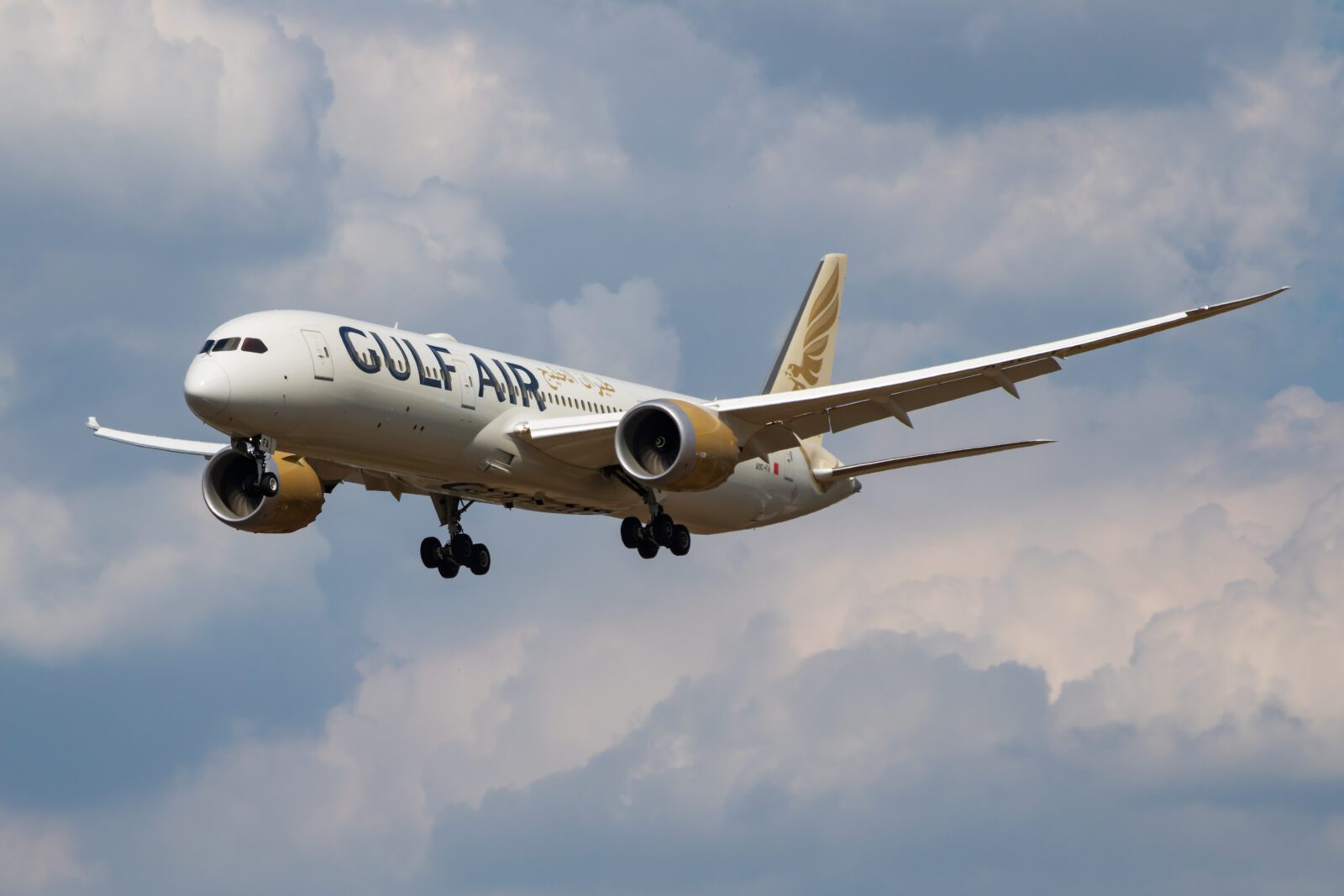
Gulf Air, the national carrier of Bahrain, has evacuated its fleet of aircraft from the capital, Manama, more than a week after airspace was shuttered when US and Israeli air strikes on Iran led to a serious escalation in the security situation in the region.
Since the war started on February 28, Bahrain has been repeatedly targeted by Iranian ballistic missiles and explosive kamikaze drones that have terrorized the country, killing and injuring dozens of civilians.

Unlike neighboring Gulf states, Bahrain has kept its airspace completely closed to civilian aircraft since last Saturday, with the government-owned Gulf Air effectively grounded until further notice.
On Tuesday night, however, that all changed when Bahrain’s civil aviation regulator gave the go-ahead for airspace to be opened for a brief period, allowing aircraft that had been stranded at Bahrain International Airport (BAH) to be evacuated.
In the short window, a long line of aircraft departed the airport in quick succession, heading immediately towards Saudi Arabia, which has seen far fewer Iranian attacks than the rest of the region.
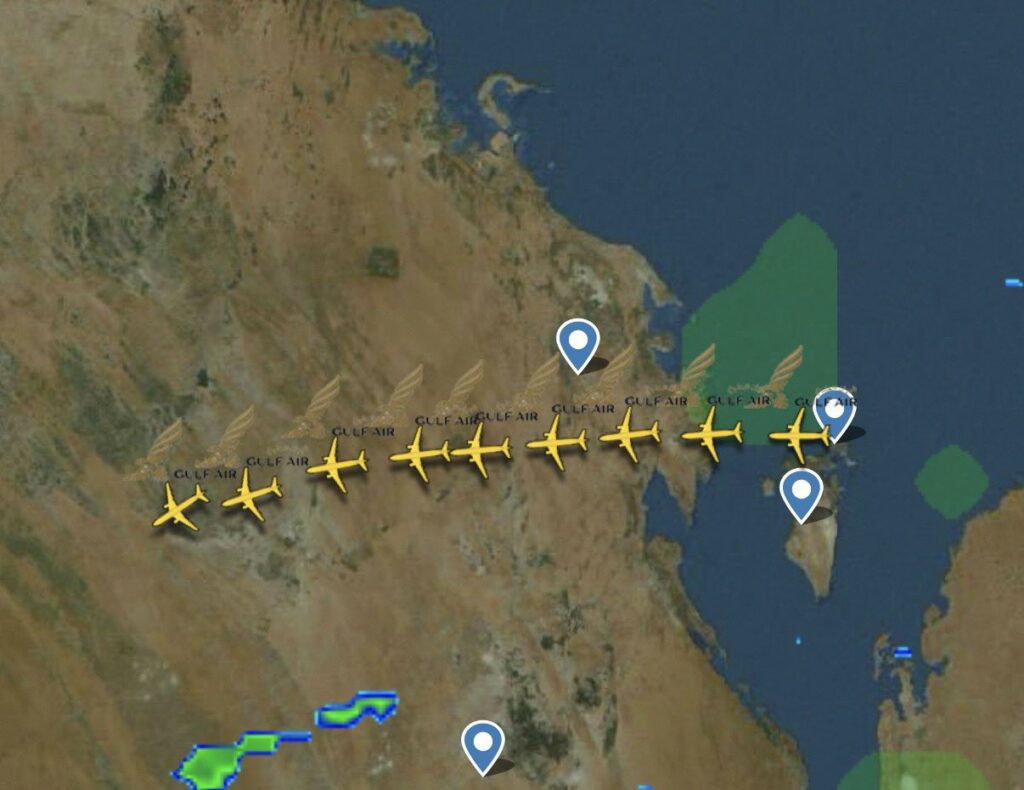
Gulf Air used the opportunity to move its fleet of aircraft out of harm’s way, with most landing at Al-Ula International Airport in the Medina province of Saudi Arabia.
At the same time, Gulf Air also started to repatriate some of its long-haul aircraft that had been stranded overseas in destinations like London and Singapore back towards the Middle East.
Rather than flying to Al-Ula, however, some of these planes are heading to Dammam, the closest city in Saudi Arabia to Bahrain, which is located just across the causeway that links the two countries.
From Dammam, Gulf Air plans to start operating a limited number of repatriation flights to London Heathrow, Mumbai, and Bangkok beginning on March 11.
At this point, many people who wanted to leave Bahrain have already done so by driving across the causeway to Saudi Arabia and driving to Riyadh, where commercial flights have operated throughout the crisis.
Nonetheless, it seems as if Gulf Air thinks there is reason for further repatriation flights to some of the biggest international destinations.
Gulf Air has a pretty modest fleet of just 43 aircraft, which mainly consists of narrowbody Airbus A320 series airplanes, along with nine long-haul Boeing 787 Dreamliners.
In comparison to the likes of Emirates and Qatar Airways, the carrier is a very small player, but there was a time when Gulf Air was the airline of the Persian Gulf.
Founded in 1950 by a British pilot and then bought by British Overseas Airways Corporation (BOAC) a year later, Gulf Air grew into the de facto flag carrier of Bahrain, Qatar, Oman, and the United Arab Emirates.
In the 1970s, the four Gulf states took ownership of Gulf Air, and for several decades, the airline operated hubs in Manama, Doha, Abu Dhabi, and Muscat.
The years of Gulf Air’s dominance began to change, however, in 1985 when the government of Dubai decided to start its own airline: Emirates.
Having witnessed Emirates’ rapid growth, Qatar decided to found its own airline in 1993, followed by Abu Dhabi with the creation of Etihad Airways in the early 2000s, and finally, Oman Air became the national carrier of Oman in 2007.
The only other airline that has taken the decision to evacuate its aircraft out of the region during the unfolding crisis is El Al Israel Airlines, which started to move its airplanes out of Tel Aviv Ben Gurion Airport within hours of the first air strikes on Iran on February 28.
Since then, however, El Al has resumed limited flights to and from Tel Aviv.
Meanwhile, Emirates is attempting to slowly rebuild its route network, although continuing attacks on the UAE by Iran might be slowing down the airline’s ambitious plans.
Last Friday, Emirates said it hoped to restore connectivity to 100% of its route network within days, but less than 24 hours later, an Iranian drone appeared to explode on the outskirts of Dubai International Airport.
Emirates was forced to temporarily suspend all flights and has since removed the statement outlining its flight resumption plans.


Following the horrors of this war, ME carriers really should follow El Al’s lead and adopt comprehensive, fleet-wide anti-missile defense systems. Additionally, the city states like Kuwait, Manama, Doha, Abu Dhabi, and Dubai must have better anti-missile and anti-drone protections, like having their own ‘iron dome’ as in Tel Aviv. It’s still wild to me how Israel and these Gulf allies are more closely aligned than ever imagined before in that they are all targets of IRGC terror these days.