



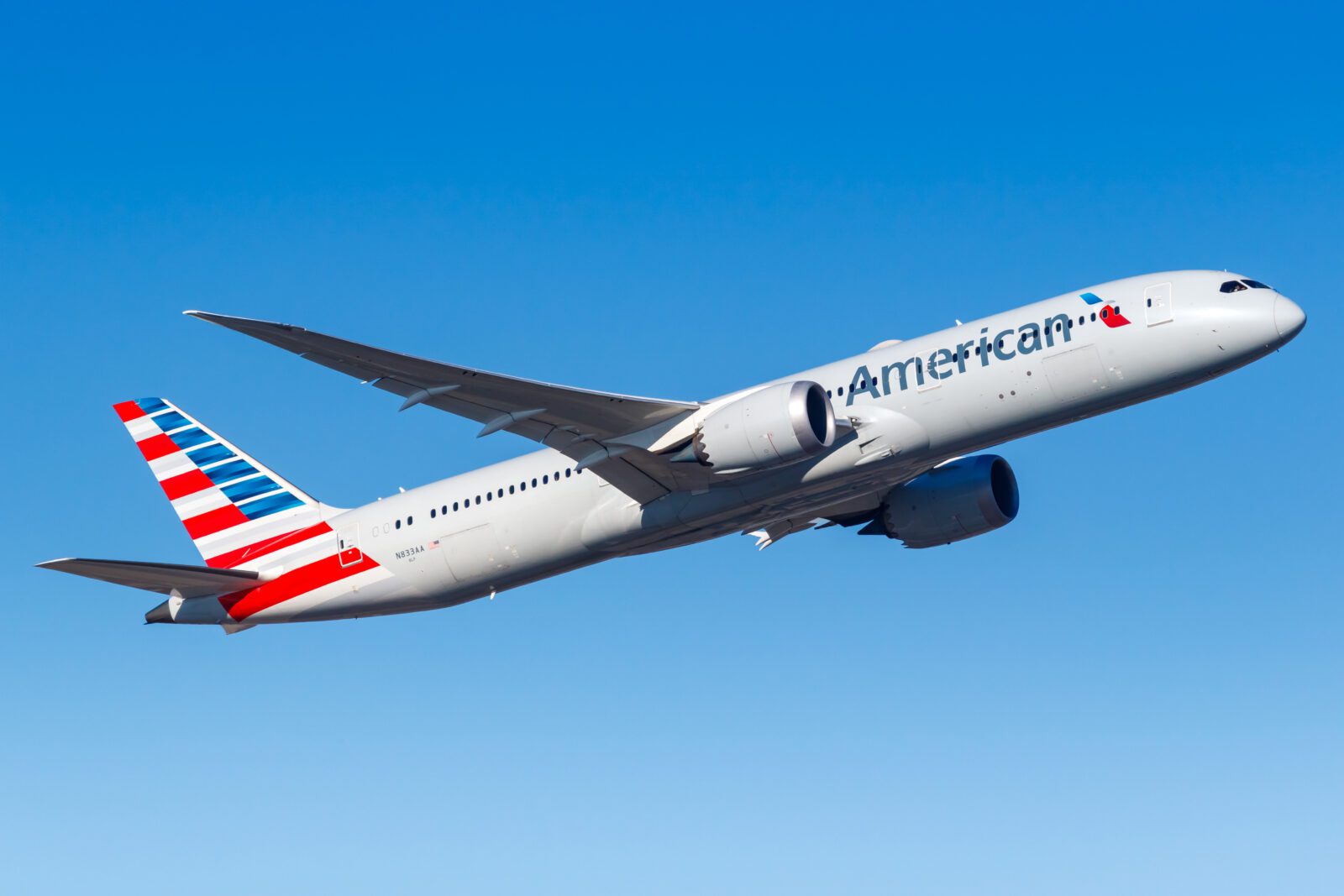
Radio interference has resulted in U.S. airlines being landed with an $8 million bill to fix faulty equipment on Boeing 787 Dreamliner airplanes after it was discovered that simple radio signals can knock out a faulty transponder on the popular widebody plane used by American, United, and Alaska Airlines.
The issue came to light after the Federal Aviation Administration (FAA) reported “multiple instances of loss of transponder for airplanes entering airspace in the presence of CW interference.”
CW interference refers to continuous-wave radio signals like Morse code and military transmitters, which could interfere with the transponder on some Boeing 787s.
When Dreamliners fitted with this faulty transponder fly through areas where continuous-wave radio signals are present, there is a risk that the Mode S transponder function doesn’t ‘reply’ to radar interrogations.
Without this electronic ‘reply,’ air traffic controllers might not be able to see where the aircraft is, and the emergency Traffic Collision Avoidance System (TCAS), often described by aviation safety experts as the ”last defense against mid-air collisions,” might not generate life-saving alerts properly.
In a worst case scenario, the FAA warned that a mid-air collision could occur.
When the FAA tested the faulty transponder in areas of CW interference, they discovered it didn’t send a reply to at least 90% of ‘interrogations,’ so the agency went about ordering a fix.
To do so, the FAA was required to issue an Airworthiness Directive, although this first required the agency to request feedback from stakeholders and other interested parties.
Boeing had no objection to the draft airworthiness directive, while the Air Line Pilots Association also supported the FAA’s intervention.
Several airlines did, however, raise some concerns. Kenya Airways, for example, asked whether the suggested fix could be delayed until the root cause of the problem could be identified.
Meanwhile, United Airlines and KLM Royal Dutch Airlines raised concerns about the availability of spare parts from the transponder’s manufacturer, Collins Aerospace.
One commentator also suggested that the suggested compliance time to fix the transponder should be shortened over fears that it could be connected to 5G cell phone signals. The FAA rejected that request, explaining that the issue was not connected to 5G signals.
Although the fix applies to any Boeing 787 anywhere in the world that is fitted with the faulty transponder, the FAA only works out the cost that the airworthiness directive might have on U.S.-based carriers.
The total cost estimated by the FAA came to $7.95 million.
The final rule for this airworthiness directive was published this week, and airlines have up to four years to ensure that all of their Boeing 787s are fixed.
The original headline for this article has been adjusted following feedback from readers. Thank you to everyone who reached out and shared their opinion.


This article is absolutely ridiculous. It’s obvious it was written by a person who has zero technical knowledge.
Unfortunately, It’s what you get when a retired flight attendant throws a load of acronyms into an AI engine.
Mr Maszczynski should go back to serving tea, coffee and hot towels, and leave the technical journalism to qualified professionals.
This article is total nonsense. CW means continuous waves. That means unmodulated radio signals.
While radio amateurs use CW transmissions interrupted to form Morse code characters, they are use on frequencies far removed from the 1030MHz that transponders use.
I don’t understand how this is the fault of ham radio enthusiasts.
Amateur radio has been around since the late 19th century and those parts of the radio spectrum in question here have been assigned to ham radio users for decades.
Either Boeing (or whomever makes the radio equipment in question here) has inadvertently (or perhaps recklessly) infringed on that spectrum, or the needed separation was not fully explored/analyzed when the nav signaling technology was created.
Please point the finger of blame at Boeing & friends or the world and national regulators like the International Telecommunications Union, World Telecommunications Conference, and FCC before you pick on the little guy.
So what did ham radio enthusiasts have to do with any of this? Apart from the clickbait headline and lead sentence blaming this group with no explanation, it’s not clear that ham radio enthusiasts played any role. The article goes on to explain that Collins provided faulty transponders on Boeing aircraft and FAA has ordered a fix. The article never actually says what ham radio enthusiasts did that would make them supposedly “responsible” for any of this.
The Silence of the Frequencies: Unpacking the FAA’s Boeing 787 Transponder Directive
When the FAA warns of “CW interference,” hams think of Morse code. Aviation engineers think of something far more dangerous—a silent, invisible wall of noise that can blind a Dreamliner to oncoming traffic.
In the world of amateur radio, “CW” is a beloved mode—the rhythmic cadence of Morse code cutting through the static, a testament to communication’s simplest form. But when the Federal Aviation Administration (FAA) uses the same two-letter abbreviation in an airworthiness directive, it is describing something far more insidious and utterly unrelated to the gentleman operator in the shack.
For an avionics engineer, “Continuous Wave (CW) interference” refers to a pure, unmodulated, single-frequency carrier signal that has no business being where it is. It is a rogue tone, a sustained note of radio energy that can overwhelm sensitive aircraft receivers. And according to a new Notice of Proposed Rulemaking (NPRM) from the FAA, this type of interference is posing a direct threat to the Boeing 787 Dreamliner’s ability to see and be seen by other aircraft.
The proposed directive, which would affect 150 U.S.-registered 787-8, -9, and -10 aircraft, mandates a costly hardware replacement to fix a vulnerability that could, quite literally, render an aircraft invisible in busy airspace. But what exactly is this interference, and why is a simple hardware swap estimated to cost U.S. operators nearly $8 million?
The Problem: A Transponder That Won’t Talk Back
At the heart of the issue is the 787’s Integrated Surveillance System Processor Unit (ISSPU), a critical component that manages the aircraft’s transponder. The transponder’s job is to listen for interrogations from Air Traffic Control radar and other aircraft’s Traffic Alert and Collision Avoidance Systems (TCAS) on 1030 MHz, and reply on 1090 MHz.
According to the FAA directive (Docket No. FAA-2025-0924), multiple reports have surfaced of 787s entering airspace with active “CW interference” and suffering a specific, dangerous failure: the transponder stops meeting its Minimum Operational Performance Standards (MOPS) . Instead of correctly replying to at least 90% of interrogations, the unit becomes desensitized, failing to respond.
This is not a gradual degradation. It is an “unannunciated” loss, meaning the pilots receive no warning light, no aural alert, no indication that their aircraft is no longer replying to ground radar or TCAS inquiries . The first sign of trouble could be a gap in the sky where an airliner used to be, visible to everyone except the pilots of the aircraft that just went silent.
“CW” for the Layman: Not Morse Code, But a Wall of Noise
This is where clarification for the broader technical community is essential. For the ham radio operator, “CW” (Continuous Wave) is synonymous with Morse code—a carrier wave that is turned on and off to form characters. It is intermittent, intentional, and communicative.
The “CW interference” cited by the FAA is something else entirely. In engineering terms, a “continuous wave” simply means a steady, unmodulated carrier signal. Think of it less as a conversation and more as a sustained, single-frequency tone—a pure, unbroken note of radio energy. If a pulsed radar signal is like a strobe light, CW interference is a laser pointer held steadily on a sensor, blinding it.
For a transponder receiver trying to pick out weak interrogation pulses from the sky, a powerful CW signal on or near its operating frequency (1030 or 1090 MHz) acts as a “jammer.” It raises the noise floor, drowning out the very signals it needs to hear.
The Hunt for the Source: Who Is Generating This Noise?
The FAA directive is notably silent on the source of this interference, focusing instead on fixing the aircraft’s vulnerability to it. So, who or what is generating these rogue continuous wave signals? The answer is complex and points to a crowded, modern radio spectrum.
While the public document does not specify frequencies, the affected systems point squarely at the 1030/1090 MHz bands. Likely culprits for high-power CW interference in or near these frequencies include:
· Ground-Based Military and Civilian Radars: Some radar systems, particularly those used for long-range surveillance or specific military applications, can produce strong continuous or quasi-continuous output that generates harmonics or spurious emissions.
· High-Power Data Links: Terrestrial microwave data links, used for point-to-point communication by telecom companies and utilities, operate in frequency bands that can, with faulty equipment, generate out-of-band emissions that bleed into the aviation surveillance bands.
· The 5G Debate, Revisited: The recent spectrum battles between aviation and 5G carriers centered on the potential for signals from powerful ground-based transmitters to cause interference with radar altimeters. While that specific fight involved different frequencies (3.7-3.98 GHz), it perfectly illustrates the principle: a powerful, continuous transmission on a nearby frequency can overwhelm aircraft receivers if filtering and shielding are insufficient.
The $7.95 Million Fix
Because the sources of interference are myriad and largely outside an airframer’s control, Boeing and the FAA have chosen to harden the aircraft itself. The proposed solution is not a software tweak, but a physical replacement of the vulnerable hardware.
The directive would require operators to replace the left and right ISSPU units, swapping out current part numbers (822-2120-101 and -102) with a new, presumably better-shielded or more selective unit (part number 822-2120-113) . The FAA estimates the parts alone will cost $52,661 per aircraft. With labor, each of the 150 affected U.S. planes will incur a $53,001 expense, bringing the total for U.S. carriers to $7,950,150 .
This is a significant investment for a problem that many in the industry suspect is not going away. As the radio spectrum grows ever more congested with diverse signals, the threat of “CW interference”—in its true engineering sense—will only increase. For the pilots of the Dreamliner, this hardware upgrade can’t come soon enough. For the amateur radio operator tuning up on 40 meters, rest assured: your key is not the culprit. The real threat is coming from elsewhere in the increasingly noisy radio spectrum we all share.
Right on.
WA9DXE
Sorry Mateusz But you are paddling up the wrong creek here with your ‘Kanoo’ and in the process tarnishing the reputation of amateur radio operators everywhere.
You should amend the story to eliminate the reference to Ham radio. this is irresponsible journalism that is click-bat and reduces your blog to a poorly researched and unreliable source. Please eliminate any mention oh ham radio… This interference issue is NOT the CW associated to Morse code!
Taken on board!
There iare no CW carriers on the air. It makes no sense.
All radio transmissions other than short duration tests or extremely low power pilot carriers from geostationary satellites are modulated one way or another.
There’s a whole lot of qualified avionics folks out there. Maybe reach out to one to rewrite the article. It is really technobabble nonsense at this point.