



Nearly three weeks after airspace across the Persian Gulf was thrown into chaos when the US and Israel launched military strikes on Iran, flights are (very slowly) returning to some sense of normality, with Qatar Airways the latest regional carrier attempting to ramp up its operations.
On March 18, the Doha-based carrier switched from operating a very limited number of repatriation flights to resuming normal scheduled services, allowing transit passengers to connect through its hub in the Qatari capital for the first time since the end of February.
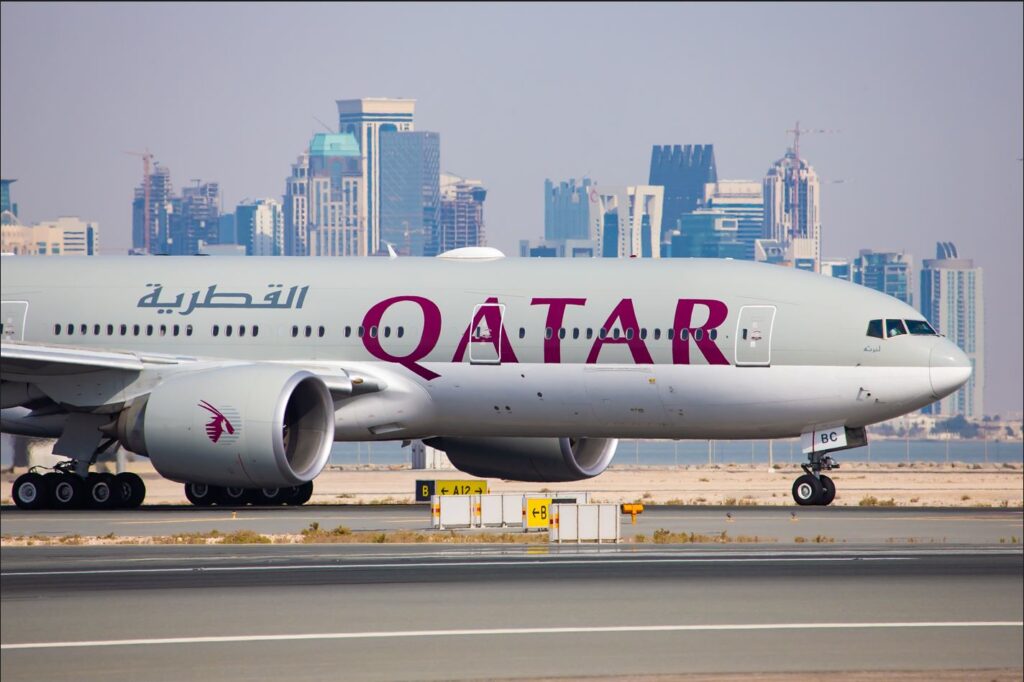
Around 180 flights were initially penciled in to depart Doha Hamad International Airport (DOH) on Friday, with Qatar Airways restoring its network to a slew of destinations around the world.
The threat from Iranian missiles and kamikaze drones is, however, omnipresent, and Qatar Airways is still only allowed to use a limited safe corridor authorized by the Qatar Civil Aviation Authority.
Qatar Airways says that every flight requires careful planning, and delays, cancellations, and schedule adjustments could still occur with little or no notice. That was certainly evident on Friday, with the planned schedule of 180 departures from Doha slashed to just 43 at the last minute.
Travelers who are in two minds about transiting through the Middle East are able to rebook their flight to a later date or request a refund, but those who are choosing to fly with Qatar Airways (and don’t have their flight cancelled) say there’s little evidence of any threat facing the airline at Doha Hamad Airport.
Restaurants and cafes across the airport are open as normal, Duty Free shops are welcoming passengers, and concourses are slowly beginning to fill with passengers once again.
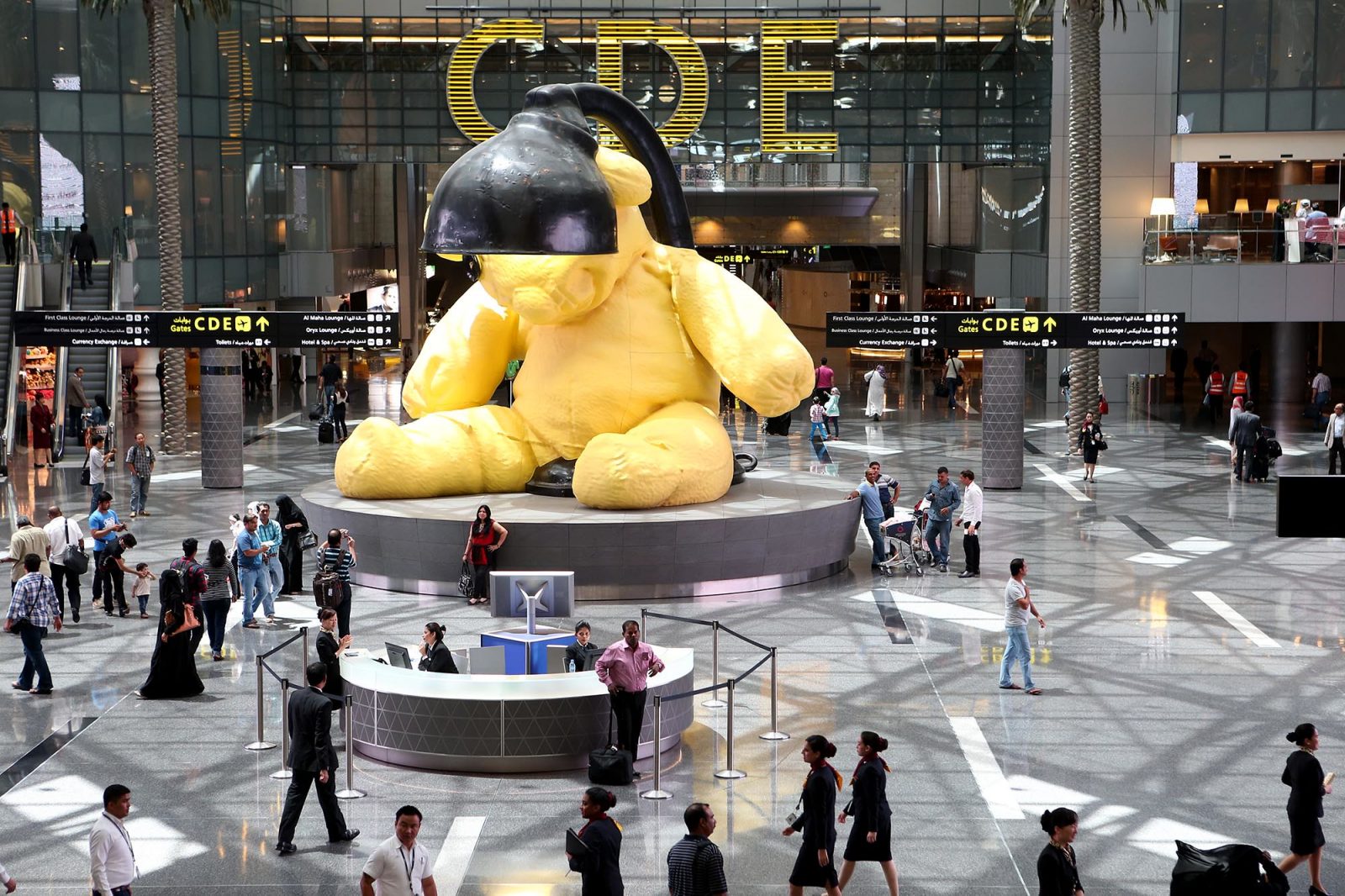
There is, however, one obvious sign that things are slightly amiss at Doha Hamad and its centers on the airport’s iconic gigantic teddy bear artwork that dominates the airport’s central Duty Free atrium.
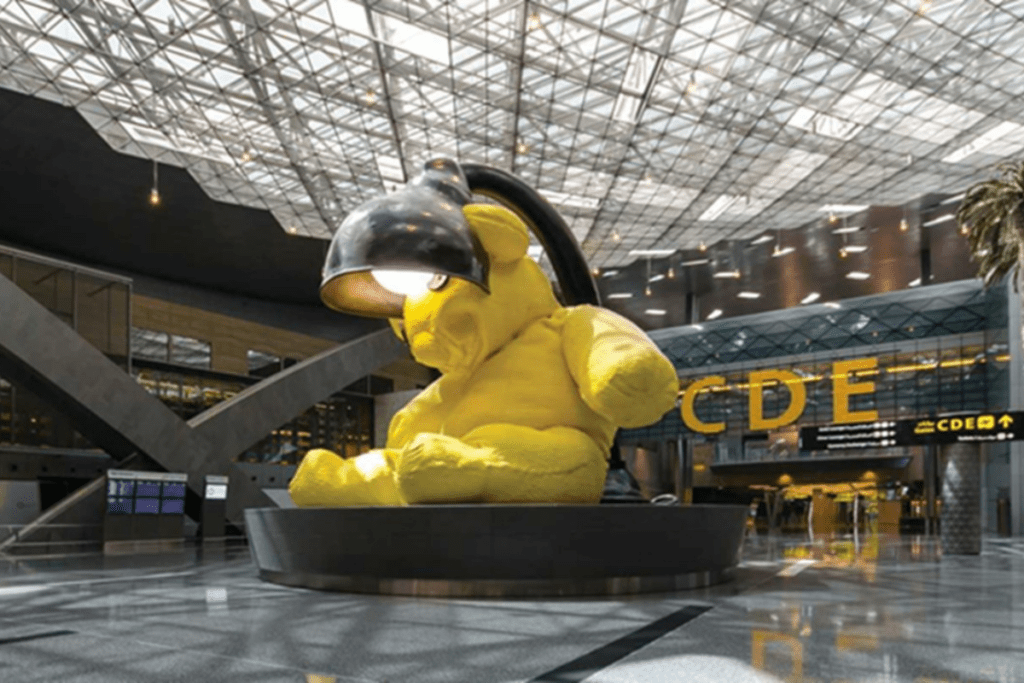
The bright yellow bear is impossible not to notice for passengers flying through Doha Hamad, and it’s been a symbol for the airport since it opened in 2014.
Created by Swiss artist Urs Fischer in 2005, the Doha bear is one of only three to have been made. It was acquired by a member of the Qatari royal family at an auction at Christie’s in New York for about $6.8 million in 2011, before its public appearance in Hamad Airport.
The bear is a focal meeting point and popular photo spot, but travelers are no longer able to get close because the entire sculpture has been roped off. Some passengers have been left bemused over the decision to block access to the bear, although the photo above clearly shows why.
The bear sits below one of the most open points of Hamad International Airport, including a massive glass skylight.
Unfortunately, civil aviation across the Middle East remains a target for Iranian attacks, and airports have come under repeated attack by kamikaze drones. It would appear, then, that local authorities don’t want throngs of passengers standing underneath a massive glassed area of the airport.
Similar measures have been taken at other airports. At Dubai International Airport (DXB), seats close to expansive glass windows have been cordoned off, and during active missile threats, passengers are urged to retreat from any windows in case of a direct hit.
What comes next for airline schedules in the region will very much depend on military developments over the next few days. Unfortunately, though, it looks like Qatar Airways is preparing for the possibility of a lengthy downturn in travel demand.
Earlier this week, the airline sent four of its Airbus A330 widebody planes to a deep storage facility in the Aragon Mountains in Spain, and on Friday, a further five aircraft made their way to the facility, including an Airbus A380, three Airbus A350s, and a Boeing 787 Dreamliner.
There are also reports that many more planes could follow in the coming days.


This is very misleading clickbait. It was cordoned off before the war started. The bear certainly is showing its age at this point so I assumed the barrier was to prevent folks from further damaging it.