



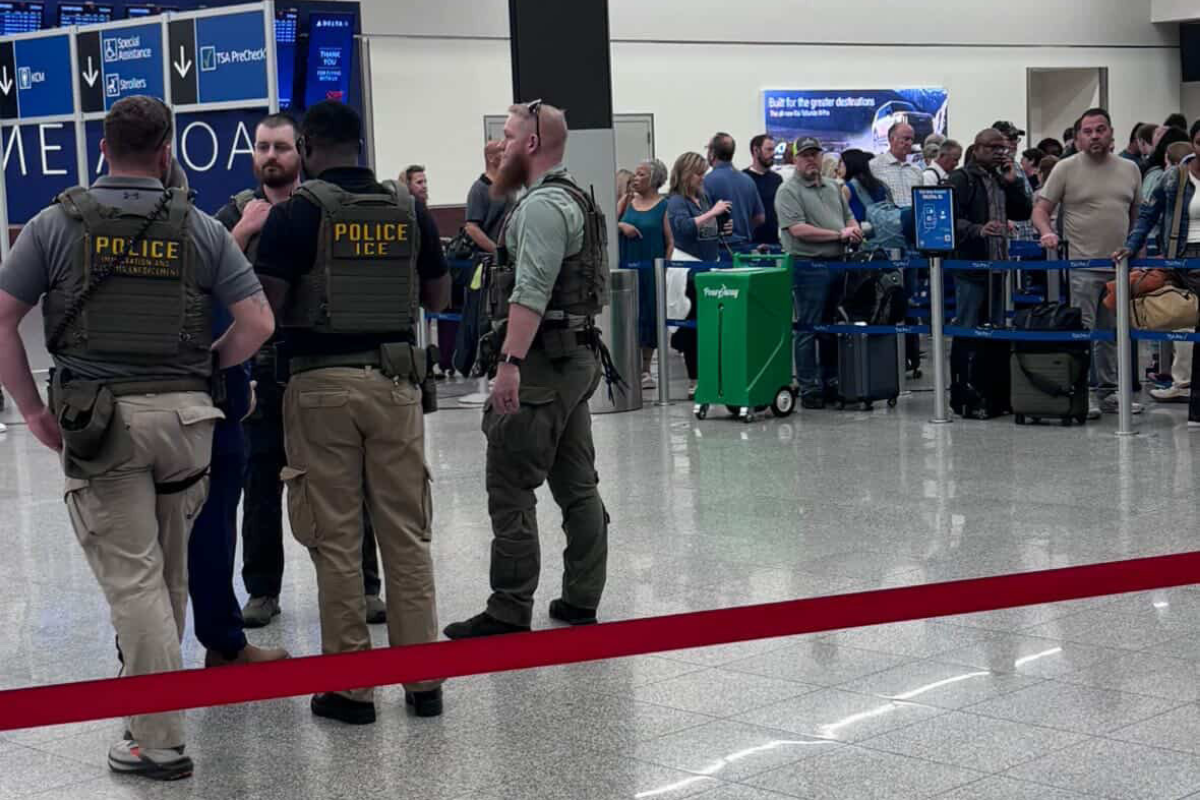
Immigration and Customs Enforcement (ICE) agents were spotted at the Atlanta Hartsfield International Airport (ATL) on Monday, as part of President Trump’s controversial emergency plan to reduce mounting lines at TSA security checkpoints.
The deployment does not, however, appear to be going very well. The three agents were standing around doing nothing and did not appear to be playing any active role in the security process at ATL.
ICE agents at ATL airport. According to federal officials, they’re there to support operational needs directed by TSA, including line management and crowd control within the domestic terminals. Federal officials have also indicated that this deployment is not intended to conduct… pic.twitter.com/FovJk9iD1x
— ATLSCOOP (@ATL_SCOOP) March 23, 2026
Meanwhile, a spokesperson for Atlanta Hartsfield urged passengers to arrive at the airport at least four hours ahead of their scheduled departure time due to the exceptionally long wait times to clear TSA security checkpoints.
The warning came after the airport’s own TSA wait time tracker was taken offline: Party to discourage passengers from surging specific checkpoints with lower wait times.
Atlanta Hartsfield has been suffering from significant TSA officer callouts in the last few days. On Saturday, a third of TSA officers who were meant to be working called in sick.
DHS border czar Tom Homan has been tasked with developing a plan to deploy ICE agents at understaffed airports in a desperate, last-ditch effort to reduce wait times at TSA checkpoints.
🚨OH MY GOSH!!!
— Matt Van Swol (@mattvanswol) March 23, 2026
The Atlanta TSA line is so long, that it is not just wrapped around baggage claim…
…BUT IS WRAPPING AROUND THE OUTSIDE OF THE FREAKING BUILDING!!!!
I am hearing that people waited in line for SIX HOURS last night and still missed their flights.
INSANE!!!!! pic.twitter.com/JP8u7QWmbU
On Sunday, Homan and his team were still figuring out what role ICE agents would play, given that they have not undergone the extensive training required to operate baggage X-ray machines and body scanners.
For context, Transportation Security Officers undertake a six-month-long training course before being qualified to undertake their role.
Homan had been unwilling to share which airports would see the initial deployment of ICE agents on Monday over fears that TSA officers stationed at these airports would deliberately call in sick.
On Sunday, major aviation unions representing more than 100,000 flight attendants accused the Trump administration of choosing to “create havoc” at U.S. airports with what they described as an “ICE invasion.”
The unions warned that flight attendants may refuse to work if they believe security is being compromised as a result of the ongoing shutdown or the arrival of ICE agents at airport checkpoints.
“Flight Attendants will not allow the TSA and the frontline Transportation Security Officers (TSOs) who keep us safe to be used as pawns in this dangerous game, nor will we fly in an aviation system that doesn’t put our safety and security first,” an open letter from the union explained.
Everett Kelley, the president of the American Federation of Government Employees (AFGE), which represents frontline TSA workers, also slammed President Trump’s plans to deploy ICE agents to security checkpoints.
“Putting untrained personnel at security checkpoints does not fill a gap. It creates one,” Kelley slammed. He added that TSOs “deserve to be paid, not replaced by untrained, armed agents who have shown how dangerous they can be.”