



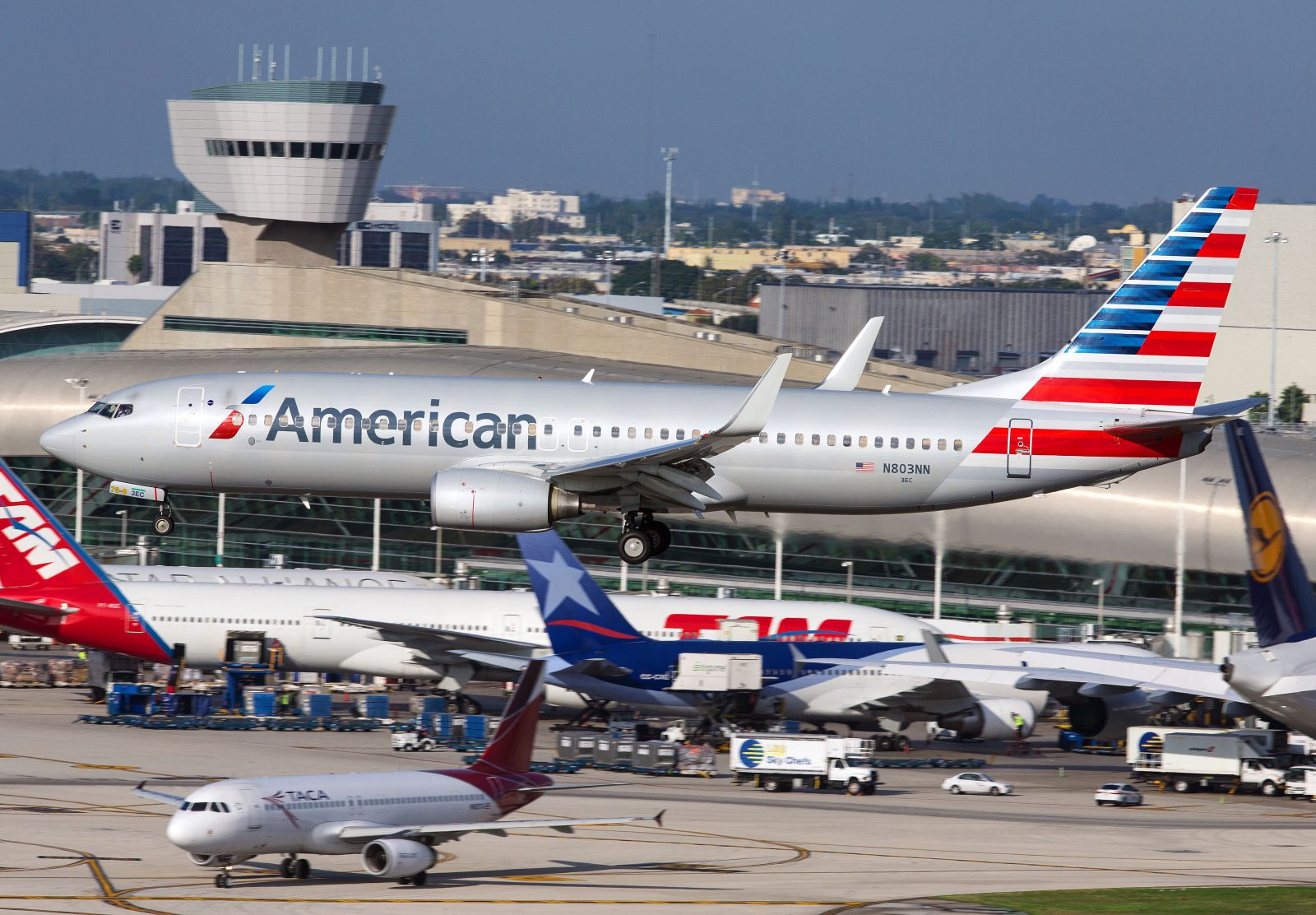
An American Airlines elite frequent flyer is fighting to have a lifetime travel ban revoked following an incident in 2022 in which a flight was forced to divert to Barranquilla, Colombia, over a dispute about using the Business Class bathroom.
John Nuñez from Miami, Florida, was an American Airlines AAdvantage Platinum Pro elite status holder at the time he was slapped with the travel ban and is taking legal action against the airline and the Federal Aviation Administration (FAA).
The incident that led to Nuñez’s lifetime ban occurred on June 3, 2022, when he boarded American Airlines flight AA-1124, on what should have been a two and a half hour flight from Barranquilla to Miami International Airport.
Despite his Platinum Pro status, Nuñez was traveling on a retired employee’s travel benefits as a non-revenue passenger.
Shortly after takeoff, Nuñez, who was sitting in the Main Cabin, went to use the bathroom in the Business Class cabin at the front of the plane. Nuñez was, however, stopped by the purser and sent to use one of the Main Cabin bathrooms at the back of the plane.
“No one treats me like s**t”
The viral tirade that got John Nuñez in hot water
Nuñez admits that he was upset by how he was treated by the purser and believes that, as an elite status holder, he should have been allowed to use the Business Class bathroom.
When he got to the back of the plane, he stood over the two flight attendants who were sitting in the rear galley and told them quite assertively exactly what he thought, saying “no one treats me like s**t,” while waving his hands.
An FAA administrative law judge described Nuñez’s contact with the flight attendants as a “tirade” but also found that the crew should have done more to de-escalate the situation, rather than admonishing him for not being on “his best behavior” as a non-revenue passenger.
Nuñez used the bathroom at the rear of the plane, but only a short time after returning to his seat, he got back up to use the lavatory.
Just about to start the inflight beverage service, one of the flight attendants used the beverage cart to block Nuñez, stopping him from reaching the bathroom.
Nuñez called one of the crew members a “fu**ing idiot” and “stupid” before returning to his seat. When the beverage service started, Nuñez asked for an alcoholic drink, but this request was refused as they believed, based on his level of agitation, that he was intoxicated.
A Mid-Air Diversion And A Social Media Fallout
When Nuñez became increasingly upset, the flight attendants abandoned the beverage service and informed the Captain who, in turn, decided to divert the plane back to Barranquilla where he was offloaded by a member of American Airlines staff.
A video of Nuñez being marched off the plane went viral on social media, and the ensuing fallout of the incident resulted in the breakdown of Nuñez’s relationship with his fiancée.
Judge Reduces Civil Enforcement Penalty
Following Nuñez’s removal, the FAA opened an enforcement action against him and initially proposed a $10,500 fine. When Nuñez appealed this to a full tribunal, however, the judge lowered the civil enforcement penalty to $4,500.
Although the judge found that Nuñez had, indeed, interfered with the crewmembers to perform their duties, they found that Nuñez had not appreciated how distracting he was being.
The judge also found that Nuñez’s enlarged prostate at the time of the incident was a significant mitigating factor, as the pain and angst from needing to use the bathroom frequently “provides some explanation for his frustration and behavior.”
Following a lengthy exchange of correspondence with American Airlines, the carrier wrote to Nuñez in September 2024, upholding its decision to slap Nuñez with a lifetime travel ban, known as the internal refuse list.
American Airlines Lifts Travel Ban – Or Does It?
But in March 2025, Nuñez received an unexpected letter from American’s customer relations department addressing complaints he had made about his treatment aboard flight 1124.
The letter specifically addressed concerns raised by the administrative law judge about the actions of the flight crew, although it noted that decisions were made in accordance with the airline’s protocols.
In a surprise twist, the letter addressed Nuñez as a “valued Platinum Executive member” and then ended with the crucial line: “We appreciate your AAdvantage loyalty very much, Mr Nuñez, and look forward to welcoming you on board your next American Airlines flight.”
Nuñez took this line to mean that his travel ban had been lifted and booked a trip the following month from Miami to Orlando on American Airlines.
When he got to the airport, however, Nuñez was shocked to discover that the ban had not, in fact, been rescinded.
In addition to the lawsuit against American Airlines, Nuñez is also suing the FAA over its refusal to hand over key documents that he believes are necessary to convince American Airlines to lift its lifetime ban on him.
Matt’s Take
As a long-serving airline employee, I know there are lots of rules around using non-revenue travel benefits, with one of the most famous being the strict dress codes that could see you rejected at the gate if you fall foul of.
Some of the rules are less explicitly stated, and there is a general understanding within the aviation industry that non-revenue travelers are on their best behavior at all times, never making a fuss or getting upset and happy that they are onboard in the first place.
Airline employees have this unwritten code of conduct drilled into them very early on, but problems can and do arise when benefits are shared with friends and family. It’s for these reasons that some flight attendants simply refuse to share their travel benefits, even with good friends.
Is Nuñez’s lifetime travel ban appropriate? Let me know what you think in the comments below…


As the former spouse of airline employee who is also an Executive Platinum member I have no sympathy for this person.
1) As a non-rev flyer, his status is irrelevant. He is not traveling as an Executive Platinum Pro member; he is travelling as non-revenue traveler.
2) As a non-revenue traveler, you are representing the airline and the key rule that is always emphasized is you must be on your best behavior. If the crew tells you the sky is red the sky is red. No arguing, no complaints, no bad behavior. If you have a problem with the way the crew handles something there are ways to address, it but NEVER act this way on the flight and in front of fellow passengers.
3) Your conduct can, and probably did, have serious consequences for the employee which can lead up to termination. As an employee you are responsible for the conduct of your guest passengers and the airline can, and does, penalize the employee for passenger misconduct.
4) His conduct was out of line no matter what his travelling status was. Even if he was travelling as a platinum pro traveler his behavior was despicable. Calling the crew a “F….g I…t” was out of line no matter who he was.
It is a well known statement among cabin crew that the worst passengers are often non-rev passengers for these reasons.
As a former airline employee, I agree 100% with the lifetime ban ! He was lucky to have his fine reduced and should just be grateful.
Obviously, his bad behavior was not unusual behavior or his fiancé would not have ended their engagement.
Sounds like she dodged a bullet!
If it’s true that the worst pax are non-revs, there should hardly be any left using their travel privileges ! What a ridiculous comment !
What is it with these entitled bloggers? First, if you’re sitting in main, I don’t care if you’re the president or god, you use the main lavs period. Second, don’t touch other people’s bags, and especially don’t move them. YOU ARE NOT ENTITLED.
Traveling non-rev. That doesn’t mean one forfeit basic rights or due process. What’s important is what the record actually shows:
• No diversion, no arrest, no intoxication. Law enforcement was never called, and I passed a breathalyzer when asked.
• FAA’s own judge discredited crew testimony. In the administrative proceeding, the ALJ found parts of the testimony “exaggerated” and inconsistent with facts. One key witness never even testified.
• Evidence was withheld and redacted. The FAA and American Airlines relied on documents that were later admitted to contain exaggerations. Those redactions are now part of ongoing litigation.
• Current litigation goes beyond one flight. This isn’t about status, lavatories, or entitlement. It’s about whether an airline can impose a lifetime blacklist without transparency, due process, or accountability.
I respect the opinions here, but the facts are what led to federal court. This is no longer just a passenger dispute — it’s a question of fairness, evidence, and how much power an airline should have over someone’s ability to travel.
A lot of these comments are built on assumptions, not facts. Let’s clear it up with American Airlines’ own policy, reported by Condé Nast Traveler:
On all American Airlines domestic flights and international flights departing the U.S., any passenger can use the first-class lavatories. That’s official policy. The only restriction applies to international flights returning to the U.S., where you’re expected to stay in your ticketed cabin. Flight attendants may redirect passengers if necessary, but there is no blanket “main-cabin only” rule.
So this idea that using the forward lavatory is some kind of “entitled blogger” stunt? Wrong. The airline itself says otherwise.
What really happened here isn’t about non-rev status or “bad behavior myths.” It’s about inconsistent enforcement and misinformation—exactly why outlets like Condé Nast Traveler had to publish clarifications.
If American Airlines doesn’t even have a uniform policy that its crews can enforce consistently, then pinning the entire situation on passenger conduct while ignoring the airline’s own contradictory rules is nothing but scapegoating.
If I’m not mistaken this is because of a TSA “security” directive that isn’t publicly available and restricts lavatory use in cabins other than the one the passenger is ticketed in. Security directives – even though they have the force of law – are usually designated as Sensitive Security Information which prohibits public disclosure.
Someone may want to consider a court challenge to that directive or the SSI regulation (in the latter case, an “as-applied” challenge), as if the law is hidden from the public it’s a serious due process issue.
That claim about a secret TSA directive doesn’t hold up. Here’s why:
1. AA’s own policy is public – American Airlines explicitly allows passengers in any cabin to use first-class or business lavatories on domestic and outbound international flights. The only exception is inbound international flights to the U.S., where FAA/TSA require passengers to remain in their assigned cabin. That’s why you sometimes hear those announcements.
2. No proof of a “hidden law” – There’s no publicly available TSA regulation in the Code of Federal Regulations (CFR) that bans economy passengers from using first-class bathrooms across the board. What exists are airline policies informed by post-9/11 guidance about congregating near the flight deck and controlling movement on inbound flights.
3. Sensitive Security Information (SSI) is a red herring – SSI does exist, but it’s meant to cover things like cockpit door procedures and security checkpoint methods. If lavatory use rules were really an SSI directive, airlines wouldn’t be openly announcing them to passengers on inbound flights.
4. Due process matters – A rule with the “force of law” can’t be enforced against the flying public if it’s completely hidden. Courts have struck down secret law before. In practice, this isn’t about a shadowy TSA ban — it’s about a narrow, published security restriction tied to specific flights, which airlines have built into their procedures.
Bottom line: This isn’t some blanket TSA “secret law” controlling bathrooms. It’s airline policy plus a narrow inbound-flight restriction. Calling it an SSI-covered directive overstates the case and muddies what is actually going on.
If it is literally your job to act nice, then act nice or get another job! Justice for this man!