



United Airlines Takes $561 Million Hit In Q2 Financial Results To Pay Flight Attendants A One-Off Bonus

- Flight attendants at United Airlines are currently voting on a new tentative labor agreement that will cost the carrier hundreds of millions of dollars in retro-pay bonuses alone. In its Q2 financial results, United has already written off $561 million to pay for these bonuses.
United Airlines has written off $561 million from its Q2 financial results running from April to the end of June 2025 to pay flight attendants a one-off bonus should they vote in favor of a controversial tentative labor agreement.
Listed as ‘labor contract ratification bonuses,’ under a special charges table in its latest financial results, the one-time charge, as noted by aviation insider XJonNYC on X, is partially offset by $114 million that the airline made on the sale of various unlisted assets.
United says that the tentative labor agreement will “deliver industry-leading pay, signing bonuses and scheduling improvements,” that could cost the Chicago-based carrier an additional $6 billion over the course of the five-year contract.
Voting on the new agreement opened on July 7 and isn’t expected to close until the end of the month, when we will finally know whether enough flight attendants are convinced that the deal is the best that their union, The Association of Flight Attendants (AFA-CWA), can deliver.
On Wednesday, the union released more details about the contract after bringing in its own financial advisor to run the numbers and highlight all of the improvements that the agreement will bring.
According to Dan Aikins, flight attendants will receive an average ratification of retro-pay bonus of $21,500, while some veteran high-time flight attendants could receive as much as $50,000 or more.
The ratification bonus is to cover the years that flight attendants went without a pay raise while the union and the airline faced off in negotiating a new contract.
In total, the union believes that the retro-pay element of the new contract will cost United around $595.
When you include all of the economic elements of the tentative agreement together, Aikins estimates that the contract adds $6 billion in value, bringing the total cost of United over the course of the agreement to around $22 billion.
The AFA-CWA has faced an uphill battle in convincing flight attendants that the pay deal really is ‘industry leading’ as has been claimed, and has now released new figures in an attempt to prove that United’s crew members will now earn more than their peers at American Airlines and Delta.
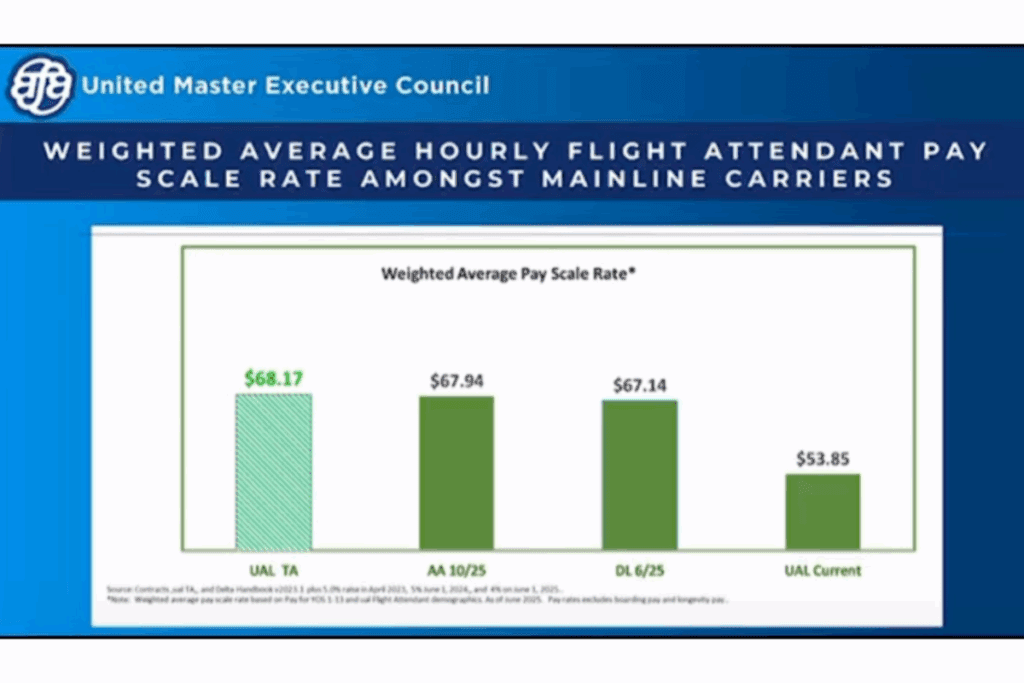
Based on weighted average pay scales, Aikins calculates that the average pay scale rate for United Airlines will come to $68.17, whereas the same average weighted pay at American Airlines is $67.94 and $67.14 at Delta Air Lines.
That figure does not, however, include ‘boarding pay’, which is paid at half the usual hourly rate for the time that passengers are boarding the plane – something that has usually been done for free at many US carriers in favor of higher flying pay.
That has now changed with Delta Air Lines, Alaska, and American Airlines, as well as SkyWest, all introducing boarding pay in the last few years.
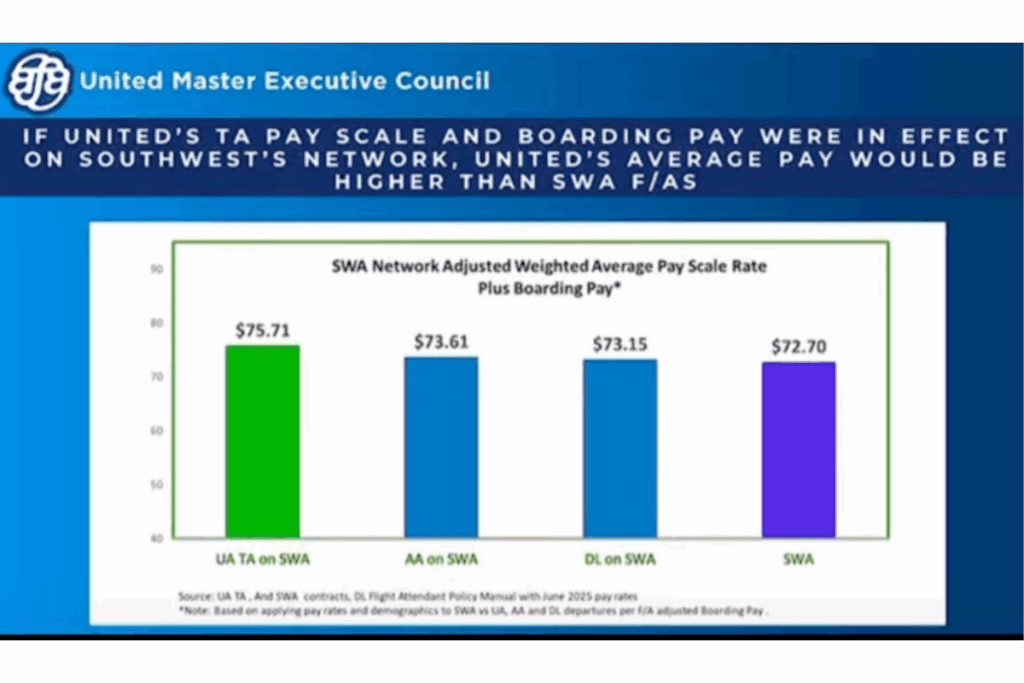
The outlier in this shift is Southwest, where flight attendants ratified a new contract without boarding pay in favor of higher flying pay in April 2024.
That has left some United Airlines flight attendants wondering whether Southwest flight attendants are actually the highest paid amongst US crewmembers.
Not so, argues Aikins, who calculates that with the inclusion of boarding pay, United’s flight attendants will actually earn an average of $3 per hour more than their peers at Southwest.
Matt’s Take
One of the biggest issues facing the Association of Flight Attendants in convincing their members to vote in favor of this contract is that this is the first tentative agreement between the union and United.
It has become an accepted practice within the US aviation industry for unionized workgroups to reject the first tentative agreement and send their union representatives back to the bargaining table.
We’ve seen this at Alaska, American Airlines, and Southwest in the last couple of years, and in each case, the unions have been able to achieve some form of improvement.
The AFA has been at pains to point out that they wouldn’t send a tentative agreement to a formal vote if they didn’t believe it was the best they could achieve, warning that a ‘No’ vote could prolong the bargaining process for many months without any guarantee that meaningful improvements could be made.


United is a an internation, multi-billion dollar company. Ceo’s and shareholders don’t load bags, assist customers, fix the machines and systems that keep planes moving.
Theses people should get wages that will allow them to live.
It is not a bonus. It is four years of back pay from the expired contract that they owe the flight attendants. They owe more than they are offering.