



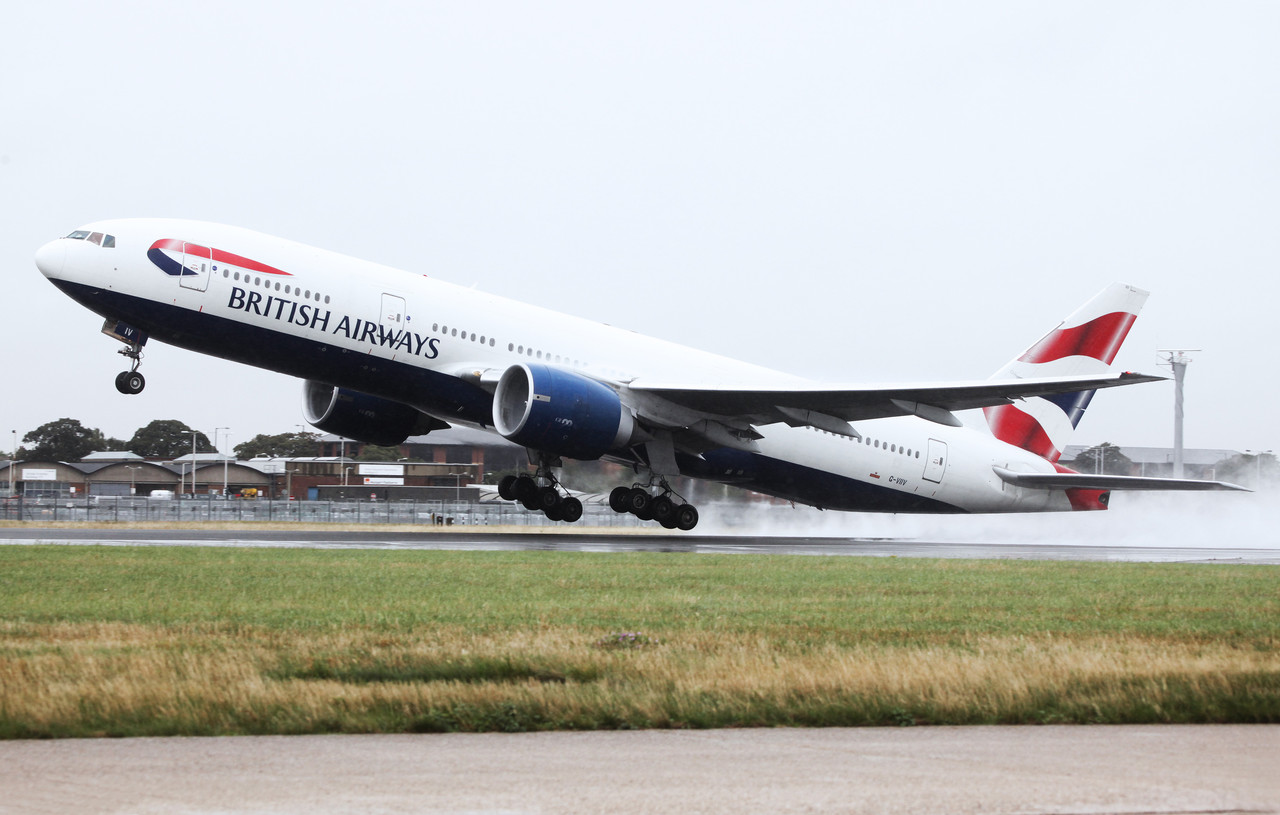
The pilots of a British Airways Boeing 777 cracked open the cockpit windows mid-flight after the smell of old, dirty socks started to waft through the entire plane, prompting an emergency diversion to London Gatwick Airport on Tuesday.
Flight Details
- Aircraft: Boeing 777-200 (G-YMME)
- Age: 25 years (first flight on April 5, 2000)
- Engines: 2x Rolls-Royce Trent 800 turbofans
- Flight number: BA2203
- Route: London Gatwick (LGW) – Cancun (CUN)
British Airways flight BA2203 had just taken off from London Gatwick for what should have been a routine 10-hour flight to Cancun, Mexico, but after climbing to just 11,000 feet, the pilots declared an emergency and entered a holding pattern over the English Channel.
According to industry sources, the pilots reported to air traffic control that there were ‘fumes’ in the cockpit and the cabin and that passengers had reported the smell of old, musty socks that was making them feel sick and dizzy.
Rather than a minor inconvenience, the smell of musty or dirty socks is well known within the aviation industry as an indication that the air inside the plane has become contaminated with engine or hydraulic oil.

Cabin air is often contaminated due to the ‘bleed air’ system that aircraft manufacturers use to supply the cabin and cockpit with what is meant to be a fresh supply of air.
The bleed air system takes some of the air that is being sucked into the engine and ‘bleeds’ it into the cabin air conditioning system through a special valve. The problem with this system is that various contaminants, such as engine oil and lubricants, can vaporize and enter the air being pumped into the cabin.
In the case of British Airways flight 2203, the pilots immediately donned their special oxygen masks so that the odor didn’t make them feel sick before descending to 9,000 feet and circling over the English Channel while they jettisoned fuel.
It has also been reported that the pilots cracked open the cockpit windows to let fresh air into the plane while they were still dumping fuel before heading back to Gatwick Airport.
A spokesperson for British Airways would neither confirm nor deny these reports.
The plane then returned to London Gatwick and landed safely before all the passengers were able to deplane as normal.
In a statement, British Airways told us: “The aircraft landed safely at Gatwick after our pilots identified a technical issue. Customers disembarked normally and we’ve apologised for the disruption to their travel plans.”
How were the pilots able to open the cockpit windows?
Boeing 777 aircraft have a window on either side of the cockpit that can be cranked open. These are normally only ever open when the plane is on the ground, but the windows can also be open when flying at low altitude.
It’s unlikely that the pilots were following a standard operating procedure, but the Captain would likely be able to justify their unorthodox decision based on the prolonged time that the aircraft had to circle while dumping fuel.
The cockpit windows on Boeing 777s are also used as a secondary emergency escape route should the cockpit door become unusable in the event of a crash. Not all Boeing aircraft, however, have cockpit windows that can open.
The more advanced Boeing 787 Dreamliner does not have cockpit windows that can open; instead, it has an emergency escape hatch built into the ceiling of the cockpit.
What aircraft use ‘bleed air’ systems to supply air to the cockpit and cabin?
Despite concerns over the use of the bleed air method being raised for decades, the vast majority of commercial passenger jets still use this system to supply air to the cockpit and cabin.
The only widebody commercial airliner that does not use the bleed air system is the Boeing 787 Dreamliner. That being said, cabin air can still sometimes be contaminated via faulty air conditioning packs.
Was this a fume event or an odor event, and what’s the difference?
How these incidents are described is a major cause of controversy within the industry, and airlines hate the term ‘fume event’ or ‘toxic fume event,’ which is often used by campaigners who have called on the industry to do more to protect workers and passengers.
British Airways much prefers the term ‘odor event’ to describe these types of incidents, claiming that any ill health effects are normally transient and short-lived.


Opening the cockpit windows in flight on some Boeing aircraft is a rare but acceptable procedure for some events. It is mentioned in the QRH. Requires the classic window layout. Can’t do it on the 787. 787 has an escape hatch in the ceiling.