



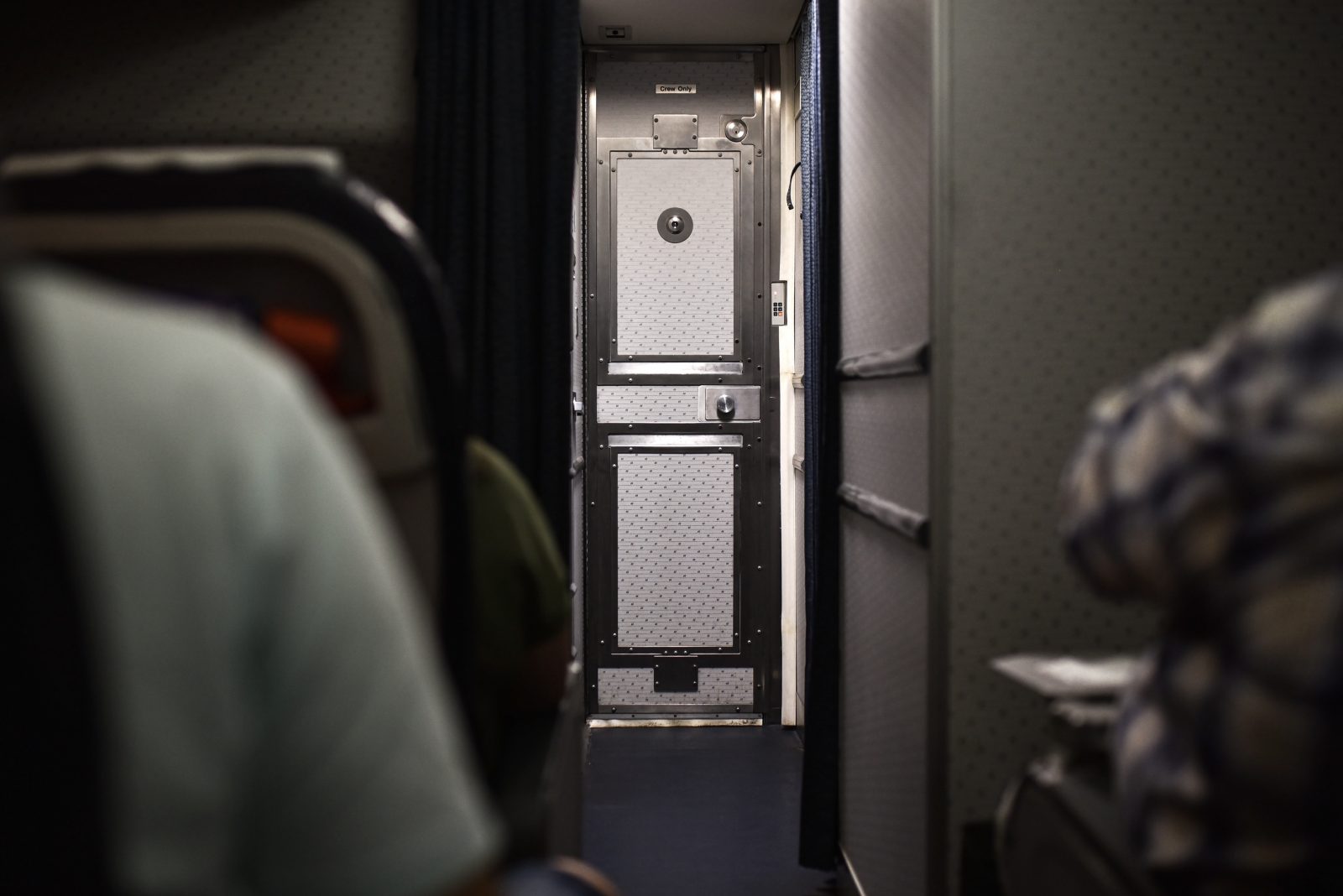
If you’ve spent any time on Facebook in the last few months, you may have seen posts from the ‘Dull Men’s Club,’ which is precisely what it says it is – a club of dull men who post seemingly dull things they’ve seen in their day to day life, often seeking answers to very niche questions.
In a recent post, dull man Kjell Patteeuw posted a photo he took of the cockpit door from a flight he was on. Next to the door was a small keyboard that appeared to be used to gain access to the flight deck.
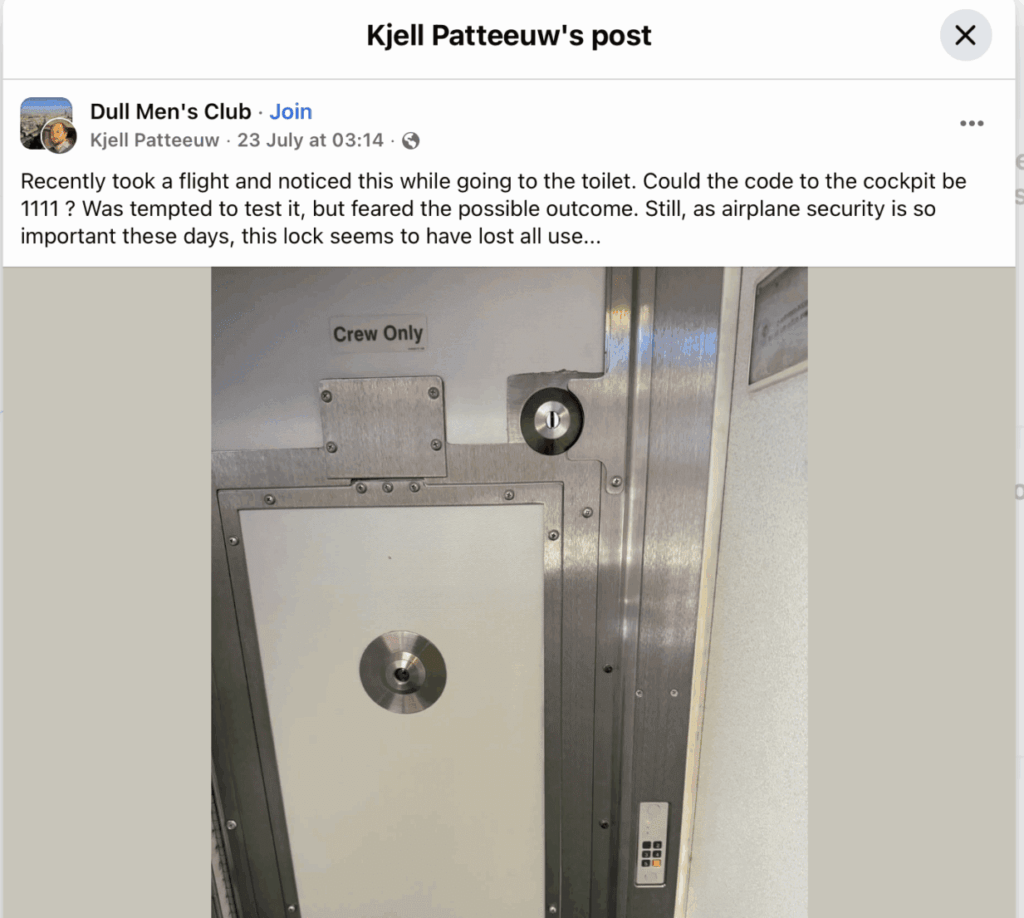
There were five numbers on the keypad, and the number 1 had been used so much that it was barely visible, having worn away over the years from being pushed over and over again.
Kjell explained: “Could the code to the cockpit be 1111? Was tempted to test it, but feared the possible outcome. Still, as airplane security is so important these days, this lock seems to have lost all use…”
Commentators on Kjell’s post were quick to muse about possible keypad combinations that might unlock the door or other security measures that airlines might use.
Some guessed that airlines frequently change the passcode, perhaps even from flight to flight, meaning that you would have to know the passcode set on the day to gain access to the flight deck.
What the cockpit keypad really does
The real answer is, however, a lot simpler and much more secure.
While the keypad has multiple buttons, it is nothing more than a fancy doorbell with a built-in override system.
In normal situations, the crew presses a combination of buttons on the keypad, and this simply rings a bell in the cockpit, letting the pilots know that someone wants to gain entry.
The pilots then check surveillance cameras installed around the cockpit or look through the spyhole built into the cockpit door to decide whether to unlock the door.
Emergency override – with built-in safeguards
There is, though, a slightly different system for an emergency situation, especially if it’s suspected that the pilots have succumbed to hypoxia and lost consciousness.
In this case, the crew would press a different combination of keys to start an emergency unlock procedure. Once activated, the door remains locked for 30 seconds, and during this time, the pilots can disable the override mechanism to keep the door locked shut.
If, however, there has been no response from inside the cockpit during that 30-second window, the door unlocks for just a few short seconds.
So, yes, while there is a combination of keys that can be pressed on the cockpit door keypad to unlock it, there are safety processes in place to ensure that no unauthorized access is gained to the flight deck.
The Germanwings tragedy and the cockpit door lock
This was evident in the tragic downing of Germanwings flight 9525 on March 24, 2015, when First Officer Andreas Lubitz took control of the Airbus A320 and deliberately crashed it into a mountainside in the French Alps, killing all 144 passengers and six crew members onboard.
In this incident, Lubitz waited until the Captain left the cockpit to use the bathroom during the flight from Barcelona to Düsseldorf.
When the Captain went to request entry back into the cockpit, Lubitz kept the door locked and failed to respond to calls from the cabin. Attempts to open he cockpit door using the emergency access code were swiftly rejected by Lubitz.
In the final moments of the flight, the Captain desperately tried to break the cockpit door using a crash axe. His attempts proved futile against the reinforced ballistic and bomb proof door.
How one ex-crew member reportedly deceived the safeguards
There is, however, a tale of how an ex-flight attendant working for a famous airline in the Middle East once managed to gain unauthorized access to the flight deck after she had been sacked from the company.
Wearing her old uniform that she had snuck onboard with her, the woman reportedly changed in the bathroom during the flight and confidently approached the cockpit.
When the pilots saw the woman on the surveillance camera video screen, they noticed her uniform and assumed she was part of the working crew and opened the door.


In case this isn’t clear… it’s a really, really, REALLY BAD IDEA to mess around with this keypad. Do people not know what “Level 4” means?
There are jokes, and then there are “oh, hell no” situations. This obviously falls into the latter.