


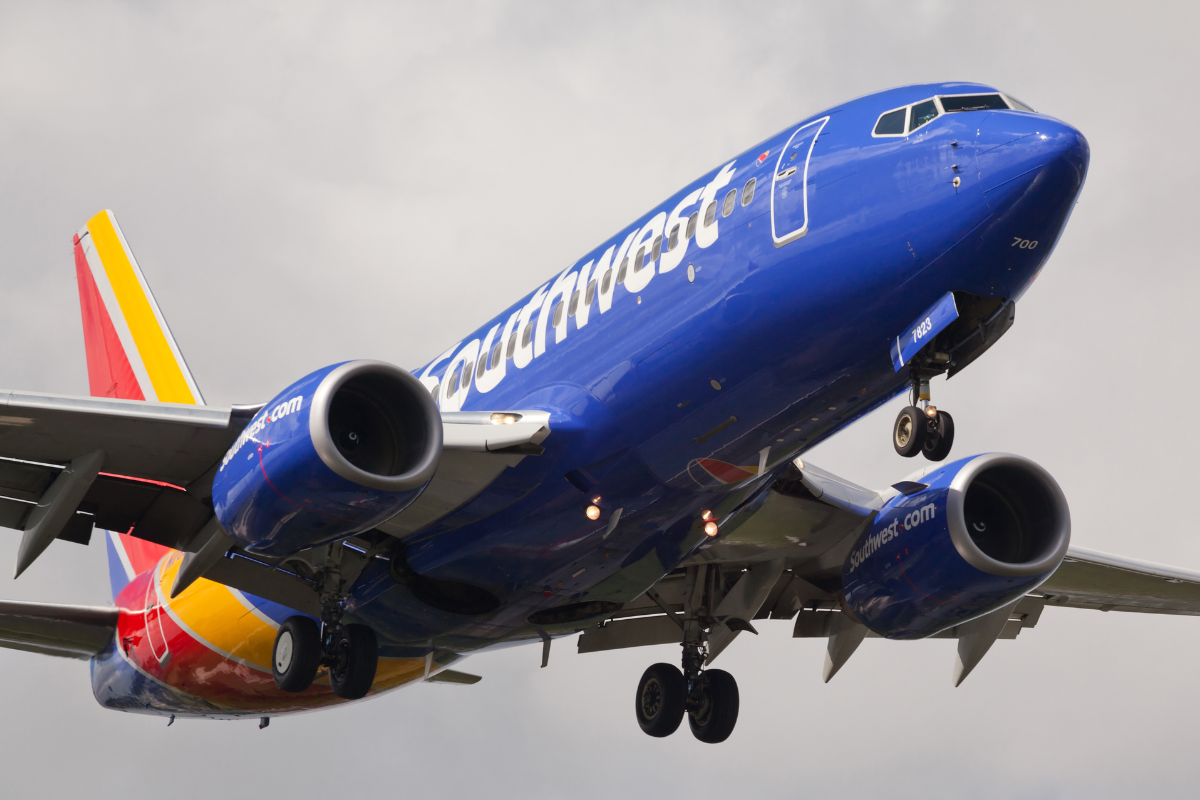
The pilots of a Southwest Airlines flight from Burbank, California, to Las Vegas had to make the “most insane dive ever” on Friday morning in order to avoid a mid-air collision with another plane.
Multiple passengers who were on the flight took to social media to report their experience that left two flight attendants with head injuries after they were flung towards the ceiling during the emergency maneuver.
Southwest Airlines says the pilots had to respond to two separate collision alarms in the cockpit, requiring them to rapidly descend to avoid other ‘traffic’ in the vicinity of Burbank Airport.
What Exactly Happened?
Southwest Airlines flight WN-1496, operated by a 19-year-old Boeing 737, departed Burbank (BURK) airport at around 11:57 am on July 25 for what should have been a routine 40-minute flight to Las Vegas.
Around six minutes after takeoff and while the plane was still climbing to its cruise altitude, the pilots received an emergency collision alert in the cockpit, warning them of another aircraft in the vicinity.
The other aircraft turned out to be a Hawker Hunter, which crossed in front of the Southwest aircraft. According to data supplied by Flight Radar 24, the closest point that the two aircraft were to each other was 4.86 miles apart laterally and 350 feet apart vertically.
The incident occurred while the two planes were using airspace controlled by the Los Angeles Air Route Traffic Control Center, so the Federal Aviation Administration will be looking at whether any error here caused the two aircraft to come too close to one another.
First Hand Passenger Accounts Of The Incident
“Our pilot had to make the most insane dive ever to avoid the other aircraft,” one of the passengers wrote on Reddit.
“So many of us flew out of our seats for about 20 seconds, even with seatbelts on, and one of the flight attendants got hurt and needed medical attention after we landed,” the passenger recounted.
Almost had a midair collision today 😀
byu/r444ven inSouthwestAirlines
“I just wanted to thank the pilot, co-pilot, and flight attendants for keeping us safe.”
Another passenger, known as Jimmy Dore, wrote on the social media platform X that the “pilot had to dive aggressively to avoid a midair collision over Burbank airport.”
“Myself and plenty of people flew out of their seats and bumped heads on [the] ceiling, a flight attendant needed medical attention.”
The passenger continued: “Pilot said his collision warning went off and he needed to avoid the plane coming at us.”
And a third passenger, Seve Francis, wrote in a post on X: “Our plane just dove 1000s of feet to avoid a collision over Burbank Airport.”
“People were screaming as the plane dove. A flight attendant is being looked at right now with an ice pack on her head.”
Southwest Responds With Detailed Statement
In a statement, a spokesperson for Southwest Airlines said:
“The Crew of Southwest Flight 1496 responded to two onboard traffic alerts Friday afternoon while climbing out of Burbank, Cal., requiring them to climb and descend to comply with the alerts.”
“The flight continued to Las Vegas, where it landed uneventfully. Southwest is engaged with the Federal Aviation Administration to further understand the circumstances.”
“No injuries were immediately reported by Customers, but two Flight Attendants are being treated for injuries. We appreciate the professionalism of our Flight Crew and Flight Attendants in responding to this event. Nothing is more important to Southwest than the Safety of our Customers and Employees.”
How The Collision Alert System Works
The traffic alert referred to by Southwest is technically known as TCAS, which stands for ‘Traffic Alert and Collision Avoidance System’. In some countries, the system is also known as the Airborne Collision Avoidance System (ACAS).
TCAS has been described by aviation experts as the “last defense against mid-air collisions.”
The system sounds an audible alarm in the cockpit if it detects the threat of a midair collision. It functions independently of ground-based alert systems, giving alerts when all other systems have failed.
The latest and most advanced system is known as TCAS II, and this provides both traffic advisories and resolution advisories. For example, the system can tell the pilots what maneuver to perform in order to avoid a midair collision.
TCAS is mandated on all commercial aircraft in the United States with more than 30 seats.
Similar Incident Left A Passenger Seriously Injured
In September 2024, two passengers were injured during a United Airlines flight from Newark to San Francisco on Thursday when the pilots performed a maneuver following a TCAS alert.
One of the two injured passengers suffered serious injuries as a result of the emergency action taken by the pilots to ‘resolve’ the alert.
The injuries occurred as the Boeing 757 was flying at around 38,000 feet over Wyoming. One of the passengers who was injured was out of their seat when the emergency maneuver occurred.