



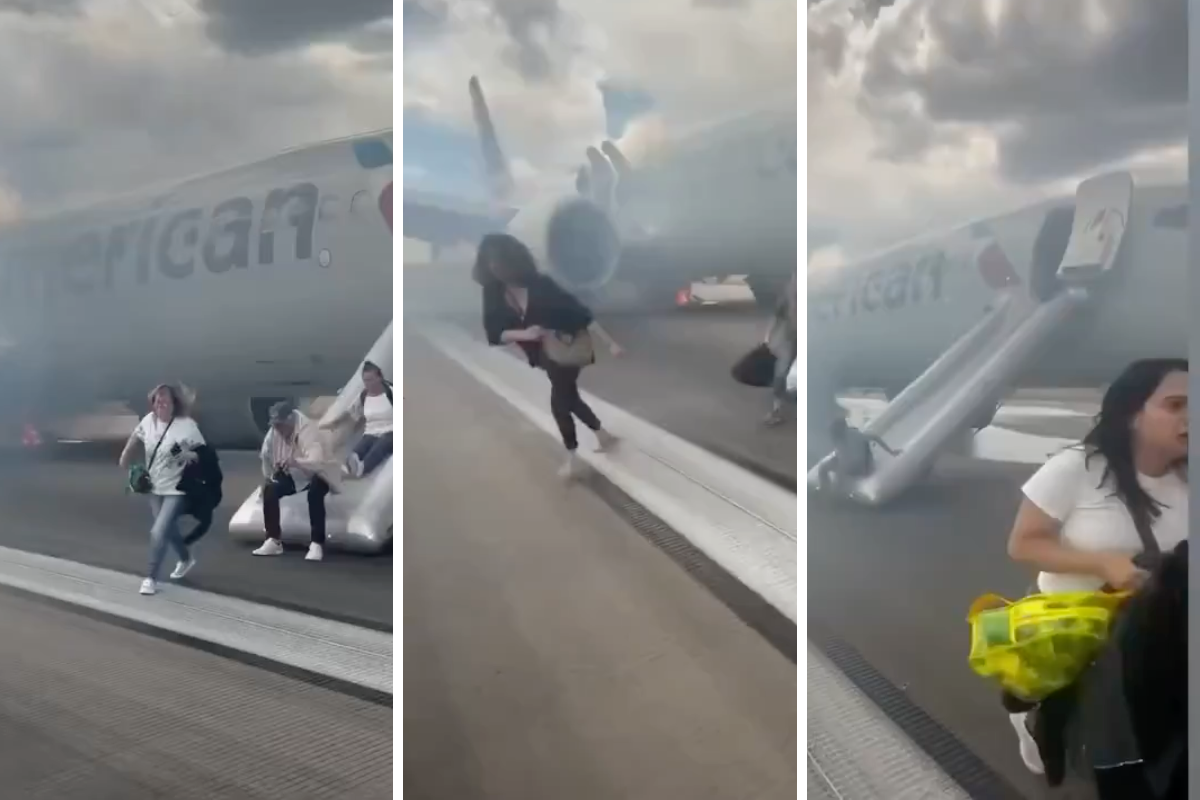
Multiple passengers were seen escaping a burning American Airlines Boeing 737 airplane at Denver International Airport on Saturday afternoon with their bags and other personal belongings after a brake fire prompted an emergency evacuation onto the runway.
The incident has prompted renewed calls for passengers to face hefty fines or even criminal prosecution if they are caught slowing down an airplane evacuating by stopping to retrieve their bags.
American Airlines flight AA-3023, operated by a three-year-old Boeing 737-MAX8 aircraft, was taxiing for departure to Miami at around 1 pm on July 26 when the left-hand main gear brakes overheated and caught fire.
Thick smoke quickly started to billow out of the landing gear and around the airplane, prompting the crew to initiate an emergency evacuation onto the runway via emergency slides and the overwing exits.
173 passengers and six crew members evacuated the plane, resulting in five minor injuries. One person was taken to a local hospital for further evaluation, but thankfully, no serious injuries were reported.
Video posted to social media by people who had been onboard the plane, however, showed numerous passengers evacuating the plane with handbags, rucksacks, and large duffel bags, potentially slowing down the evacuation process and endangering the lives of other people onboard.
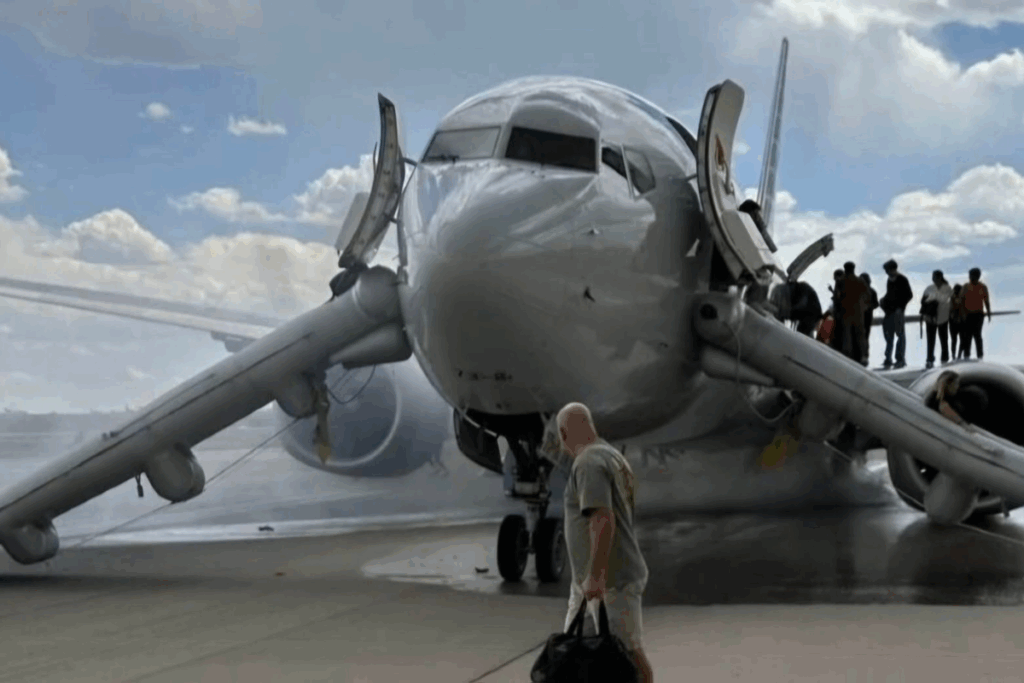
Passengers evacuating with their hand luggage has become an all-too-common sight, despite repeated warnings during the safety briefing that passengers must leave everything behind in the event of an emergency.
In May 2019, 41 passengers and crew died after a fire engulfed an Aeroflot Sukhoi Superjet 100 regional jet that made an emergency landing at Moscow Sheremetyevo Airport following a lightning strike.
Many of the victims were trapped at the back of the plane, and there has been widespread speculation that their escape from he burning wreckage was significantly slowed by passengers towards the front of the plane stopping to retrieve their luggage from the overhead bins.
Unfortunately, studies have suggested that despite the warnings in airline safety briefings, passengers are still likely to try to grab their bags in the event of an emergency evacuation.
In 2018, for example, a study commissioned by the Royal Aeronautical Society (RAeS) in the United Kingdom revealed that as many as 75% of Britons would stop to retrieve their luggage in an evacuation if they believed there was no immediate risk to their own safety.
Even if they thought there was an immediate risk to their lives, 35% of respondents still said they would stop to get their bags.
The big question remains: why would so many passengers deliberately risk their own lives, as well as those of their seatmates, just to stop for easily replaceable items?
Nearly two-thirds of people polled in the 2018 study said they would probably have an instinctive reaction to grab personal belongings within easy reach, while nearly half said they would be worried about the airline not returning their bags to them.
While some of those respondents realized their personal belongings were replaceable, around a third said they wouldn’t want the “hassle” of buying new clothes that were lost in an accident. Just over a third also claimed that their personal belongings were too valuable to replace.
Rules on when an emergency evacuation should take place can vary from country to country and from airline to airline. Some airlines have a much lower threshold for initiating an evacuation, which may make it more likely for passengers to believe that their safety isn’t at immediate risk and that there is plenty of time for them to stop to take their bags.
Emergency evacuations are inherently dangerous, and it’s not uncommon for passengers and crew to suffer broken bones.
It’s for this reason that emergency evacuations should only be ordered when the risk of staying on the plane or deplaning via a jetty or airstairs poses a greater danger than the risk of sustaining injuries jumping onto an inflatable slide.
It’s clear that passenger education in the form of the pre-flight safety briefing is having a very limited effect on stopping people from taking bags with them during an evacuation, so how else can the industry stop this trend?
Following the 2018 study, RAeS suggested that aircraft manufacturers and third-party suppliers should develop a system that automatically locks the overhead bins after the plane has been prepared for departure.
Nearly seven years have passed since that recommendation was made, and there are no signs that any such system is even being considered by either Airbus or Boeing.
There isn’t a single airline that has publicly stated it is in favor of automatic locking overhead bins, and some experts believe this could slow down an evacuation even further, as passengers struggle to open the bins.
The other option could be to limit the amount of hand luggage that passengers bring onboard with them in the first place, but this would completely reverse an industry trend towards larger overhead bins that allow an increasing amount of baggage in the passenger cabin.
In other words, the likelihood of airlines adopting this approach is extremely low.
That’s why some safety experts believe that passengers caught flouting evacuation rules and taking their hand luggage should be fined or even criminally prosecuted. Of course, this raises moral arguments of turning victims into criminals, and it’s unknown how much of a deterrent effect this would have in future evacuations.
Matt’s Take
During an emergency evacuation, one of the key commands that flight attendants will shout repeatedly at passengers is: “Leave everything behind!”
The fact that passengers so often ignore this key message just shows how chaotic and confusing a real-life evacuation can be. As outside observers, it’s very easy to judge the mistakes of others, while never really knowing how you might react in a similar situation.
The fear, however, is that it will take a tragedy such as the 2019 Aeroflot disaster for the aviation industry in the US and Europe to take notice of this problem and take more meaningful action.


The only thing I would take is my passport! That’s why it’s in a handy place to grab and go. As an airline pilot instructor, I see way too many people that don’t realize that, although flying is safe, in an emergency, being in pajamas, flip flops, shorts and a T-shirt will almost guarantee injury. LEAVE the stuff and get the hell off of the jet! Ignorance can be educated…stupidity can’t.
My passport is in my pockets but my meds are in the carryon. On a domestic flight I can get on the phone and have my doctor send a prescription to the local pharmacy. On an international flight I’m SOL.
In simulations it turns out that in an emergency landing+evac the aisle is immediately filled with people, worse than Tri-sttate businessmen on an 0800 flight to “an important meeting.” Seriously, that aisle is blocked before the “beep” that said we’re stopped. People have plent of time to reach up and grab their bags without further impeding everyone else. This is the aisle-seat advantage, and if you’re an east-cost self-important flyer, you’re out of your seat before landing.
I will be standing there trying to get to the aisle while everyone else is slow. My bag has essentials including meds that can’t be easily “replaced” within 30 days of last filling or in a foreign land or random phrarmacy.
Phone charger is in that bag, and I’ll need it because things just got f’d.
I carry Allianz all-year travel insurance, and that will cover a lot, but not a new phone charger bought at airport concession prices, let alone foreign medications (that I have to exit the airport to get), and basic clothing and toiletries.
If you want to “be clever” and carry on three bags, you’re the problem. I have one roller and it is sized to fit in the overhead bin. I purchase seats where I can put my bag above my seat, not four rows down.
I do follow crew instructions, don’t flirt with the FAs, and in an emergency help others.
Beffore you shame someone — ask yourself — what if they take daily meds that keep them alive? What if twas your mother or sister or brother? Don’t be hasty to judge. Sure, there are jerks. Then there are helpful people.