



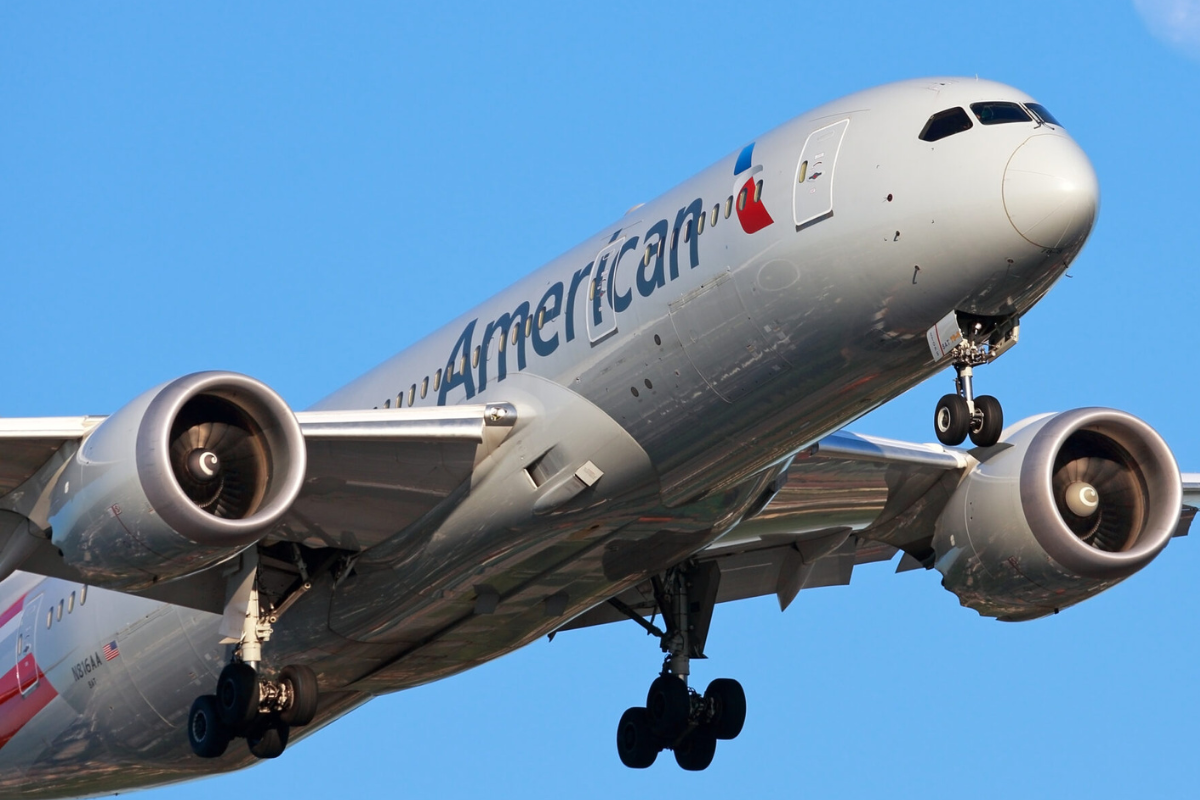
Flight attendants at American Airlines are stepping up a campaign to mandate at least one crew member per door on widebody aircraft, calling on the new administrator of the Federal Aviation Administration (FAA), Bryan Bedford, to reverse a decision that allows the Dallas-based airline to operate its new premium-configured Boeing 787-9s with just seven flight attendants.
Why American Airlines Flight Attendants Are So Concerned
Last month, the FAA approved an application from American Airlines to staff its new premium-configured Boeing 787-9 Dreamliners (known internally as the 787P) with just seven crew members.
All models of the Boeing 787 have eight emergency exits, meaning that one exit will not have a flight attendant stationed beside it, and that in the event of an evacuation, one crew member would be required to try to open two exits.
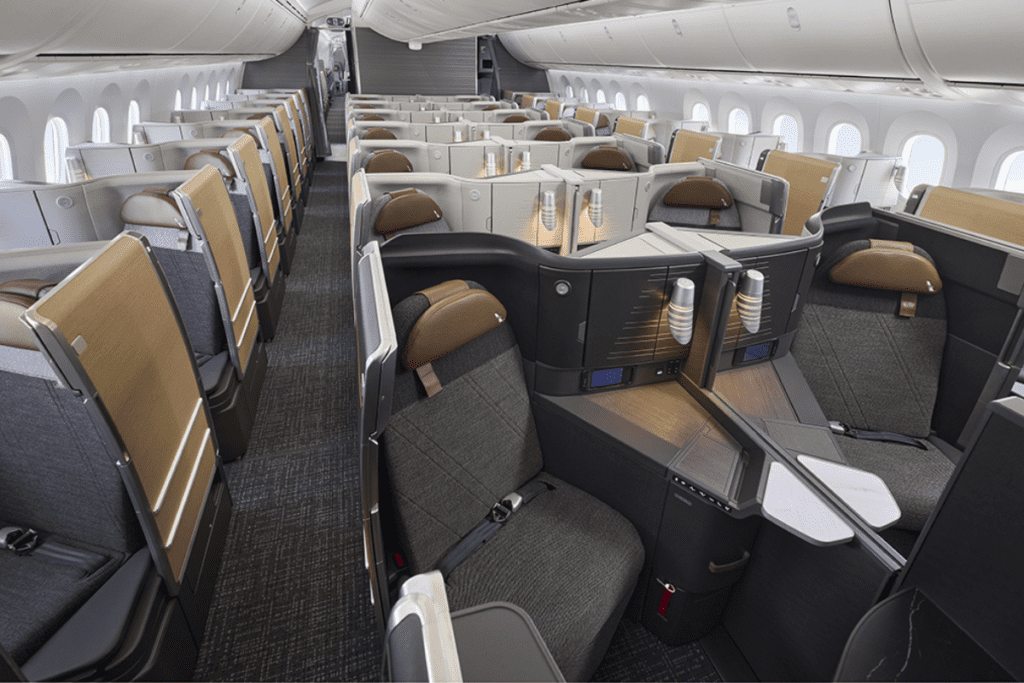
The Association of Professional Flight Attendants (APFA), however, fears that in reality, one exit would not be opened and that could significantly lengthen the amount of time it takes to evacuate an aircraft.
It should be noted that American Airlines doesn’t intend to routinely deploy its 787Ps with just seven crewmembers, but should a flight attendant go sick at the last minute, the airline can still fly the plane without incurring a delay or costly cancellation.
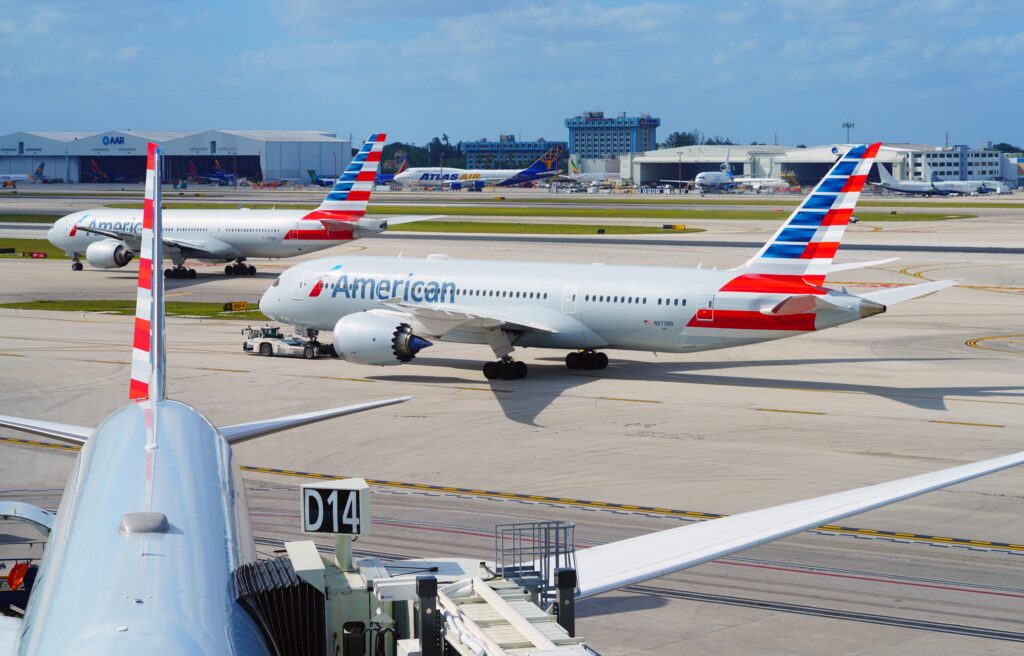
However, if a flight does depart with only seven crew members, it would leave just one flight attendant at the aft of the plane, in the dense Economy section.
Union Highlights Concerns To New FAA Administrator
In a letter to the recently appointed FAA administrator, Bryan Bedford, the American Airlines flight attendant union claims that the recertification of the 787-9 with just seven crew members has “crossed a critical line,” and has enabled the airline to prioritize cost-cutting over passenger safety.
“Through this recertification, a single Flight Attendant is left responsible for evacuating hundreds of passengers through two emergency exits on opposite sides of a widebody aircraft and nearest to where the highest density of passengers is seated,” the letter explains.
“There is no question that an unattended emergency exit hinders the ability for passengers and crew to evacuate safely and efficiently within the 90-second parameter.”
Some of the immediate concerns raised by the union include:
- The possibility that the sole flight attendant at the rear of the plane is incapacitated, leaving two doors at the aft of the aircraft unopened in an evacuation.
- The ability of the flight attendant to open both doors at the rear of the aircraft.
- What would happen if a single flight attendant were left to deal with a serious security threat at the rear of the aircraft?
Julie Hedrick, president of the flight attendant union, raises the fact that the Trump administration is currently looking at how understaffing has affected aviation safety, framing the reduction in crew members on the 787P against air traffic controller shortages.
How Do AA’s Widebody Staffing Levels Compare To Delta’s And United’s?
Since the 1970s, it has become standard for US airlines to station at least one flight attendant at every emergency exit on widebody (dual-aisle) airplanes. That, however, changed during the COVID-19 pandemic when passenger demand plummeted and airlines started deploying widebody aircraft with far fewer passengers.
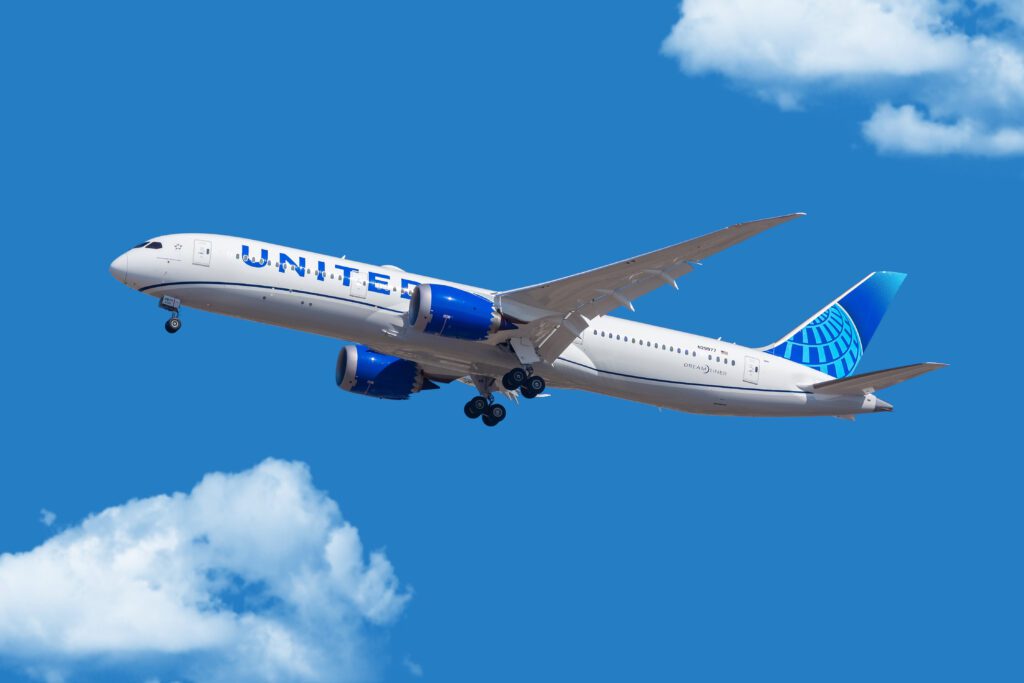
During this time, both Delta and United Airlines applied for permission from the FAA to reduce minimum flight attendant staffing on some widebody aircraft types.
- United secured a minimum flight attendant level of just seven crew members on all of its Boeing 787 Dreamliner fleet, including the larger -10 model, which can carry 74 more passengers than AA’s 787P.
- Delta Air Lines was given permission to operate its similarly sized Airbus A330 aircraft with just six crew members.
An International Comparison – Eight Doors And Only Six Flight Attendants
Internationally, it’s not uncommon for widebody aircraft to be certified for commercial passenger use with fewer flight attendants than there are emergency exits.
For example, in Europe, the Boeing 787 has been certified with a minimum of six flight attendants. Most airlines have more than this number of crew members for onboard service reasons, but they don’t have any issues deploying aircraft with these minimum staffing levels when circumstances warrant it.
The number of cabin crew required is usually set during the primary certification of the aircraft, but if this is not explicitly stated, then European regulators require at least one crew member per 50 passenger seats (or fraction thereof) on each deck of an aircraft.
In some extreme cases, this rule has led to European airlines temporarily removing seats from their planes to reduce the number of cabin crew they have on board.
Single-Aisle Aircraft Have Long Had Fewer Crew Than Doors
While reducing the minimum flight attendant staffing levels on widebody aircraft is quickly becoming a hot topic, it has long been the case on single-aisle aircraft that there can be fewer flight attendants than there are emergency exits.
The thinking is that on a much smaller airframe, a single flight attendant can quickly and easily get from one side of the aisle to the other in order to open two emergency exits and deploy the evacuation slides.
In real-life evacuations, this isn’t always the case, and there have been recent examples of emergency exits being left open while a single flight attendant focuses on evacuating passengers from the exit that they were immediately stationed next to.
Aircraft Manufacturers Replacing Staffed Doors With Self-Help Exits
In recent years, we’ve seen aircraft manufacturers explore ways to replace traditionally crew-supervised emergency exits with self-help exits that are activated by passengers without any involvement from flight attendants.
The goal behind this shift is essentially to squeeze even more seats on board single-aisle aircraft, where floor-level doors used to be situated.
One of the most evident examples of this is on the Airbus A321 aircraft. In the past, this aircraft had right floor-level emergency exits, but recent iterations of this model allow airlines to replace the second floor-level exit with self-help overwing exits.
There have not, however, been any industry plans to replace floor-level exits with self-help exits on widebody aircraft.
DARED Principles Require Trained Flight Attendants To Shorten Evacuation Time
In the 1990s, Boeing conducted research on the important role that flight attendants had in ensuring that emergency evacuations could be completed in or under the long-established 90-second limit.
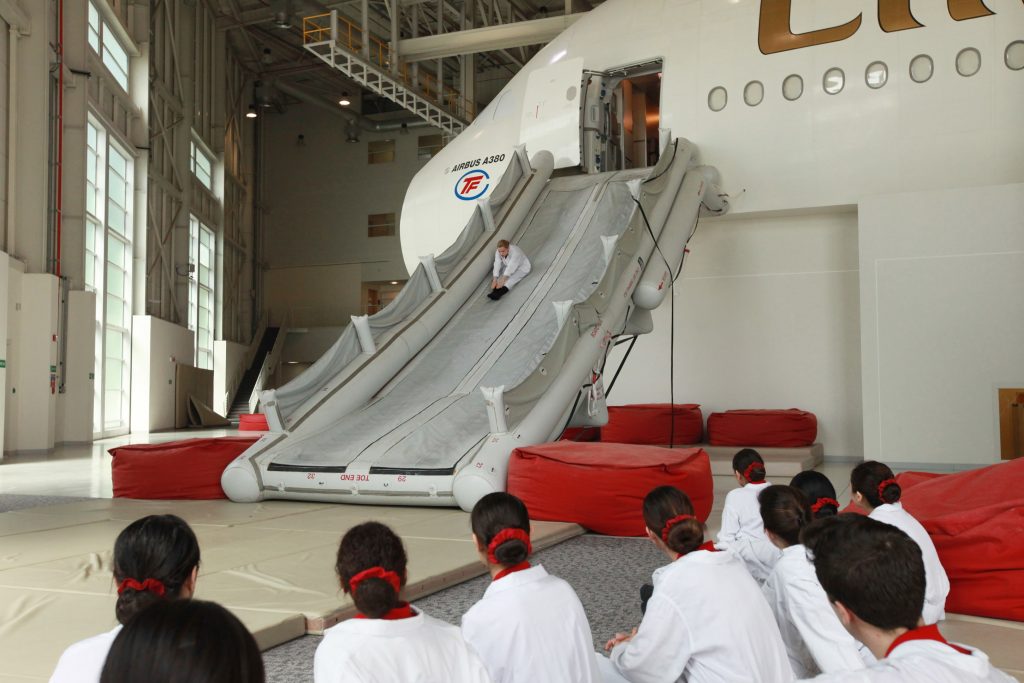
The research found that there were five key principles that flight attendants should be taught to ensure that an evacuation is successful. These five rules have become known as the DARED principles:
- Dedicated Assist Space: Flight attendants must stand in a way that they can help passengers evacuate, without blocking the emergency exit, especially on widebody aircraft fitted with dual lane escape slides.
- Assertiveness: Short, assertive commands from flight attendants are widely recognized as critical in ensuring that passengers get off the plane as fast as possible without taking their hand luggage.
- Redirect: Flight attendants must assess the outside conditions and redirect passengers to an alternative exit if it is not safe to open their door or if there is a malfunction with the escape slide.
- Exit Bypass: In some circumstances, it may be necessary to direct passengers towards an alternative door to ensure efficient use of all doors and reduce the time it takes to complete the evacuation.
- Dried Up Exit: In a similar vein, there might not be many passengers using a particular exit, such as in a First Class cabin, so passengers can be redirected to this exit to reduce the load on other exits.


I don’t see many flight attendants doing much but complain… they can certainly get by with just 7, particularly if the FAA believes that is sufficient for safety.
Why does the safety card provide information on how to open all of the exits? Why are “self-help” exit rows briefed? I can’t tell you how many AA flights I’ve been on where the exit row briefing consisted of a “You know you’re in an exit row, right? I need a yes from everyone. Thanks.” In a planned/prepped evac, wouldn’t ABPs be assigned to the door? I have in an emergency landing on an A319 while in row 1 with one F/A up front and was told I was responsible for the 1R door.
Sounds like perhaps some improvement on “self help” opening of not only overwing hatches but also doors.