


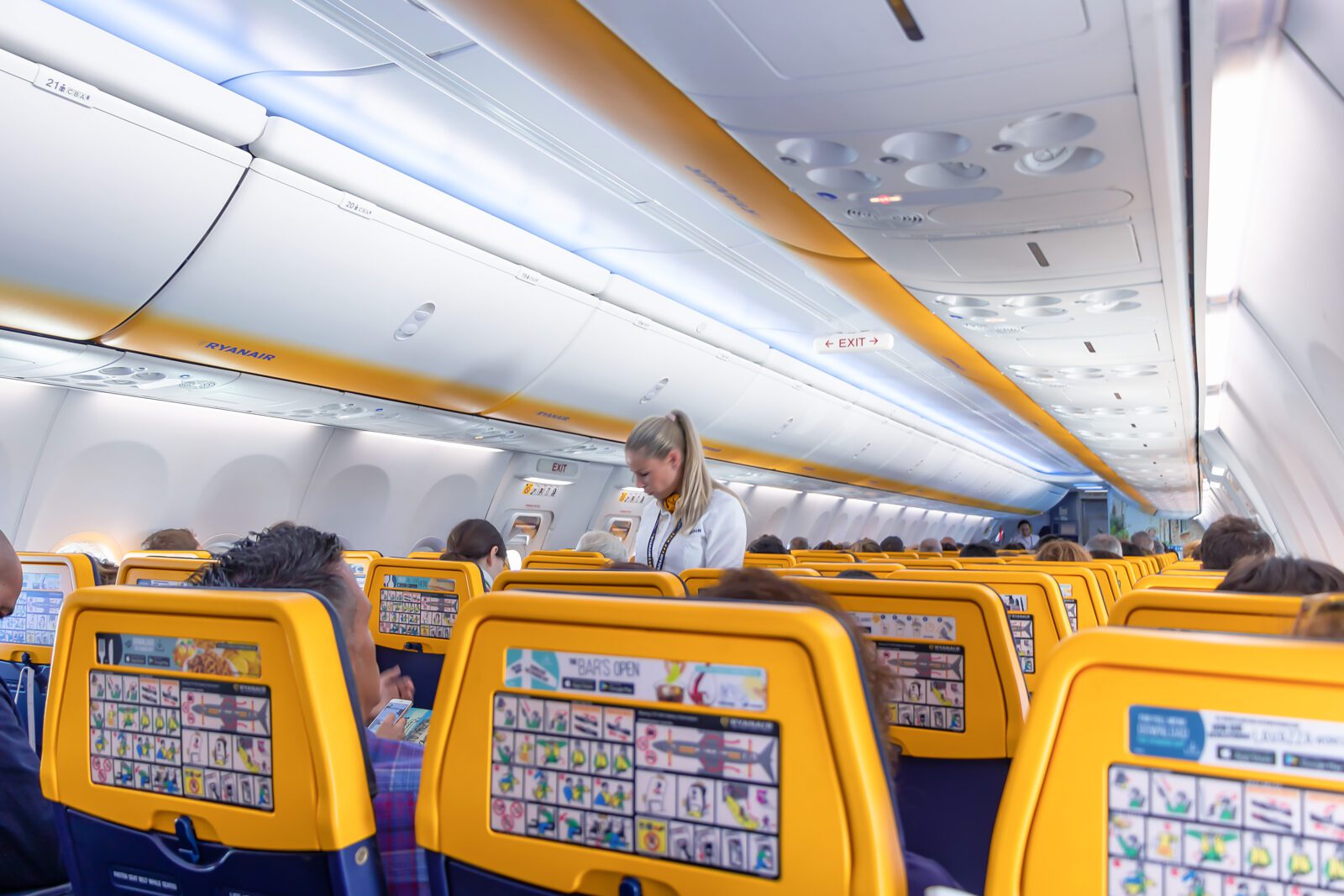
The familiar airline passenger safety card has been around for decades, with its odd cartoon images depicting what one should do in the most horrendous emergencies you could imagine.
Of course, there is a very good reason why airlines use cartoons to share this information, and that’s because images are a universal language that anyone, regardless of what language they speak or their reading proficiency should be able to understand.
What is this symbol on the safety card?
byu/Generic_userID001 inRyanair
Sometimes, however, even cartoon images can get lost in translation, and that’s especially true for the Ryanair safety card, which has left travelers across Europe scratching their heads in bewilderment at what it’s meant to mean.
Take a look at the part of the safety that has caused so much confusion, which shows what is banned during an emergency evacuation.
Most of the symbols are self-explanatory… there’s a suitcase, a high-heel shoe, a cigarette, and reading glasses all within a ‘no symbol’ indicating they are not permitted.
But take a closer look at the top right of this section of the safety card. Can you easily make out what this symbol means?
If you’re struggling to make any sense of this image, then don’t worry, you are certainly not alone, as this symbol has been the subject of debate amongst Ryanair passengers for years.
Would it help if I said the symbol is actually two images… in the top left-hand side of the picture, you are meant to be looking at an ear with an earring. The bottom right-hand side of the picture is meant to be a woman wearing a necklace.
Some travelers have also been confused by the image on the bottom right-hand corner. Along with the eyeglasses, what is the other item? The correct answer is dentures. Yes, Ryanair wants passengers to leave their eyeglasses and dentures behind in an emergency evacuation.
This video from Linus Boman explains the absurdity of Ryanair’s safety card, which isn’t actually a card at all, but is stuck to the back of every seat to avoid the need to replace cards.
Linus really goes to town deconstructing Ryanair’s safety card design and let’s just say, he is not impressed with the budget’s most recent attempts at safety card design.
In fact, Linus discovered that the current safety card design is based on old cartoons from when Ryanair actually had proper safety cards in seatback pockets. At that time, the symbols that are so hard to decipher now were a lot more legible.
It seems, however, that over the years, the quality of these symbols has gradually eroded to the point that passengers are struggling to understand what they mean.
The now familiar safety card design can be traced back to the 1960s, when researchers conducted crash evacuation tests. In some of the tests, the researchers made the participants read a safety card, whereas other participants were, quite literally, left in the dark.
The results of these tests were immediately obvious – evacuation times were significantly faster when participants had read the safety card. The problem was designing a safety card that anyone could understand.
The researchers turned to a professional illustrator to design the first safety cards that we know so well today. These cards were deliberately devoid of words, apart from the word ‘EXIT’ in the illustration of an aircraft door.

I hope they mean to leave your extra glasses/reading glasses that you may have left in your carryons behind…
Taken literally, somebody can interpret it to mean take your glasses off.. in which case, I’d be legally blind and likely cause more issues with evacuation considering I can’t see 3 inches in front of my face with uncorrected vision.
“These cards were deliberately devoid of words, apart from the word ‘EXIT’ in the illustration of an aircraft door.”
For many aircraft there isn’t that word either – they use a symbol instead. (For example, the 787 almost always uses the exit symbol, with the notable exception of United whose 787’s still have the word ‘EXIT’. Any idea why United insisted on this? Perhaps this could be explored in an article here on PYOK.)
The exit symbol was first developed in Japan by Yukio Ota in the late 1970’s, and has become part of an international standard for safety symbols, known as ISO 7010. It can also be found in public buildings in many countries. (US building codes have been a bit slower on this topic and many others compared to building codes in other countries but they have slowly been evolving.)