



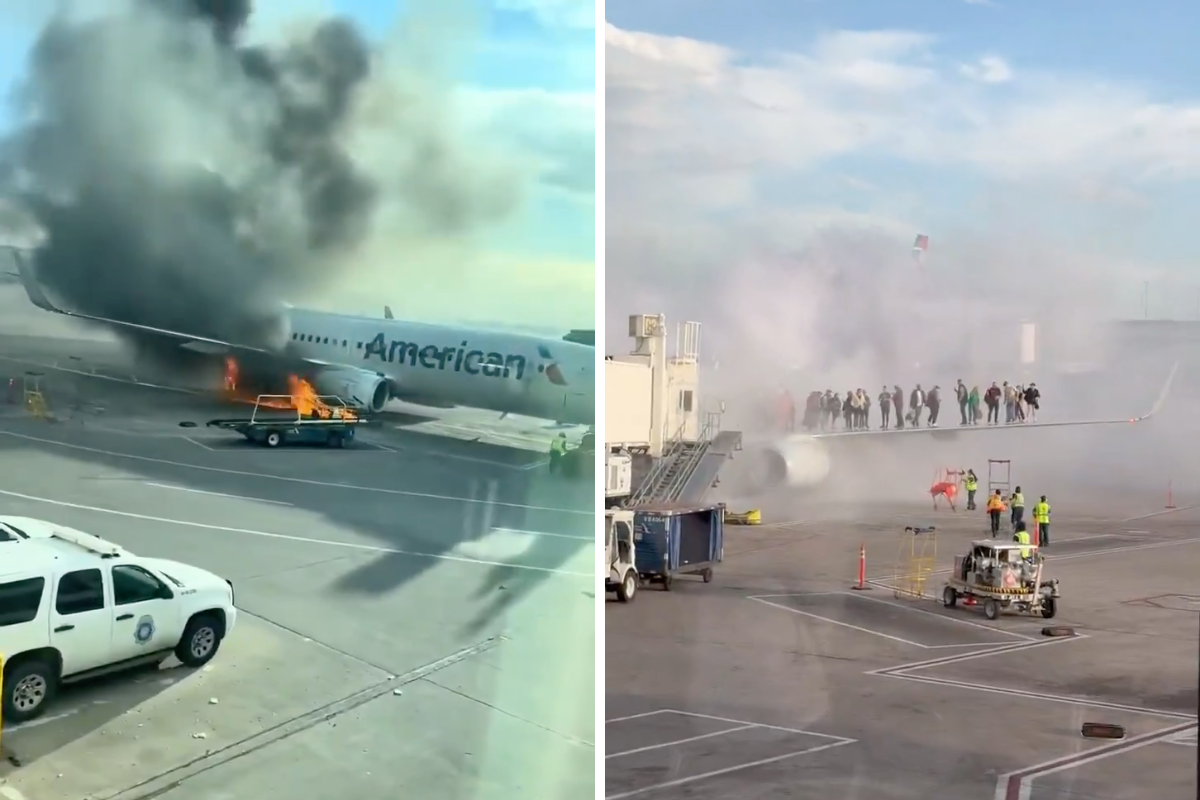
Sixteen passengers who were onboard an American Airlines Boeing 737 that suffered a serious engine fire after diverting to Denver International Airport in March are now suing the carrier for negligence and gross, extreme, and outrageous conduct.
The passengers were flying from Colorado Springs to Dallas-Fort Worth aboard American Airlines flight AA-1006 on March 13, 2025, but their journey was interrupted just minutes after takeoff when the pilots noticed engine vibrations and eventually decided to divert to Denver.
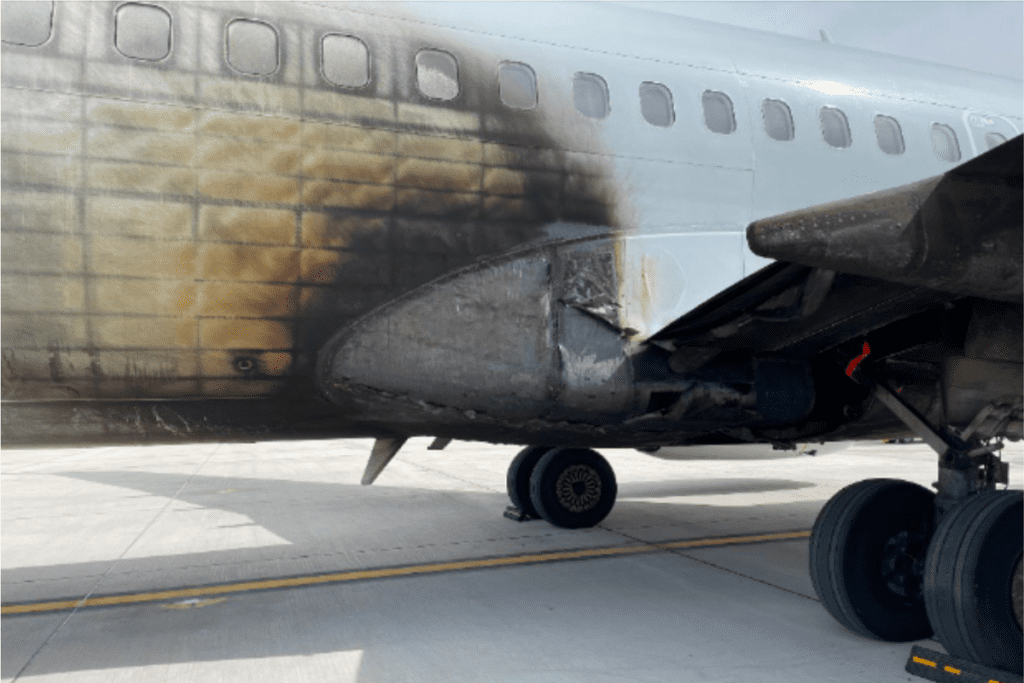
Upon landing in Denver, the 13-year-old plane started to taxi to the gate under its own power, but just as it reached its parking spot, the right-hand engine suddenly burst into flames with thick black smoke swirling around the aircraft.
Terrified passengers screamed that there was a fire, but after the flight attendants tried but failed to get in contact with the pilots, they self-initiated an emergency evacuation.
A 14 page complaint filed by 16 passengers who were on American Airlines flight 1006 describes the moment that people realized an engine had burst into flames
“After coming to a stop, panic ensued inside the cabin as the unaware passengers of flight 1006 noticed flames and smoke outside their windows.”
Dozens of passengers evacuated onto the wings but found themselves trapped as smoke continued to swirl around the plane. Six passengers had to be transported to the hospital due to injuries they sustained during the chaotic evacuation.
In a new lawsuit filed by 16 of the 175 passengers aboard flight 1006, including two children and a pregnant woman, in a Colorado district court, lawyers claim the plane should never have taken off in the first place after the pilots were alerted to an exhaust gas temperature warning in the right-hand engine.
After continuing with the takeoff roll, however, the pilots soon realised there were engine vibrations coming from the right-hand engine and decided to stop their initial climb at just 16,000 feet.
Rather than diverting back to Colorado Springs, the pilots decided to divert to Denver International Airport. The pilots decided not to declare an emergency and rejected an offer from air traffic control to have the airport fire service meet the plane on arrival in Denver.
Rather than stopping on the runway to have the aircraft checked over, the pilots then started to taxi to their assigned gate without any escort. During this time, fluid leaked out of the aircraft during the eight-minute taxi to the gate.
When the engine suddenly burst into flames, the pilots quickly declared a Mayday emergency as “panic ensued in the cabin.”
One of the flight attendants tried to call the pilots, while another knocked on the cockpit door to get their attention, and smoke started to fill the cabin.
The lawsuit describes how “passengers screamed, pushed, and jumped, desperate to escape the burning aircraft,” although their egress was hampered by a faulty emergency slide at the rear, left-hand door, which failed to deploy.
Desperate to get off, passengers started to evacuate via the opposite doorway, despite the fact that this was close to the fire. Others evacuated onto the left-hand wing only to then realize that the drop to the ground below was too high for them to safely jump.
A preliminary report into the incident released by the National Transportation Safety Board (NTSB) in June revealed that a maintenance error may have been the root cause of the engine vibrations and subsequent fire.
Several issues were identified by NTSB investigators, including:
- A small wire, which is meant to keep a fuel connection in place in one of the engines, was loose and put in the wrong way.
- A part known as the variable stator vane actuator, or VSV, was not properly attached, which could have allowed fuel to leak.
- And an engine drain pipe was clogged with a kind of glue or sealant.
The lawsuit accuses American Airlines of negligence, not only due to the apparent maintenance issues, but also over how the pilots handled the engine vibrations. Lawyers believe the pilots should have immediately declared an emergency, requested airport fire services, and diverted back to Colorado Springs, rather than Denver.
The passengers have not asked the court for a specific compensation amount but have asked for “an amount which will fully compensate them for all damages they have sustained to the full extent allowed by law, including, without limitation, economic, non-economic, and physical impairment and disfigurement damages as provided for under Colorado law as well as interest, costs, and such other relief as the Court deems just and appropriate.”
A scheduling conference is expected to take place on November 3.