



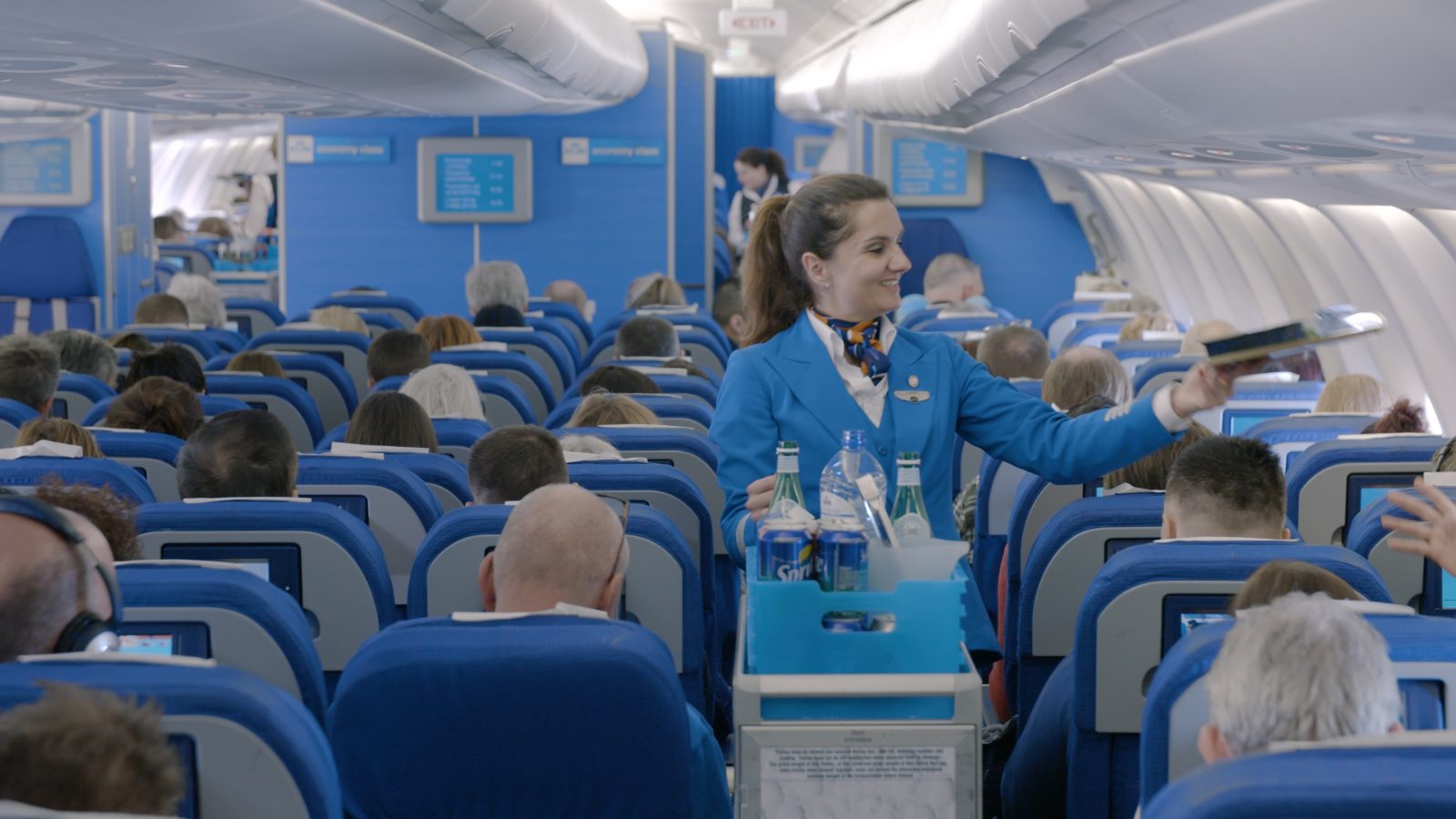
For a country that experiences 217 days of rain per year, accumulating between 30 and 35 inches of rainfall annually, the Netherlands is most definitely not short of water. But the Dutch flag carrier, KLM, is keen to get passengers to drink desalinated seawater, and it’s all in the name of sustainability.
Removing salt from the seawater to make it drinkable is, traditionally, an incredibly costly and energy-intensive process that relies upon fossil fuels and chemicals to get the water to a state that is considered ‘potable.’
That was, at least, the case until 2022, when two Dutch brothers created a small solar-powered desalination plant on the country’s coast. Their brainwave for the idea came a few years earlier.
Back in 2018, the brothers Tammo and Jort Wildschut were on vacation in Cape Town as the city experienced its worst drought in many years. While surfing in the Atlantic Ocean, the brothers pondered the paradox of a city surrounded by water, yet with nothing to drink.
Desalination is, of course, nothing new. It is widely used in the Middle East to produce potable water and is, in fact, the main source of drinkable water in many Persian Gulf countries.
The process of desalination through reverse osmosis is, however, incredibly costly. This is a necessary expense in places like Qatar, which also has the wealth to build, maintain, and run its desalination plants.
That’s not, however, the case in countries like South Africa and many drought-stricken countries.
Tammo and Jort had a simple idea…. make desalination more widely available with cheaper solar-powered plants. To prove their concept, they created their own bottled water company called, rather appropriately, SEA Water.
Based locally in the Netherlands, the SEA Water plants use 100% renewable energy, and it’s claimed, the process is 75% more energy efficient than the traditional desalination process.
SEA Water is available in supplied in cans and recyclable glass bottles, and is available in leading supermarkets across the Netherlands and a growing number of restaurants and cafes.
It stands to reason, then, that KLM Royal Dutch Airlines might want to get in on the action, upsetting a longtime partnership with the local mineral water company SPA Reine.
If this all sounds a little weird to you, however, you can at least rest assured that KLM is currently only testing the concept on some flights operated by its regional KLM CityHopper subsidiary.
And besides, it’s not only KLM that serves desalinated seawater to passengers to drink. For decades, Emirates has served the famous, or perhaps infamous, Mai Dubai bottled water, which is made from desalinated seawater that has been filtered and remineralised to improve the taste.


I’m and ex-Pat (former American) and have lived in the Netherlands since 2008.
I know of these brothers and their technology, but have never seen this bottled water here. I’m sure it exists but have not seen it on the shelves.