



An airline passenger suffered head injuries when he fell from an unsecured set of airstairs and is still receiving hospital treatment nearly a year after the incident, when a flight attendant who was battling personal problems forgot to secure a handrail on the stairs.
Despite the flight attendant’s mistake, accident investigators found that a safety system designed to keep the handrail in place was poorly designed and had not been changed despite several similar incidents on the same aircraft model.
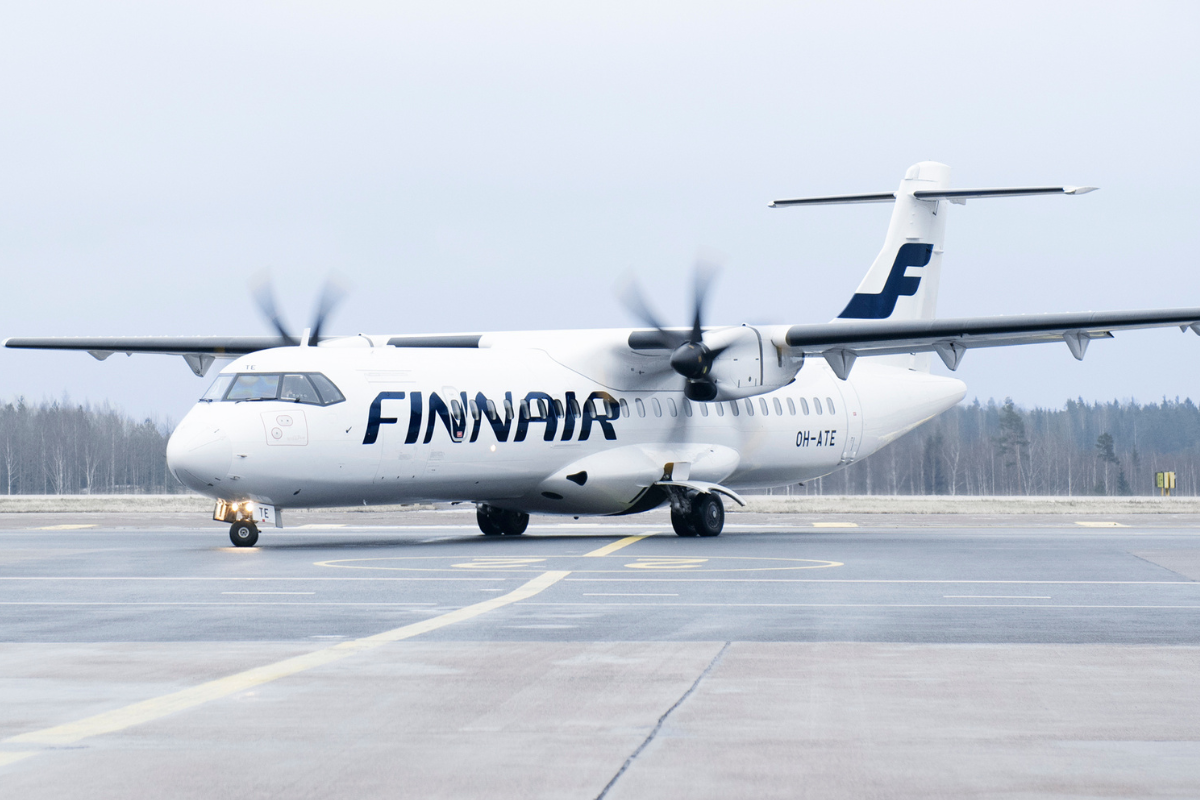
The incident occurred on November 12, 2024, a short time after a regional turboprop aircraft operated by Nordic Regional Airlines (commonly known as Norra) on behalf of Finnair had landed at Helsinki from Kuusamo.
The ATR-72 aircraft has its own passenger steps built into the rear left-hand door, so when the plane parks at a remote gate, passengers can quickly deplane onto the tarmac and board buses that will whisk them to the terminal building.
The passenger steps are fairly unique in that one side has a fixed handrail, whereas the other side has a collapsible handrail that has to be lifted and locked into place with a safety locking pin.
Attached to the locking pin is a red lanyard that should indicate whether the handrail is locked in the upright position.
After Finnair flight AY-482 had landed at Helsinki-Vantaa Airport, the purser opened the rear door to start deplaning, and the right-hand handrail was already in the open position.
Passengers started using the steps and boarded a waiting bus. Everything seemed normal until the very last passenger started to deplane. Weighed down by a suitcase and a canvas bag in one hand, and a handbag in the other hand, he grabbed the right-hand handrail to steady himself as he walked down the steps.
As he stepped down, the handrail suddenly collapsed, and he tumbled off the stairs and onto the hard tarmac below, smashing his head on the ground and causing serious injuries.
The purser quickly alerted the pilots, who, in turn, radioed the control tower for emergency medical assistance.
When an ambulance arrived, nearly 30 minutes later, he was rushed to the nearest hospital and admitted for two days. Treatment has, however, continued throughout 2025.
Accident investigators were called in to get to the bottom of what happened, and they soon discovered that there had been several other similar incidents involving this aircraft model’s in-built airstairs, including two recent near-miss accidents at the same airline.
Despite these narrowly avoided accidents, Norra didn’t implement any major changes until a passenger suffered a serious injury.
Investigators believe that the safety pin design on the airstairs is flawed because the two holes – one for locking upright on the ground, and one for locking collapsed during flight – were right next to one another.
As a result, flight attendants who visually check to make sure the locking pin is in the correct position could easily mistake which hole the locking pin was in.
In this particular incident, there were, however, other factors involved. The purser who opened the door admitted that she had been dealing with personal problems, and accident investigators suspect this could have impacted her performance.
Investigators didn’t, though, paint this as a criticism of the crew member. In fact, it should be recognized that human beings are fallible and prone to making mistakes, and that’s why safety systems should be designed to take into account human performance.
In the wake of the accident, Norra implemented a ‘cross-check’ system just like flight attendants commonly perform when they arm and disarm the emergency slides.
Accident investigators have also called on the aircraft manufacturer to redesign the locking pin system to make it clearer whether the safety pin is in the correct hole.
Matt’s take
This is the worst kind of mistake for any flight attendant, although most crew members fear ‘popping’ a slide by forgetting to disarm the emergency slide before opening a door.
It’s not just an embarrassing mistake that a flight attendant would struggle to ever live down, but also a costly one that could not put lives at serious risk.
An emergency slide activating at the wrong moment could hit ground employees going about their work on the ground, or explode into a jetbridge where workers are waiting to meet the aircraft.
Despite various cross-check protocols used by different airlines around the world, mistakes do still occasionally happen. That’s why some airlines ban flight attendants from opening doors and leave that to ground staff. Why? Because when most aircraft doors are opened from the outside, a slide that hasn’t been corrected disarmed will automatically disarm.


Why did it take 30 minutes for EMS to arrive?
As an aside, I wouldn’t describe deplaning by stairs and boarding buses to the terminal as being “whisked.”