



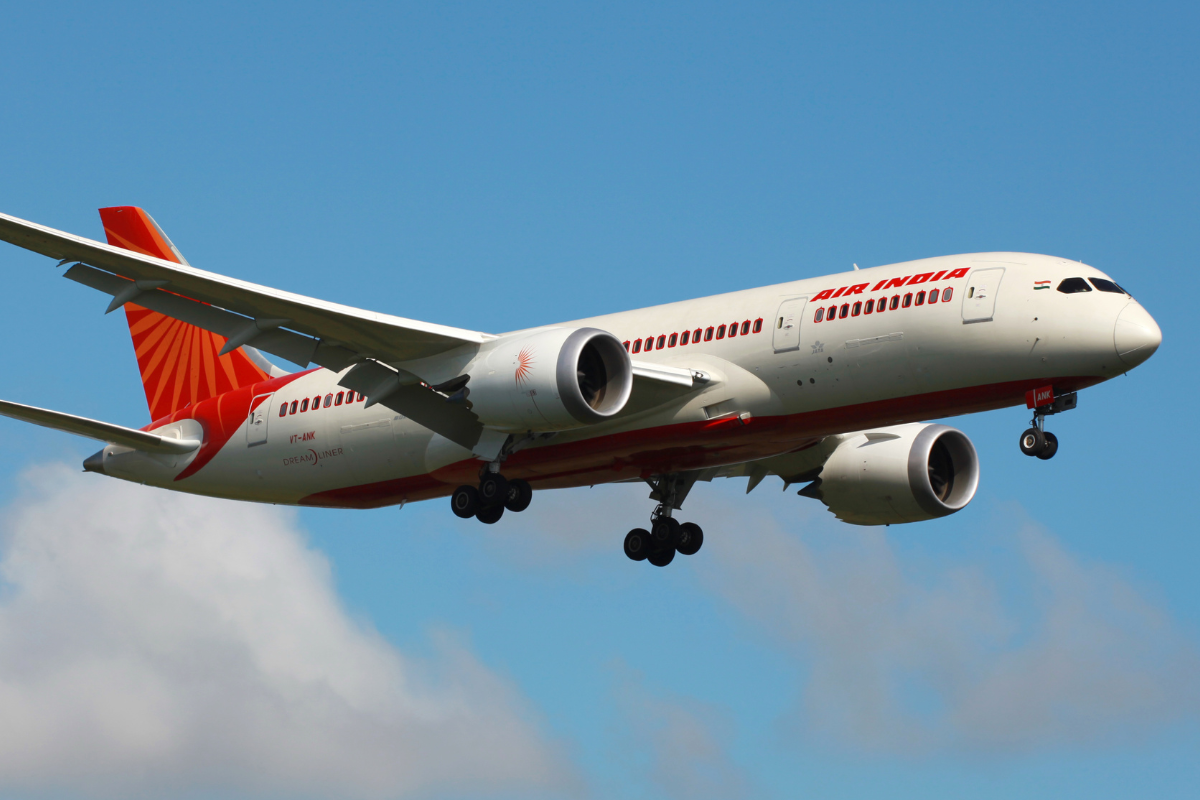
The pilots of an Air India Boeing 787-8 Dreamliner flying from Vienna, Austria, to New Delhi were forced to make an emergency diversion to Dubai after the autopilot started to go ‘haywire.’
The 11-year-old aircraft was flying at 39,000 feet, high above the Persian Gulf on October 9, when the plane started to unexpectedly started to “deviate from its assigned flight level,” according to a report in the Aviation Herald.

The aircraft first climbed to 39,100 feet before dropping down to 39,000 feet, which was the altitude the pilots had programmed into the autopilot for the aircraft to fly at.
Moments later, however, the aircraft then climbed 39,125 feet of its own accord. At the same time, the pilots were alerted to a slew of computer malfunctions, including the autopilot, autothrust, flight director, and autoland systems.
According to the Aviation Herald, the pilots managed to restore function to one of the autopilot systems but decided to handfly the aircraft, diverting to Dubai, where the plane landed safely nearly an hour later.
Although relatively unusual in itself, any problems with Air India’s fleet of Boeing 787-8 Dreamliners garner even more attention given the tragic loss of Air India flight AI-171 in June, which killed all but one of the 242 passengers and crew onboard.
The crash, the first fatal hull loss of a Boeing 787 Dreamliner, occurred just moments after takeoff from Ahmedabad on June 12, after the power to both engines was suddenly cut as the plane was in its initial ascent.
Power to both engines was restored seconds later, but it was already too late, and the plane plunged into a building housing medical students and hospital staff.
Accident investigators have released few details in their preliminary report, although attention has turned to the two fuel cut-off switches located in the cockpit. A leading theory behind the cause of the crash is that one of the pilots deliberately cut the power to the engines.
India’s largest association of pilots, however, has suggested that flight AI-171 may have crashed due to an electrical problem or maintenance issue.
Earlier this month, the Federation of Indian Pilots called for all Boeing 787 Dreamliners in India to be grounded pending further checks after an emergency power system on another of Air India’s 787-8s activated without warning during the final moments of a flight to Birmingham, England.
In that incident, the so-called RAT (RAM Air Turbine) deployed without warning. The RAT is a small propeller-driven turbine that pops out of the bottom of an airplane’s fuselage in the event of a serious electrical failure to provide the aircraft with an emergency supply of power.
The flight that diverted to Dubai to cleared to return to the skies just three hours after landing, while the 787-8 that landed in Birmingham with its RAT deployed remained on the ground for a longer period while engineers thoroughly checked the plane.
Unfortunately, modern aircraft can experience computer malfunctions, although there are various backup systems and failsafes to keep passengers safe.
Last September, a United Airlines Boeing 787 Dreamliner, which was just about to cross the Atlantic Ocean, was forced to make an emergency landing after the cockpit computer displays suddenly went blank and the flight management system entered a ‘degraded mode.’
At the time of the incident, the plane at flying at 35,000 feet in a remote region over Hudson Bay when the cockpit computer display on the Captain’s side of the plane suddenly went blank.
At the same time, both flight management computers entered an emergency degraded mode, which limited the capabilities of the aircraft, including taking lateral navigation out of action.


Air India has a horrific 787 crash because the fuel cutoff switches had an “un-commanded” movement to the “CUTOFF” position.. Air India has an un-commanded 787 RAT deployment. Air India 787 has an autopilot go bonkers. It sounds to me like Air India has the problem, not the planes!
“Last September, a United Airlines Boeing 787 Dreamliner, which was just about to cross the Atlantic Ocean, was forced to make an emergency landing after the cockpit computer displays suddenly went blank and the flight management system entered a ‘degraded mode.’”