



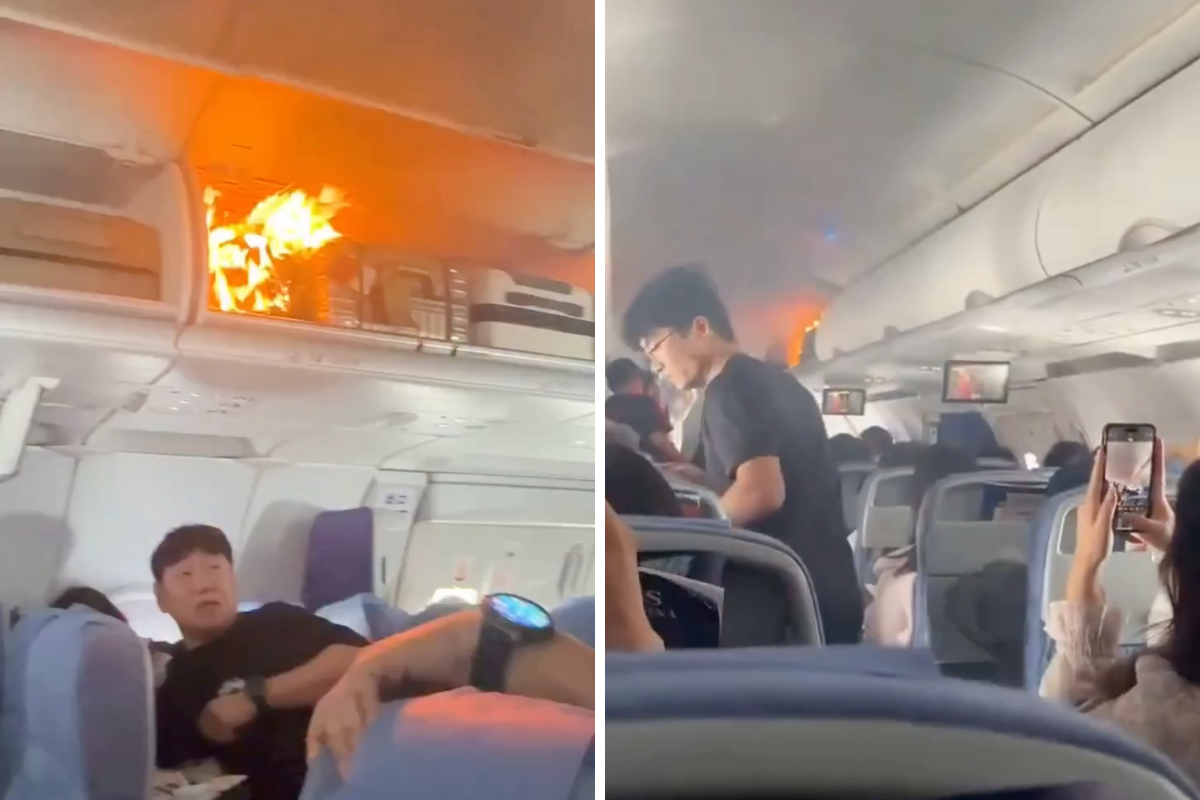
In the latest of a recent string of scary mid-flight fires, an Air China flight was forced to make an emergency diversion on Saturday morning after a passenger’s lithium battery erupted into flames after suffering a so-called ‘thermal runaway’ while stored in the overhead bin.
Flight Details
- Air China flight CA-139 (October 18, 2025)
- Route: Hangzhou (HGH) to Seoul Incheon (ICN)
- Aircraft: Airbus A321
- Registration: B-8583
Passengers onboard flight CA-139 from Hangzhou (HGH) to Seoul Incheon (ICN) on October 18 looked on in terror as the bright flames from the overhead bin lit up the cabin of the Airbus A321 aircraft.
Cabin crew rushed to douse the fire with water as the pilots quickly started a descent from a cruising altitude of 33,000 feet and diverted the aircraft to Shanghai (PVG), where airport fire services were waiting to meet the aircraft.
Video shared on social media showed the moment that passengers realized just how serious the situation was, and the moments that flight attendants turned into firefighters to contain the fire before it spread any further.
Local media reports that the fire was caused by a lithium battery, which powers common everyday items like mobile phones, tablets, and laptop computers. Lithium batteries are also used in portable power banks.
In the last 12 months, the aviation industry has become increasingly concerned about the risk posed by lithium batteries and, in particular, portable power banks, due to the risk of them heating and starting a chain of events called ‘thermal runaway.’
What is thermal runaway?
Lithium batteries are made up of many fuel cells, and if the battery is damaged or accidentally overheats, it can cause one of these fuel cells to start emitting smoke and eventually catch fire.
When one cell overheats, it can then cause a chain reaction in which the fire spreads from one cell to the next in quick succession. This is called ‘thermal runaway’ because once this process starts, it is very hard to make it stop.
When thermal runaway occurs, a lithium battery can become incredibly hot, emitting a large amount of smoke and fire, which can pose a serious risk in the confined environment of an airplane cabin.
The incident that changed it all
Lithium battery fires have been a cause for concern within the airline industry for many years, but in the last 12 months, the number of incidents has risen considerably.
While airlines had emergency procedures in place to deal with in-flight fires, some carriers started to take the risk a lot more seriously following an onboard fire that occurred on an Air Busan flight in South Korea in January.
In that incident, a passenger’s lithium battery overheated and caught fire in the overhead locker. No one initially noticed because the overhead bin was closed, allowing the flames to quickly spread and become uncontrollable.
Thankfully, disaster was averted as the plane was still on the ground and everyone was able to evacuate via the emergency slides. The aircraft was, however, completely destroyed by the fire, and several passengers sustained minor injuries during the evacuation.
In the wake of the Air Busan incident, some airlines toughened up their lithium battery rules, especially portable power banks, which are more prone to overheating than other devices.
Emirates has one of the toughest portable charger rules in the world
Earlier this month, mega carrier Emirates introduced some of the toughest portable power bank rules of any airline in the world in response to the growing threat of in-flight fires.
The airline’s new rules include:
- Only one portable power bank is allowed per passenger
- Power banks cannot be used or charged on board any Emirates plane
- They must also not be stored in an overhead locker.
- Power banks must remain accessible throughout the flight, just in case they overheat.
Other airlines have introduced similar rules, first in Asia but now further afield, with airlines such as Lufthansa, WestJet, Qatar Airways, and Southwest Airlines all restricting the use of power banks on their flights.
What does the aviation industry say about lithium batteries?
While individual airlines are introducing their own restrictions on the use of power banks, the aviation industry at a global level has taken a lot longer to respond to the threat posed by a mid-flight lithium battery fire.
The International Air Transportation Association (IATA) sets minimum rules for the vast majority of airlines around the world, and this currently only bans passengers from checking in any lithium batteries into their checked luggage.
This rule has been in place for some time, as a lithium battery fire in the cargo hold would be a lot harder to contain.
How do flight attendants contain an onboard battery fire?
Flight attendants are required to undergo so-called recurrent training every year, in which they practice emergency drills like firefighting. This can cover all sorts of fire events, such as a galley oven catching fire or a discarded cigarette causing a bin fire in a lavatory.
More recently, however, airlines have been really concentrating on methods to control a lithium battery fire in the air. Some airlines are equipped with special fire containment bags for lithium battery fires, while others teach crew to douse and submerge overheating batteries in water or any other non-flammable liquid they have at hand – including fruit juice.


Didn’t realize the Air Busan incident destroyed the aircraft. Would have thought the overhead bin materials aren’t flammable and the flames would be starved of oxygen in that case.