



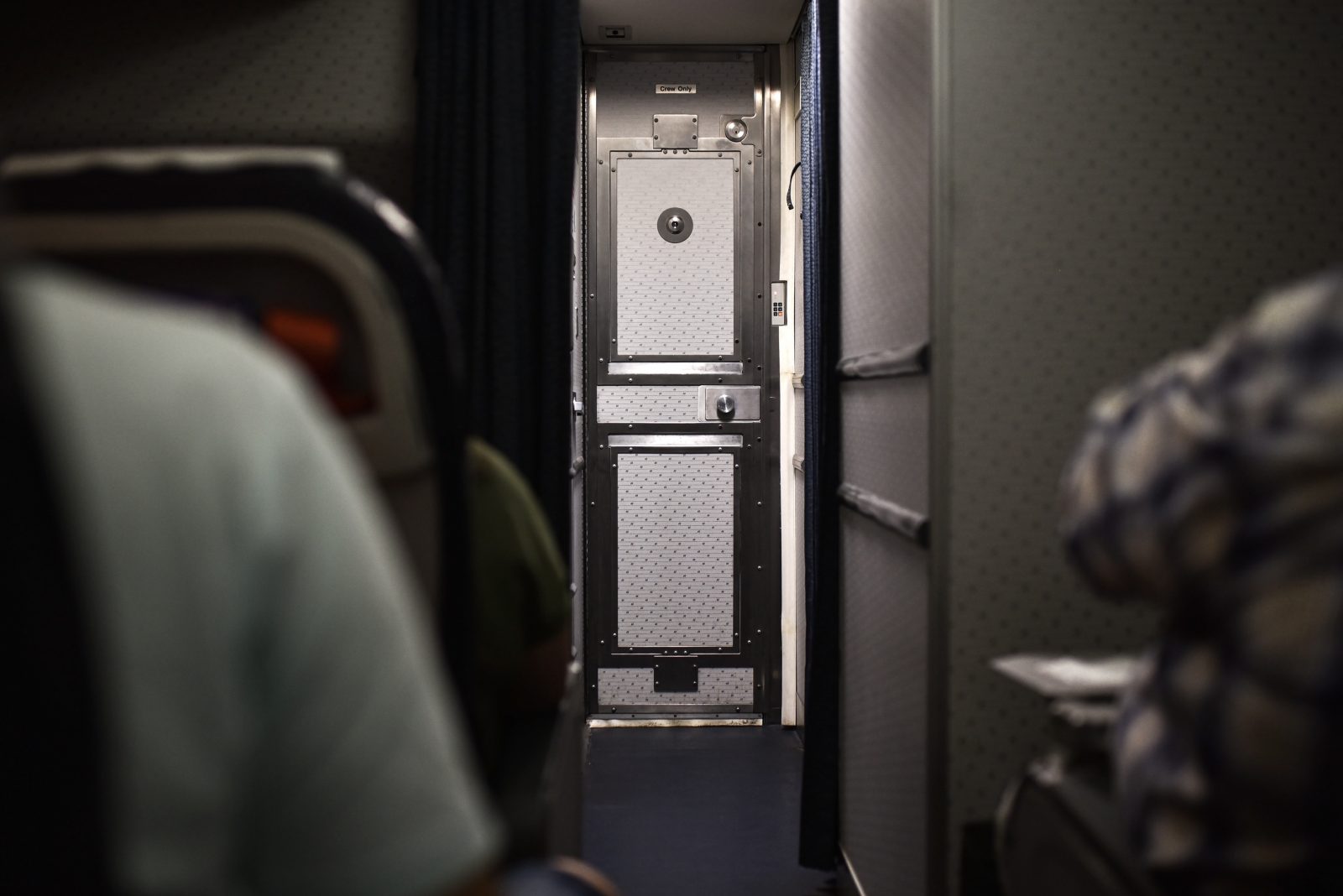
The pilots of an American Airlines regional jet flying between Omaha and Los Angeles mistook the noise of static from a faulty cabin telephone for someone trying to break into the cockpit.
The mistake resulted in a full-scale emergency as the pilots diverted straight back to Omaha, fearing that the cockpit could be breached by a violent assailant.
Flight Details
- Flight: AA-6469
- Route: Omaha (OMA) to Los Angeles (LAX)
- Aircraft: Embraer E175
- Registration: N510SY
The incident occurred at around 6:40 pm on October 21, just minutes after American Airlines flight AA-6469, operated by regional partner SkyWest, departed Omaha Airport.
The plane, an Embraer E175 regional jet, was still in its initial ascent and had climbed to around 8,000 feet, when the pilots heard what they thought was banging on the cockpit door.
How airlines grade passenger threats
Internationally, airlines grade the potential threat posed by passengers in the same way to ensure that this information is universally understood – from flight attendants and pilots, to air traffic controllers and law enforcement.
There are four threat levels:
- Level 1 – Disruptive Behavior: The passenger is being verbally disruptive or unruly, such as swearing or verbally threatening crew members, or refusing to comply with lawful instructions.
- Level 2 – Physically Abusive Behavior: At this point, the passenger is physically abusing crew members or other passengers. Behavior such as kicking, hitting, or spitting could fall into this category.
- Level 3 – Life Threatening Behavior: The passenger’s behavior has become so violent that they could cause serious injury to a crew member or seatmate. The use or threat of a weapon instantly makes a situation a Level 3 incident.
- Level 4 – Actual or Attempted Breach of Cockpit: This is the most serious grade of threat and covers everything from someone actually breaching the security of the cockpit or threatening to do so.
Data captured by the flight tracking website Flight Radar 24 shows the moment that the pilots suddenly performed a u-turn and immediately started heading back to Omaha, getting priority clearance to land after the onboard emergency had been declared.
Passengers and even the flight attendants remained in the dark until the plane got on the ground and was immediately sent to the penalty box, where airport emergency vehicles raced to meet it.
It was only at this point that the pilots realized what had actually happened – rather than a terrorist or unruly passengers trying to breach the cockpit, there was a far more innocent explanation for the noise that the crew had heard.
During takeoff, it appears that the intercom system (an internal telephone system between the cockpit and flight attendant seats in the cabin) had either malfunctioned or had been accidentally left on.
As the aircraft took off, a static noise started to blow through the intercom system in the cockpit, and the pilots mistook this for the sound of knocking.
Whether the intercom was faulty or had been accidentally left on an open line remains unclear. Presumably, either way, the pilots were unable to get in contact with the flight attendants, and this heightened their fears that something terribly wrong was taking place in the cabin.
Thankfully, the mistake was quickly identified as a false alarm, and the aircraft was eventually cleared to complete the flight, although with a delay of more than four hours.