



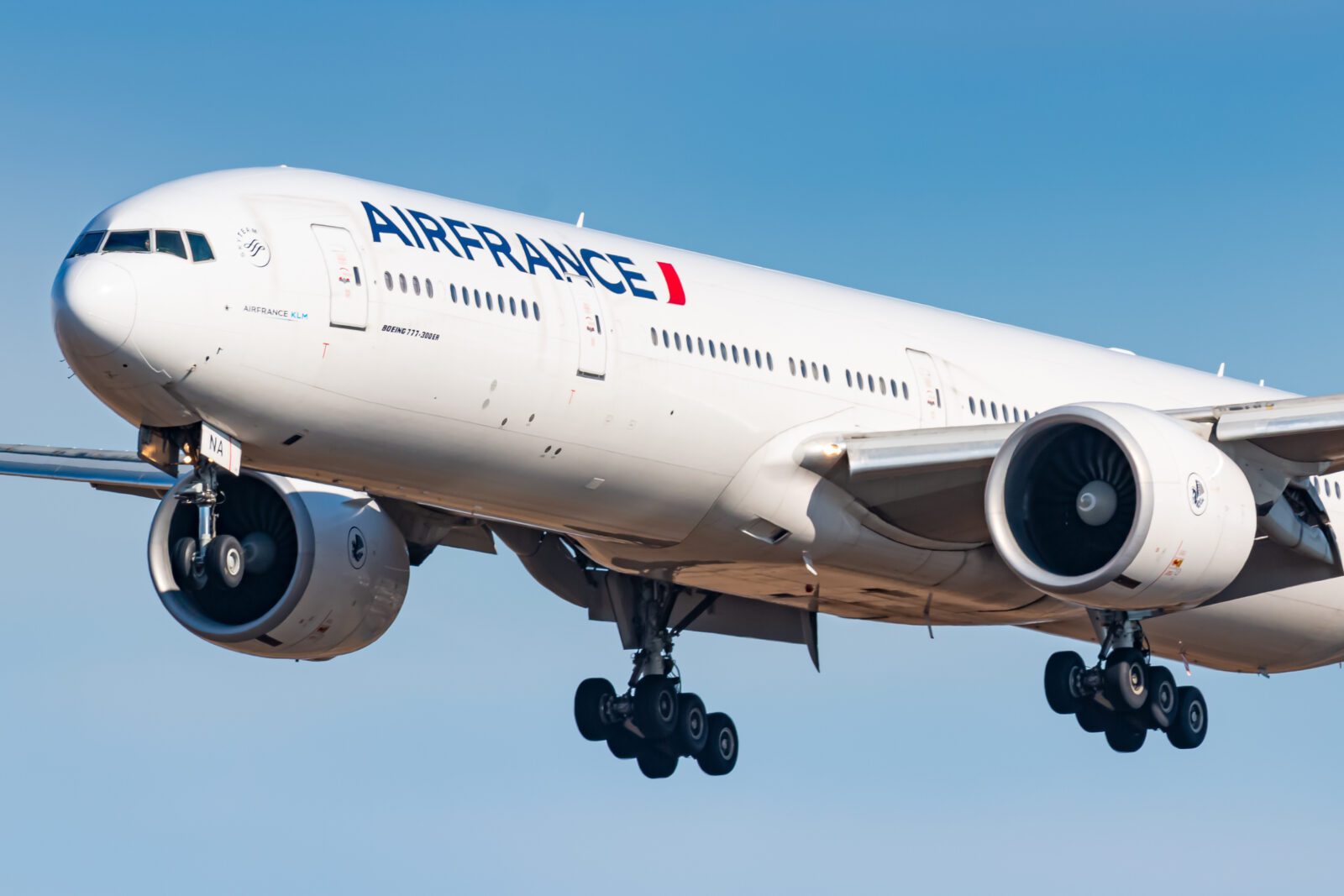
The pilots of an Air France flight from Paris Charles de Gaulle to the French island of Réunion in the Indian Ocean were forced to make an emergency landing after passengers started to suffer as the cabin became unbearably and uncontrollably hot.
The Boeing 777 widebody aircraft had been in the air for less than an hour when the pilots alerted air traffic controllers that they needed to return to Paris because of the sweltering conditions in the cabin, although what started off as an inconvenience soon turned into a full-blown emergency.
Air France flight AF-652 departed Paris at around 30 minutes later at 6 pm on October 24 for what should have been a routine eleven-hour flight to Saint Denis on Réunion.
The flight was being operated by a 16-year-old Boeing 777-300, which was delivered factory-fresh to Air France in June 2009. The aircraft is configured for leisure routes with a massive Economy Class cabin comprising 430 seats, with just 28 Premium Economy and 14 Business Class seats.
Data supplied by flight tracking website Flight Radar 24 shows the aircraft climbing to 31,000 feet after departing Charles de Gaulle Airport on Friday evening as it headed southeast towards Switzerland.
But the Aviation Herald reports that as the plane came within 50 nautical miles of Zurich, the pilots told air traffic control they needed to return to Paris because the heat in the cabin was becoming unbearably hot and, no matter what they did, they couldn’t get it to cool down.
The pilots initially declared a ‘pan pan’, which signifies that there is a safety issue or mechanical issue, but that the situation isn’t an emergency or immediately life-threatening.
Because the aircraft was loaded with enough fuel for its long-haul flight to the Indian Ocean, the pilots then decided they would need to jettison some fuel to lower the landing weight of the plane for its arrival back in Paris.
At that point, air traffic control advised the pilots they would only be allowed to dump fuel over France if they upgraded their distress call to a ‘Mayday’, which signifies a life-threatening emergency.
This sounds like the Mayday call was very much the pilots being required to comply with French procedures, and the plane landed safely back in Paris less than two hours after departure.
At this point, the passengers were able to deplane in the climate-controlled bliss of the terminal. In fact, they ended up with plenty of time to cool down as Air France scrabbled to find a replacement plane, eventually sourcing a different Boeing 777-300, which took off seven hours after the original scheduled departure time.
Matt’s Take – Cabin temperatures can be tricky to manage
Getting the right cabin temperature that pleases everyone can be a real mission for flight attendants, even when airlines have set guidelines that are meant to ensure the temperature is set just to the right level for the time of day (slightly cooler during a night flight to aid restful sleep).
But there can be variations depending on where in the world your airline of choice of based – North American carriers skew towards the cooler side, whereas Asian airlines generally opt for a warmer cabin environment, even at night.
If you were to apply the Goldilocks Principle, then European and Middle Eastern carriers generally get the cabin temperature just right – around 70°F to 72°F (21°C to 22°C).
But temperature guidelines are sometimes of little use when certain planes seem to have a mind of their own. One end of the cabin can feel like the Antarctic, while a few steps back feels like a Sahara desert. This is often a result of how the airflow works on some planes, especially in cabins with complicated layouts and multiple bulkheads.
In this case, it seems as if an air conditioning system malfunctioned and wouldn’t stop producing heat no matter what the flight attendants or pilots input into the system.