



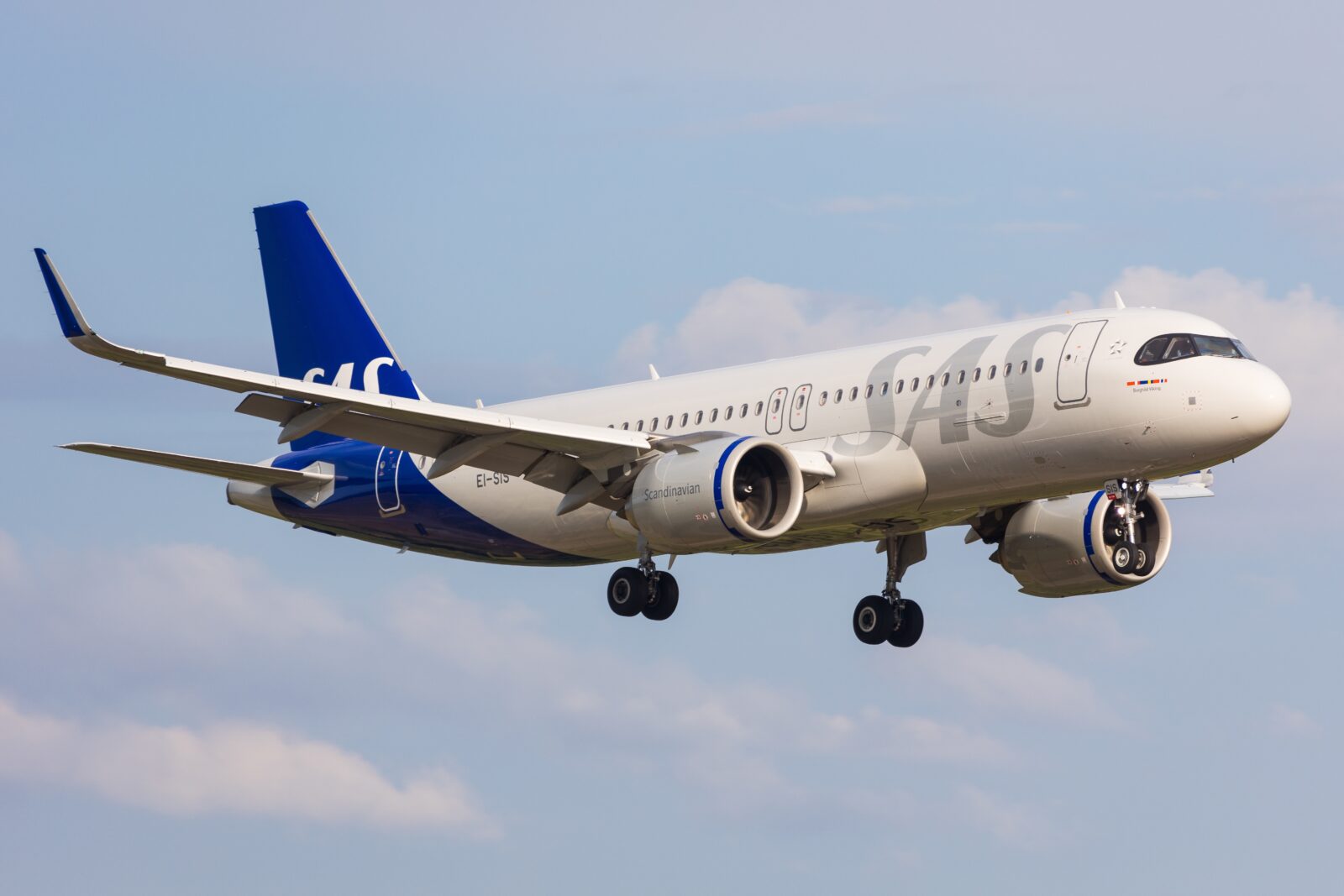
Eight people had to be rushed to the hospital after a portable battery pack burst into flames in a passenger’s bag at Oslo Airport and filled the cabin with toxic smoke – the latest in a series of worrying incidents involving lithium batteries in airplane cabins.
The incident occurred back on October 14, but has only now come to light after Norway’s Accident Investigation Board opened an investigation into the incident.
The fire broke out as passengers were still boarding an almost brand-new Airbus A320 aircraft operated by the Scandinavian airline SAS at Norway’s Oslo Airport for what should have been a routine 40-minute flight to Bergen.
Around 50 travelers had already boarded the plane when smoke started to pour out of passengers’ cases.
The cabin crew immediately jumped into action, ordering the passengers off the aircraft as they put on special breathing apparatus known as ‘smoke hoods’ so they could fight the fire without inhaling any of the toxic smoke that was filling the cabin.
The crew used a Halon fire extinguisher on the suitcase and managed to get it out of the aircraft cabin and onto the tarmac, where the airport fire brigade was already waiting.
Once in the open air, however, the fire erupted again before it was successfully contained.
In a statement, accident investigators said that eight people had to be taken to the hospital with suspected toxic smoke inhalation, and several were kept in overnight for observation. All of those taken to the hospital were, however, discharged within 48 hours.
Why are airlines still allowed to use Halon extinguishers?
Originally developed in the 1940s, Halon became an incredibly widespread firefighting tool in the aviation industry as it was highly effective on a wide range of fires, was safe to use on electrical fires, could be used in confined spaces, and was both compact and lightweight.
Unfortunately, Halon is incredibly bad for the Ozone layer, and its production has been banned in developed countries since the 1990s. Despite the production ban, many airlines are, however, allowed to use Halon extinguishers from existing stocks.
The European Union plans to completely phase out Halon fire extinguishers in aircraft cabins by the end of 2025, although there are now Halon-free extinguishers with work in a similar way.
Why are lithium batteries so concerning for the aviation industry?
Any device powered by a lithium battery, be it a cellphone, laptop, e-cigarette, or power bank, has the potential to overheat and catch fire.
Lithium batteries are made of lots of fuel cells, and when one fuel cell overheats, it can lead to a chain reaction in which cell after cell quickly overheats – this is known as ‘thermal runaway.’
Thermal runaway is incredibly dangerous as it is not only very hard to put out the fierce fires that this can create, but because it also emits a lot of toxic smoke.
Airlines have witnessed a spike in lithium battery thermal runaways in recent years, including the complete loss of an Air Busan Airbus A320 in South Korea in January, when a battery pack overheated and caught fire during boarding.
What action is the airline industry taking to combat the risk of lithium battery fires?
The aviation industry has long banned passengers from packing lithium batteries in checked luggage, as it is much more difficult to contain a fire that breaks out in the cargo hold of a plane.
At an international level, the industry is yet to adopt more stringent rules on the carriage of lithium batteries, but individual airlines are introducing their own enhanced rules.
Emirates, for example, bans passengers from bringing more than one power bank on board. Their sole battery pack must not be hidden away in a bag, and it cannot be used to charge another device during the course of a flight.


Hi Mateusz. Thanks for sharing! Please take a look at the UL5800 standard which guarantees complete containment for 6 hours. The airlines are ignoring this and are extremely under equipped with inadequate solutions. The FAA has tested these containment devices and they have failed miserably. Please send me an email and I can share all of this with you.
More than 100 airline companies worldwide now carry around 17,000 AvSax lithium battery fire mitigation bags on board to deal with these emergencies quickly, stifling the fire and toxic smoke.
The AvSax won the Queen’s Award for Enterprise in the UK for its innovation – the highest accolade any business can achieve – and every time an AvSax has been deployed the aircraft has been able to continue to its final destination, saving the need for costly and highly disruptive diversions and emergency landings.