



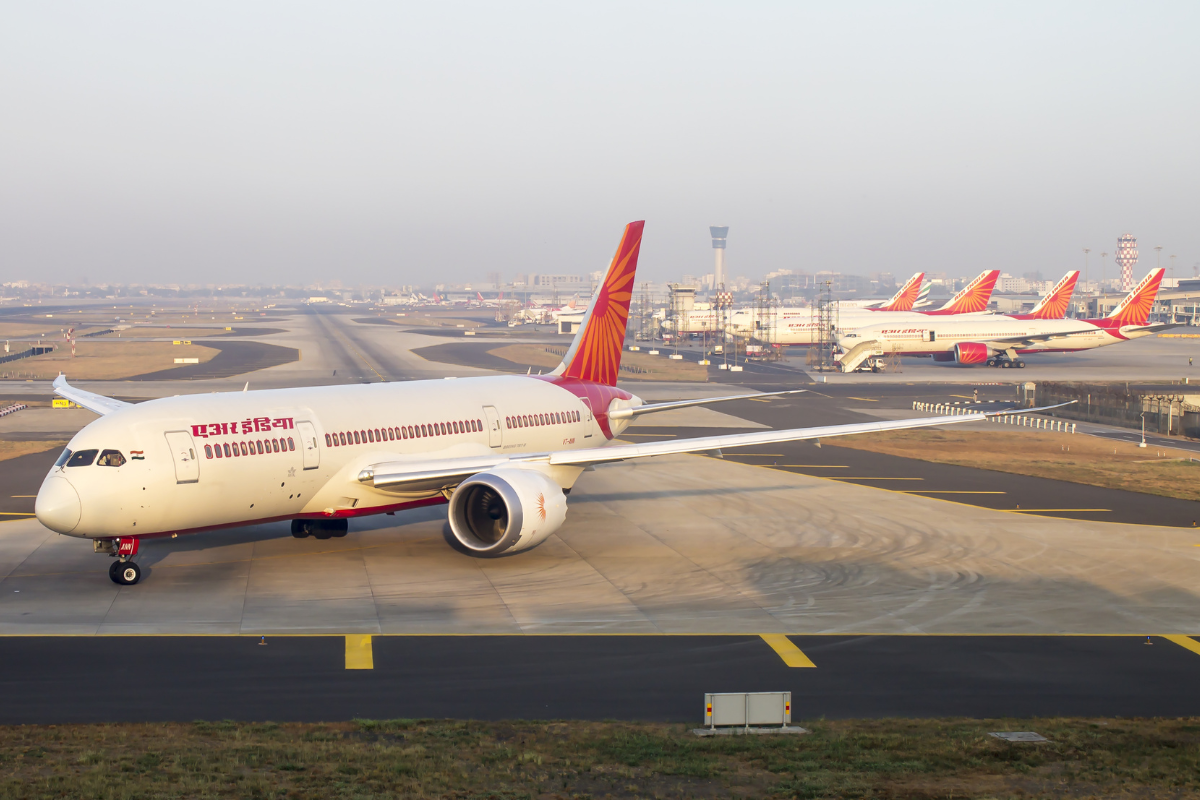
Air India has been forced to ground several aircraft for emergency engineering checks after they flew through areas affected by a giant ash cloud produced by the Hayli Gubbi shield volcano in Ethiopia.
The airline said it had been forced to cancel 11 flights on Monday and Tuesday due to the continuing checks, including long-haul departures from Newark and New York JFK to Delhi.
The Hayli Gubbi volcano erupted on Saturday morning – the first known eruption in at least 10,000 years. Ash plumes were sent high into the atmosphere and have been sent towards India by the prevailing winds.
Following the eruption, Air India said it had been closely monitoring the situation but did not immediately anticipate any impact on its schedule.
Volcanic ash can be very dangerous to aircraft engines, not only because the material is very abrasive and could damage the inner workings of the engines, but also because it could also melt inside the engines and cause them to stall at high altitude.
Ash from the Hayli Gubbi eruption has, so far at least, had a very limited impact on the airline industry – unlike the infamous Eyjafjallajökull volcanic eruption in Iceland in 2010.
A giant plume of ash from Eyjafjallajökull rose to around 30,000 feet and was slowly carried across Europe by the wind. At the time, the airline industry had a zero-tolerance approach to the risk posed by volcanic ash.
For nearly six days, European airspace was effectively closed down, leaving millions of passengers stranded around the world, as airlines cancelled a staggering 100,000 flights.
Willie Walsh, the then chief executive of British Airways, was so frustrated by the closure that he arranged for a Boeing 747 with no passengers on board to be deliberately flown through an ash cloud area over the North Sea to prove that it was safe to resume flights.
Once the plane was safely back on the ground, engineers found no evidence of ash ingestion in the engines, pushing regulators to allow flights to resume.