



Last October, American Airlines was slapped with a massive $50 million fine for repeated and serious violations of disability rights laws. On Tuesday, the Fort Worth-based carrier was told that it would no longer have to pay the remaining $16.1 million of that civil penalty to the U.S. Treasury.
The airline did not, however, escape completely scot-free under the watch of President Trump’s Department of Transportation (DOT). Instead, American Airlines now has a multi-million-dollar shopping list of equipment it needs to buy to improve its handling of wheelchairs and mobility scooters.
DOT says amended consent order is better for disabled passengers
When American Airlines was issued the record-breaking civil penalty late last year, the DOT was sending a very clear message. As the then Transportation Secretary Pete Buttigieg summed it up: “The era of tolerating poor treatment of airline passengers with disabilities is over.”
But at twenty-five times the size of the DOT’s previous biggest penalty served on a carrier for violations of disability rights laws, American Airlines had already been given a hefty discount on the sticker price.
American Airlines was required to pay just half of the $50 million fine, with $25 million credited for investments the carrier had already made to improve its wheelchair handling services.
As of today, AA has only paid $8.3 million to the U.S. Treasury, and the carrier has now been told it won’t have to pay a cent more.
Instead, the DOT says in a reworked consent order that it is restructuring the fine in a way that “improves the travel experience of passengers who use wheelchairs by requiring American Airlines to make investments in handling wheelchairs and encouraging the carrier to provide direct compensation to affected passengers.”
The $16 Million ‘Shopping List’ to Improve Wheelchair Service
So what does that mean exactly? Rather than paying any more money to the U.S. Treasury, American Airlines has instead had a shopping list drawn up to buy equipment to improve its handling of wheelchairs and mobility devices.
- $5.3 million will be spent on 119 lifts to safely transport wheelchairs between the airbridge and the tarmac in Philadelphia, Miami, and Chicago O’Hare.
- $10.6 million will go towards buying mobile devices and making software enhancements that will allow the airline to track wheelchairs from point to point.
- $300,000 will buy 23 wheelchair movers to help ground staff safely transport heavy mobility devices to and from the aircraft.
Disabled passengers will, however, have to wait quite a bit of time before these improvements are implemented. The new software, for example, doesn’t have to be up and running until May 2027, while it could be another 12 months before the wheelchair movers and lifts come online.
The DOT has also credited American Airlines a further $700,000 for goodwill compensation payments that the carrier voluntarily made to disabled passengers who have had their mobility devices mishandled by the carrier since last October.
How the original $50 million fine came about
The DOT opened an investigation into American’s treatment of disabled passengers after it was inundated with complaints from travelers who had their mobility devices badly damaged while in the care of the airline.
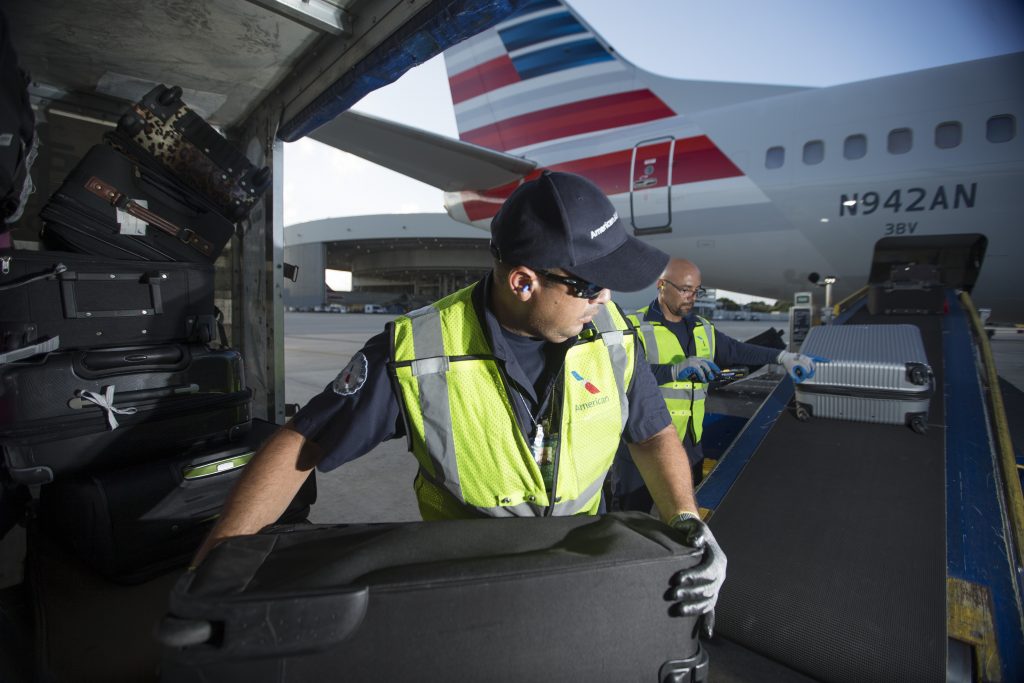
The investigation looked at a slew of complaints received by the DOT between 2019 and 2023, including a viral incident in which two baggage handlers at Miami airport were filmed sliding a wheelchair down a luggage chute with such force that the mobility device crashed into a metal barrier, flipped over, and slammed onto the tarmac.
In April 2023, American Airlines was also sued by two women who rely on powered wheelchairs for their freedom after the carrier first lost and then allegedly damaged their mobility devices during a trip from Des Moines, Iowa, to Houston, Texas.
While acknowledging that it had invested a lot of money in an attempt to improve the service it provided disabled travelers, the airline noted that it served 8 million passengers who requested assistance, and transported more than 146,000 wheelchairs and other personal mobility devices in 2023 alone.
AA Still Lags Rivals in Wheelchair Handling Data
Unfortunately, American still trails both Delta and United when it comes to mishandling wheelchairs.
According to the DOT’s own Air Travel Consumer Report, AA recorded a wheelchair mishandling rate of 1.39 in July 2025, compared to 1.26 for United and just 0.47 for Delta.
While American Airlines still has plenty of room for improvement, it has at least made great strides in the last year. In July 2024, AA’s wheelchair mishandling rate stood at 1.84.
Bottom line
American Airlines will no longer have to pay the Treasury the remainder of the $50 million fine it was slapped with last October for serious violations of disability rights rules.
Instead, the airline will put the money towards making investments in new equipment that should reduce wheelchair mishandling incidents in the future. You do have to wonder, however, whether American Airlines was planning on making this investment regardless.
The other unknown is whether this investment is enough to really improve AA’s safe handling of wheelchairs, or whether it’s doing little more than scratching the surface of a much bigger investment that is required.