



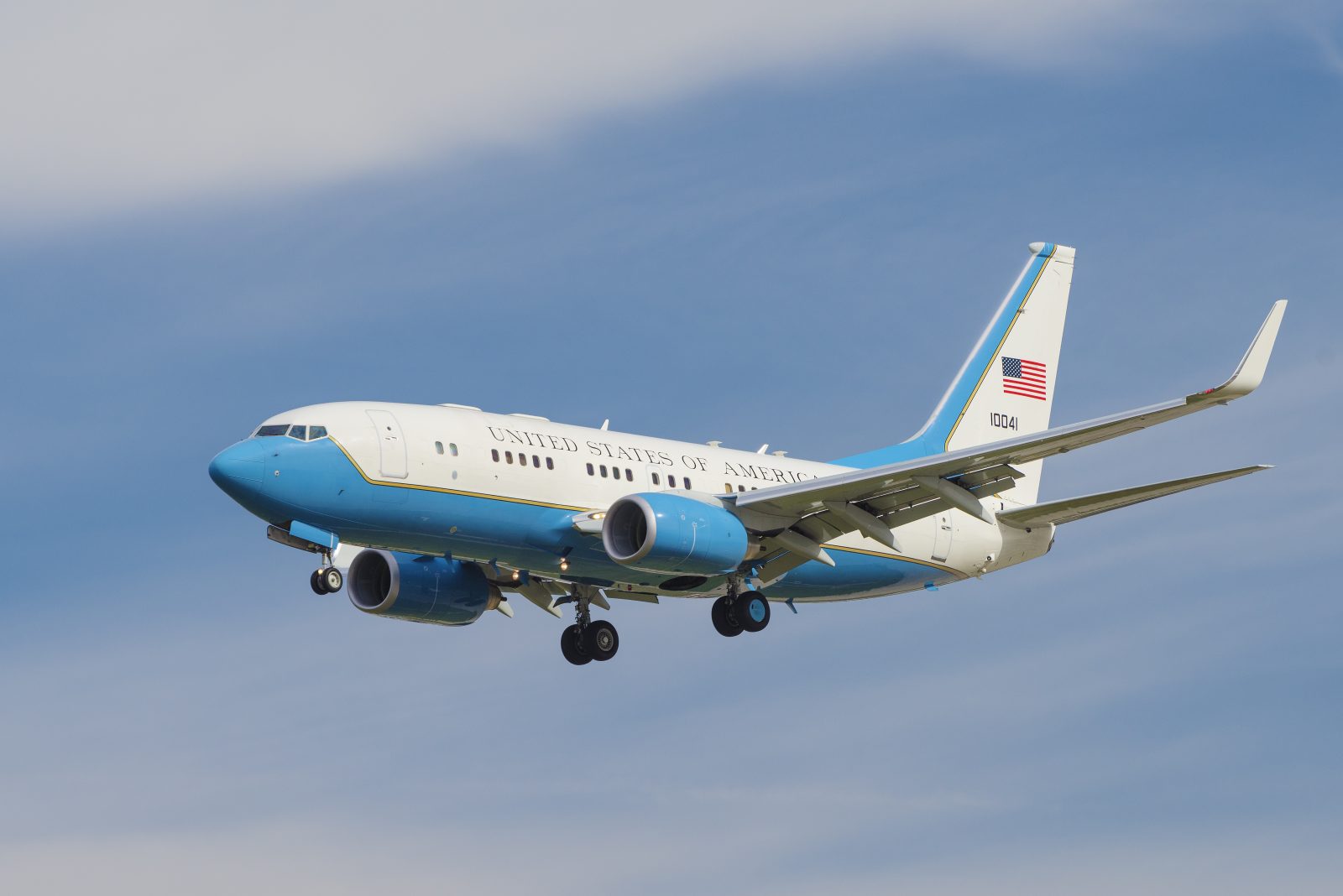
New claims about the legal legitimacy surrounding the Trump administration’s targeting of drug-running boats in the Caribbean have been raised after reports emerged that the Department of Defense used military aircraft painted to look like civilian airliners in the first attack in September 2025.
The claims, first reported by the New York Times, suggest that potential war crimes could have been committed – with the legal term ‘perfidy’ entering the popular lexicon.
Military aircraft painted to look like civilian airliners in boat attacks
According to a new investigation by the NYT, the Department of Defense used a military aircraft painted to look like a civilian airliner to carry out its first attack on a drug-running boat in the Caribbean last September.
The aircraft was likely a military version of the Boeing 737, which is known as the Navy P-8 Poseidon.
There were reportedly no visible military markings on the plane, and the munitions used to destroy the boat were contained within the fuselage of the aircraft, rather than on the wings as would normally be the case.
According to sources cited by the NYT, the aircraft ‘swooped’ in low enough for the people on the boat to clearly see it. The boat had reportedly turned back towards Venezuela before the military plane carried out a deadly strike.
NYT raises possibility of war crime known as ‘perfidy’
The Trump administration has insisted that the boat attacks are legal because the United States is in an armed conflict with drug cartels, but experts say that the use of a military plane made to look like a civilian airliner could be a war crime.
The experts have suggested that the use of the plane could amount to a crime of perfidy, which is prohibited under the Geneva Convention
In simple terms, perfidy under these circumstances refers to the feigning of civilian, non-combatant status to betray the confidence of the enemy and carry out an attack.
Other common examples of perfidy would be, for example, to put the marking of the Red Cross on a military vehicle in order to carry out an attack on the enemy.
In the first boat attack, sources claim the plane flew low enough for the occupants to see it, but without any visible military markings or munitions, they may not have known that an attack was about to occur.
Since that first boat attack, the U.S. military had reportedly switched to using recognizable military assets, including Reaper drones.
The FAA told airlines to avoid overflying Venezuela
In November 2025, the Federal Aviation Administration (FAA) warned U.S. airlines to avoid flying over Venezuela and its territorial waters due to heightened military activity in the region and fears that a civilian airliner could be accidentally shot down by a Venezuelan air defense system.
The warning was issued in the form of a NOTAM or ‘Notice to Airmen’ which cautioned that “threats could pose a risk to aircraft at all altitudes.”
The FAA also provided further background information on its decision, saying there had been an increase in satellite navigation interference in the region, as well as increased military readiness.
“Additionally, since early September, Venezuela has conducted multiple military exercises and directed the mass mobilization of thousands of military and reserve forces,” the FAA explained.


Should have said “… administration’s targeting of ALLEGED drug-running boats in the Caribbean …”
No, they didn’t. This is wrong on so many ways it hurts. Not the least of which is if a small boat were hit with the kind of ordinance a P-8 carries, there wouldn’t be any survivors to tell a story and the boat would be match sticks.