



Well, this doesn’t seem like something that should be possible, but a third United Airlines flight has now been forced to make an emergency diversion after a passenger’s laptop somehow fell through a crack in the cabin floor and dropped into the cargo hold.
United flight to Geneva makes costly diversion
On Thursday, United Airlines flight UA-748 departed Washington Dulles at around 5:45 pm for what should have been a routine seven-hour flight across the Atlantic Ocean to Geneva, Switzerland.
Unfortunately, the Boeing 767 never made it very far, and less than an hour after takeoff, the aircraft suddenly turned back over the coast of Maine and started heading towards Newark, where it landed just after 8 pm.
The official reason given by United for the diversion was that the aircraft had to undergo an unscheduled ‘maintenance inspection.’ While that’s not necessarily inaccurate, the full story is a lot more interesting.
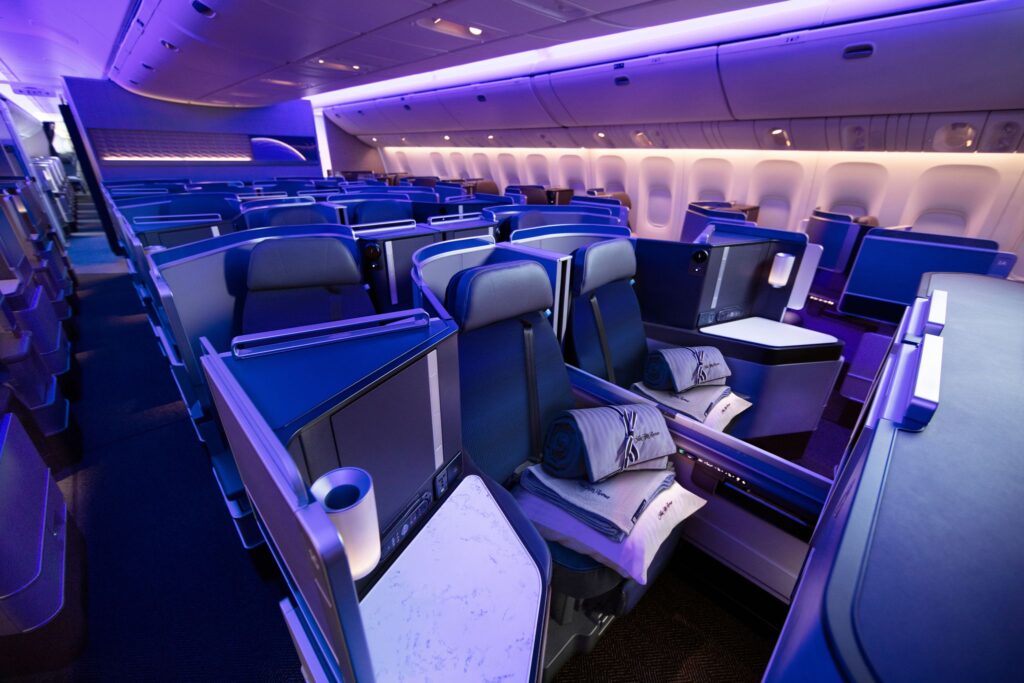
It turns out that a passenger’s laptop in the Polaris Business Class cabin somehow slipped through a crack in the floor of the cabin and dropped into the cargo hold, which isn’t accessible.
How could this happen? Well, it turns out that there is a small gap between the Polaris seats and the cabin wall, which is normally covered by a long piece of foam to stop things falling through.
It appears that passengers have been using this foam padding as an extra ledge to store items, and because laptops can be pretty hefty, the weight can cause the foam to move and fall through.
Once falling to the cabin floor, there is a vent that leads into the cargo hold. This should be covered, but the grate is easily moved, and it’s believed that this was the case in this case as well.
Not the first time this has happened
The bizarre thing about this incident is that it’s not an isolated case. Last October, a laptop also dropped through the cabin floor into the cargo hold on another United Boeing 767 flying from Washington Dulles to Rome, Italy.
Flight UA-126 departed IAD at around 10:22 pm on October 15, 2025, and again, little more than an hour into the flight, the plane turned back around, this time, electing to return to Dulles, where engineers could access the cargo hold and retrieve the laptop.
Why can’t they just retrieve the laptop after the flight?
You might be wondering why the flight would have diverted just to retrieve the laptop instead of continuing the flight and making the passenger wait for their laptop at the other end.
The reason is that the lithium battery inside the laptop could have been damaged in its fall into the cargo hold, which could then lead to it overheating and catching fire.
In an inaccessible location like the cargo hold, it would be incredibly difficult, if not impossible, to fight the fire, and that could result in a catastrophic scenario.
Last year, an Air France Boeing 777-300 with 375 passengers on board diverted because someone misplaced their mobile phone and, despite the best efforts of the passengers and cabin crew, it couldn’t be located.
It’s understood that the errant mobile phone was somewhere in the cabin, but because it couldn’t be located, the pilots decided to err on the side of caution and return to Paris to mitigate any risk of an in-flight fire at 38,000 feet.
Bottom line
United Airlines seems to have an issue with laptop computers falling into the cargo holds of its Boeing 767s. It should be noted that United isn’t the only airline to use foam pieces to seal gaps between premium seats and the sidewall of the cabin, although it does seem to be the only airline with this unique issue.
In fact, the problem is so bad that flight attendants even have a special announcement available to them to remind passengers not to place anything on the foam padding in Polaris.


Another Boeing design failure.
That’s how stupids talk.