



Aviation accident investigators have opened a probe into a potentially serious incident involving a LATAM Brasil Boeing 777-300 at Sao Paulo International Airport on Sunday night, after the pilots carried out a high-speed ‘rejected takeoff’ only after the front wheels had already left the ground.
The aircraft, which had as many as 414 passengers on board, came to a halt towards the end of the runway, with the brakes visibly red hot. The pilots then initially started taxiing back towards the gate, before stopping on a taxiway where emergency services rushed to the scene.
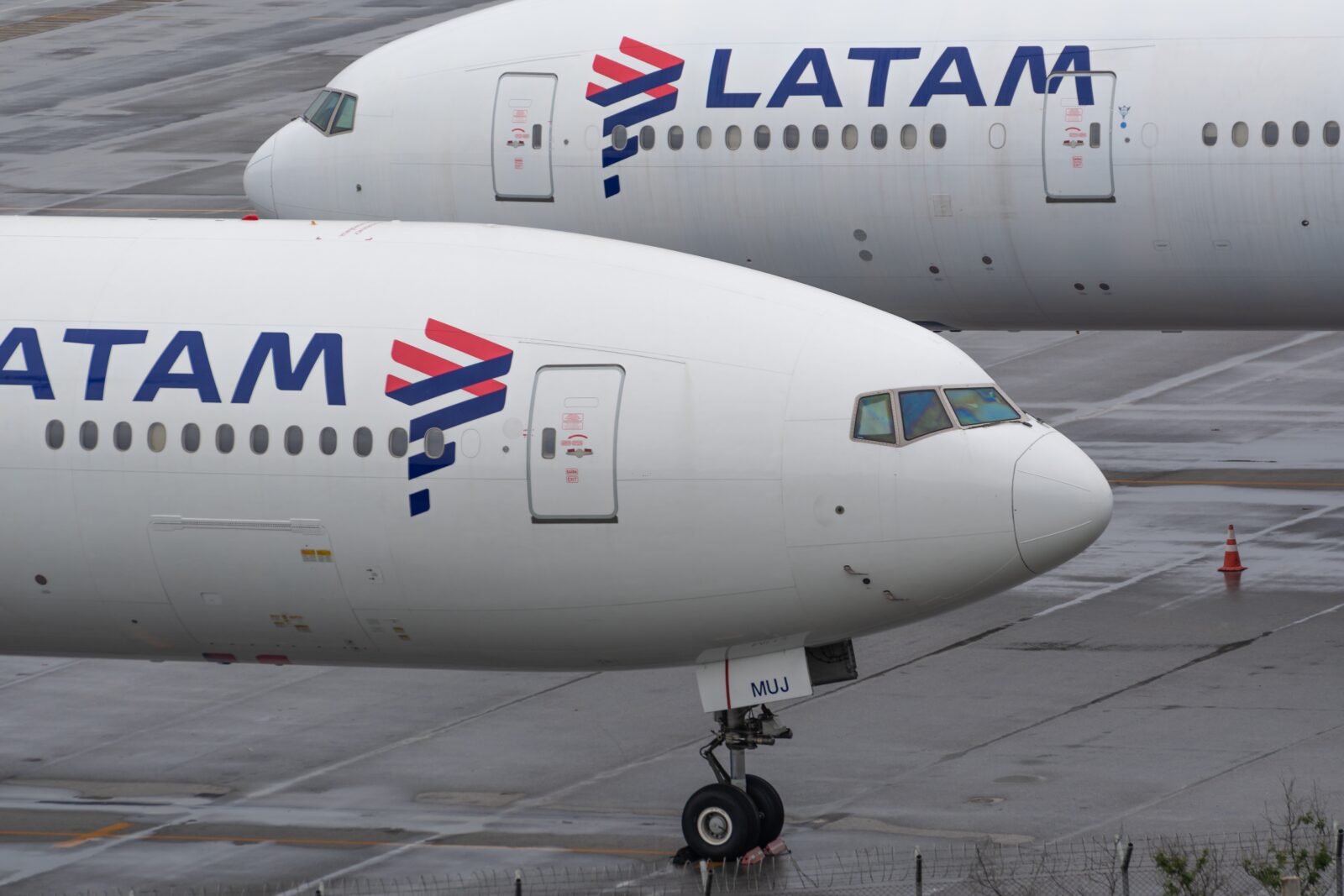
The incident unfolded as LATAM flight LA-8146, operated by a 13-year-old Boeing 777-300 (registration: PT-MUH), was preparing for departure for an overnight transatlantic flight to Lisbon, Portugal.
Following a one-and-a-half-hour departure delay, the aircraft pushed back from the gate at Terminal 3 at around 7:10 pm on February 15 and taxiied the short distance to Runway 10L, where the pilots were given the go-ahead to start their takeoff roll.
Plane spotters at the opposite end of the airfield captured the moment that the front wheels of the massive twin-engined aircraft lifted off the ground before the pilots suddenly rejected the takeoff as the plane was traveling at around 174 knots over ground.
Once stopped on the taxiway, it became apparent just how forceful the rejected takeoff had been, with all of the tires appearing to be shredded from the extreme force exerted on them.
The passengers were eventually deplaned and transported back to the terminal on coaches while, unsurprisingly, the aircraft was taken out of service.
Along with getting to the bottom of what caused the pilots to reject the takeoff, accident investigators will also be trying to determine whether that decision came before or after a critical moment in an aircraft’s takeoff, which is known as ‘V1’.
V1 is essentially the takeoff decision speed. Once a plane reaches V1, pilots are generally considered to be committed to lifting the plane off the ground because the risk of overrunning the runway or causing serious damage to the aircraft is so great.
The V1 speed is dynamic and can depend on a number of factors, such as the combined weight of the aircraft, cargo, and its occupants, as well as the temperature at the departure airport and other weather conditions.
In this case, flight tracking services have recorded the ground speed of the aircraft as 174 knots, which would be a typical maximum V1 speed.
What is interesting in this case is that V1 is declared before the takeoff ‘rotation’ – the moment that the pilots lift the wheels off the ground.
Given that the front wheel did lift off the ground in this case, some observers believe that the pilots rejected the takeoff after the V1 decision. Unless the situation was catastrophic, pilots would ordinarily continue with the rotation and fly the plane, rather than rejecting the takeoff.
That’s not to say, however, that the front wheels lifting off the ground was uncommanded. Or, to put it another way, that V1 hadn’t been declared, and the pilots never intended for the front wheel to lift off the ground when it did.
In a statement, a spokesperson for LATAM told us: “LATAM Airlines Brazil clarifies that the aircraft operating flight LA8146 (Guarulhos–Lisbon) this Sunday (February 15) aborted its takeoff. The procedure was carried out with complete safety and follows the protocol established for this type of situation.”
“LATAM Airlines Brazil provided assistance to all passengers, who were disembarked and rebooked in hotels and on other flights. The company reiterates that safety is a priority in all its operations.”
On July 9 2024, a LATAM Brasil Boeing 777-300 suffered an extreme tailstrike as it was departing from Milan Malpensa Airport, with surveillance cameras capturing the moment the aircraft started to blow up dust and smoke as its tail dragged along the runway for around 720 meters.
A report by Italian accident investigators found that the pilots input the wrong figures into the onboard computer to calculate the correct takeoff speed.
In this case, it appears that the pilots entered the so-called ‘zero fuel weight’ for the aircraft, rather than the actual fuel weight, which meant that the computer calculated the takeoff speed at a much lower rate of knots than was actually required.