


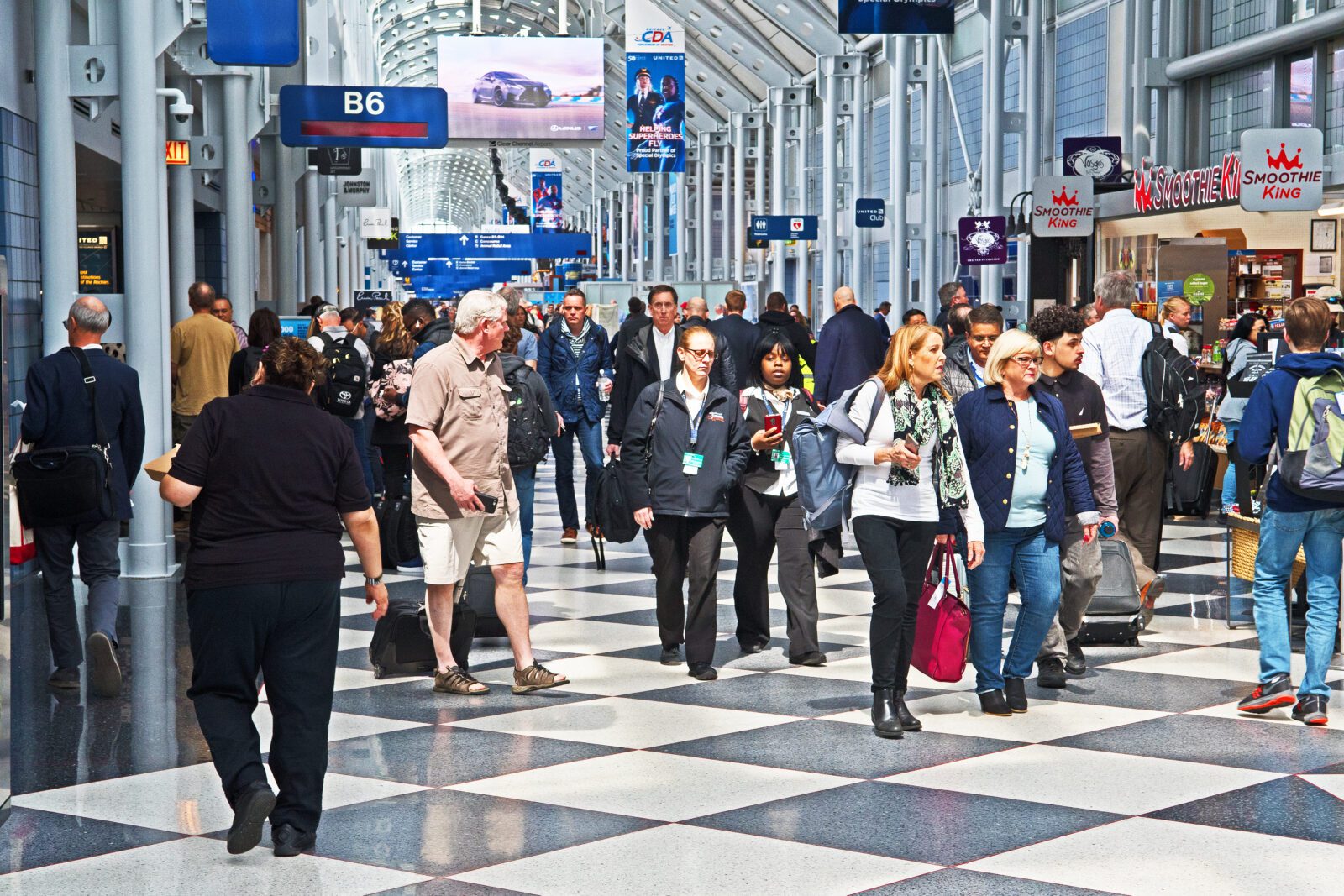
Passengers could face even longer delays when traveling through Chicago O’Hare (ORD) after thousands of pilots were told to refuse a special time-saving trick to speed up operations at what has become the busiest airport in the United States, as measured by the number of takeoffs and landings.
Unfortunately, Chicago O’Hare is already one of the poorest performing major airports in the U.S. for on-time departures, with an on-time rate of around 65% based on data from BTS/Cirium.
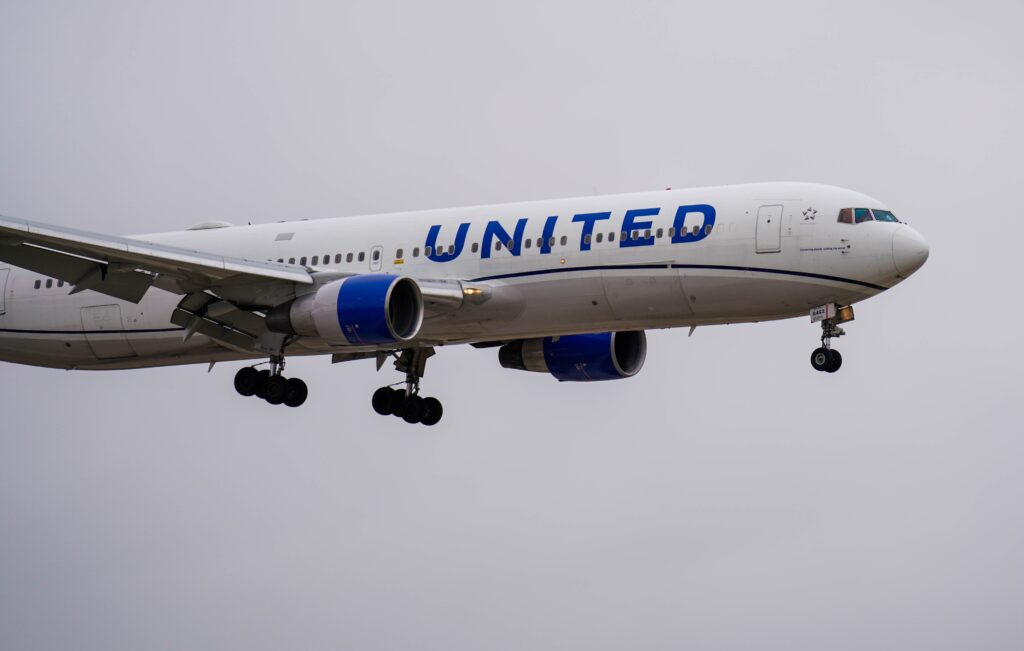
On-time performance could, however, get even worse over the course of 2026 after safety concerns were raised about the way that Chicago O’Hare uses an FAA-approved technique to make the most efficient use of available runway and taxiway space.
At the center of an issue is a procedure used at a slew of airports across the United States, which is called LAHSO – Land and Hold Short Operation.
The basic principle behind LAHSO is that pilots coming into land agree to a stop at a pre-defined point on the runway, which is usually shorter than the full length of the runway.
That pre-defined point is known as the LAHSO hold-short point, and it’s often positioned before an intersecting runway or taxiway that is being used for ground operations. When a pilot agrees to LAHSO, air traffic control can then keep operations moving on the intersecting runway or taxiway.
LAHSO has been in use for decades, although there are very strict criteria that control when this procedure can be used. Perhaps most importantly, while air traffic control can request that a pilot ‘holds short’ the final decision rests with the aircraft commander.
At Chicago O’Hare, two major pilot unions have raised concerns about unusual or difficult-to-identify hold-short points in use at the airport, which have caused pilots in the past to ‘bust’ past the hold-short line.
This is how one pilot described the situation:
“Imagine a landing clearance with a “Hold Short of intersection (xxx)” instruction was like when driving a car, and coming to a stop light, and you were expected to stop your car prior to, and not protrude at all into, the crosswalk (“Hold short of the crosswalk”). Seems simple enough – and 99.9% of the intersections have a line painted just a few feet before the crosswalk, where you expect it to be found. This is the line where you are supposed to stop, with none of your car at all in front of it.
In ORD, for some reason, on certain runways, the “line” to officially “hold short” of a given intersection is not just before the intersection you are told to hold short of, but instead is nearly 1,000′ prior. It is the only airport in the US with this configuration that I know of. To continue with the Crosswalk Example – you are told to “stop your car before the crosswalk” but the painted “Hold” line is now 3-4 car lengths before the crosswalk – and stopping your car just over it (but still several hundred feet before the “actual” crosswalk) gets you a ticket.
If you want to see this depiction for yourself – search for an image of the KORD taxi chart, make sure it is a recent edition, look at RWY 10C/27C, and the LAHSO (Land And Hold Short Operations) hold short points on both ends of the runway. ATC instructions, when it is in use, will say, “Cleared to Land RWY 27C, Hold short of intersection KK” or “Cleared to Land RWY 10C, Hold short of intersection TT” but you can see the hold lines are significantly earlier than KK and TT. Stopping well prior to “KK” or “TT”, but just a little over the arbitrary “line” as shown, will get a violation.”
These unions – the Air Line Pilots Association (ALPA) and the Allied Pilots Association (APA) – represent thousands of aircrew at some of the biggest airlines in the United States, including Alaska Airlines, Delta, Frontier, Spirit, JetBlue, and United, in the case of ALPA and American Airlines for APA.
Last week, APA told its members that it “highly recommends” that its members not accept LAHSO clearance at Chicago O’Hare, mimicking a similar request by ALPA.
Again, pilots get to make the final decision, but the advice from both of these unions is very clear.
And it’s not just Chicago O’Hare that is covered by this advisory. Similar concerns have also been raised about the LAHSO points at Minneapolis Saint Paul International Airport, although the impact this could have on delays is less clear.

Airline pilot here who flies regularly into ORD. A little more elaboration might be necessary to fully understand what is happening here. Without being able to load the taxi diagrams into the comments, I’ll do my best to use an easy to understand example.
Imagine a landing clearance with a “Hold Short of intersection (xxx)” instruction was like when driving a car, and coming to a stop light, and you were expected to stop your car prior to, and not protrude at all into, the crosswalk (“Hold short of the crosswalk”). Seems simple enough – and 99.9% of the intersections have a line painted just a few feet before the crosswalk, where you expect it to be found. This is the line where you are supposed to stop, with none of your car at all in front of it.
In ORD, for some reason, on certain runways, the “line” to officially “hold short” of a given intersection is not just before the intersection you are told to hold short of, but instead is nearly 1,000′ prior. It is the only airport in the US with this configuration that I know of. To continue with the Crosswalk Example – you are told to “stop your car before the crosswalk” but the painted “Hold” line is now 3-4 car lengths before the crosswalk – and stopping your car just over it (but still several hundred feet before the “actual” crosswalk) gets you a ticket.
If you want to see this depiction for yourself – search for an image of the KORD taxi chart, make sure it is a recent edition, look at RWY 10C/27C, and the LAHSO (Land And Hold Short Operations) hold short points on both ends of the runway. ATC instructions, when it is in use, will say, “Cleared to Land RWY 27C, Hold short of intersection KK” or “Cleared to Land RWY 10C, Hold short of intersection TT” but you can see the hold lines are significantly earlier than KK and TT. Stopping well prior to “KK” or “TT”, but just a little over the arbitrary “line” as shown, will get a violation.
This is the issue pilots face, and these procedures (where the “Line” is) were set by the ATC personnel in ORD – and they appear to have no desire to change or fix it. The chart does accurately show the “hold short” is earlier than a pilot would normally expect. But that is one of several dozen “small notes” – not to mention all the NOTAMS, etc. – that must be reviewed on a flight, so it’s easy to miss if you are not familiar with it. Especially when the ATC instructions say to hold short of an “intersection”.
The safety divisions of both unions (ALPA and APA) have noticed an uptick in pilots going past the “Line” with LASHO operations in ORD, engaged ATC about making a change, and they declined. In the interest of both safety (don’t go past the Hold Short line!) and to protect pilots from violations, ALPA earlier advised their pilots to decline LASHO. APA is now doing the same for the same reason.
This is a great explanation: I’ll add it into the article.