



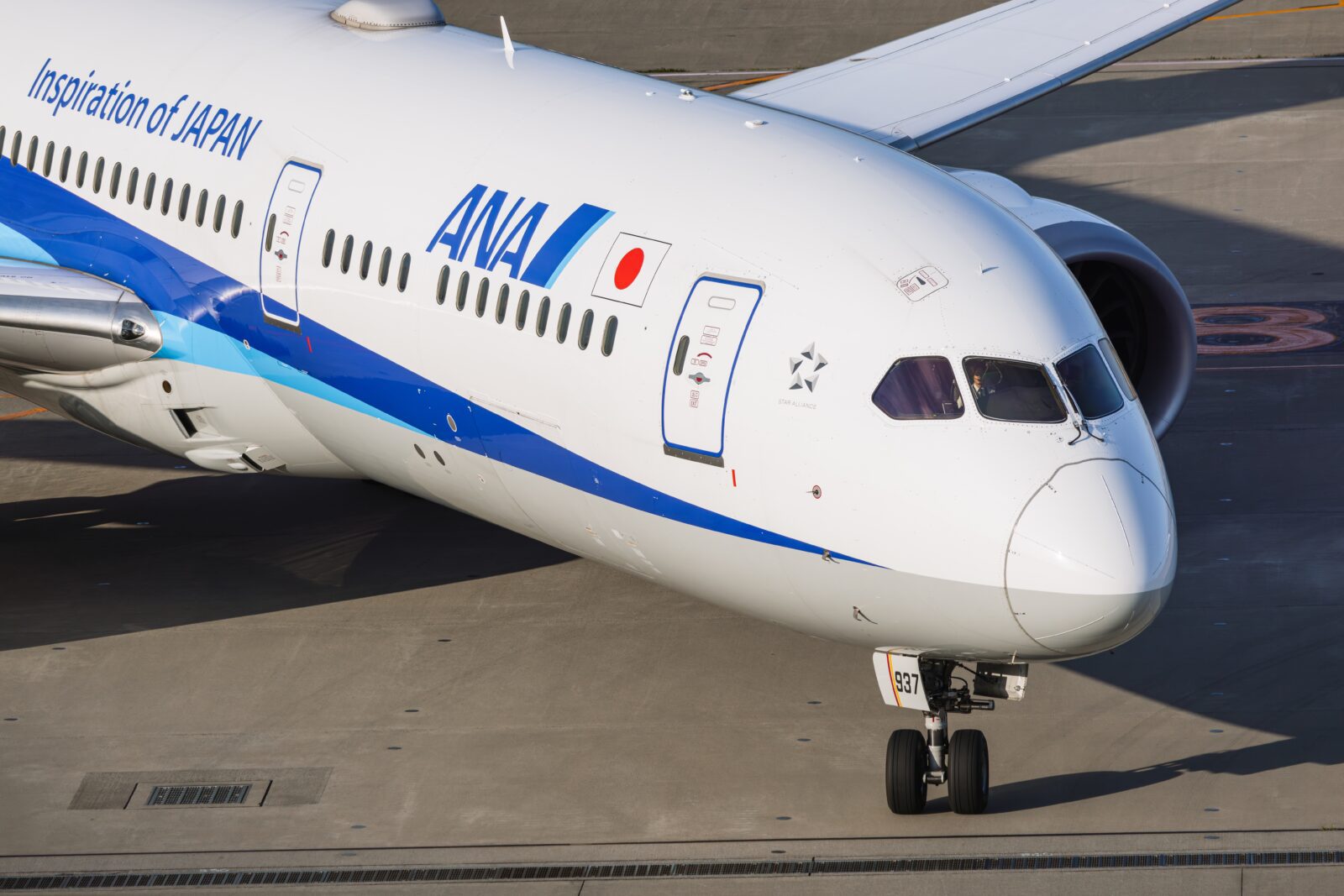
Passengers on an ANA Airlines flight from Tokyo to Frankfurt on Tuesday faced one of the longest ever ‘flights to nowhere’ when their Boeing 787-9 Dreamliner experienced a maintenance issue as it was flying at over 34,000 feet above the Arctic Ocean.
What followed was an endurance marathon as the plane turned back towards Tokyo, landing back exactly where it started after nearly 14 hours in the air.
ANA flight NH-223 departed Tokyo Haneda at around 10:55 am on February 17 for what should have been a sub-14-hour flight to Germany’s financial capital, Frankfurt.
Because ANA has voluntarily chosen to avoid Russian airspace since 2022, when President Putin ordered his military forces to invade Ukraine, the airline now operates its Tokyo to Frankfurt flight in the opposite direction, flying above Alaska and Greenland to make use of the curvature of the earth to keep the flight as short as possible.
But six hours into the flight, as the decade-old Boeing 787-9 (registration: JA875A) was flying off the far north coast of Alaska, the pilots performed a U-turn and started heading straight back to Tokyo.
It turns out that there had been an indication of low oil pressure in one of the engines, and after trying to troubleshoot the issue, it was decided that engineers would need to investigate further on the ground.
These kinds of situations are always tricky for airlines to deal with because, while they don’t necessitate an immediate diversion to the closest available airport, it’s difficult to explain why the plane can’t just continue onwards to its intended destination.
This is normally because the airline doesn’t have the right engineers and maintenance services available at the destination airport to fix the problem, meaning that the plane could be stranded in a foreign country.
This is also the reason why an airline won’t divert to an intermediate airport along the way, as the problem might not be possible to fix easily, and then you end up with a plane load of passengers and a plane stranded in the middle of nowhere with no local airline support available.
While incredibly inconvenient, it is normally better for everyone to return the plane to one of the airline’s main hubs, where passengers can be rebooked onto a new flight.
Clocking in at 14 hours in the air, NH-223 is now one of the longest-ever flights to nowhere, although there are some other very notable cases:
- Air New Zealand (Auckland to New York JFK) – On February 16, 2023, flight NZ-2 was halfway across the North Pacific Ocean en route to New York when the pilots learned that Terminal 1 had experienced a fire that had knocked out most of the power. With no spare capacity at New York JFK, the pilots were told they couldn’t continue onwards. The pilots asked to divert instead to Houston, but this suggestion was rebuffed by their bosses, leading to a 16-hour flight to nowhere.
- Emirates (Dubai to Auckland) – Just days later, on January 26, 2023, Emirates flight EK-448 was forced to turn around as it neared the halfway point of the Dubai-based carrier’s longest flight after severe weather flooded the terminal buildings at Auckland Airport. This flight to nowhere clocked in at 14 hours.
- British Airways (London Heathrow to Hong Kong) – In July 2024, passengers on BA flight 31 endured an 11 hours to nowhere when the Boeing 777 suffered a technical fault as it was flying over Turkmenistan. Again, the fault wasn’t serious enough to require an emergency diversion, but BA wanted to repatriate the plane back to its home base.


“Perhaps the one consolation for the passengers of ANA flight NH-223 is that they should be eligible to claim €600 each under Europe’s EU261 passenger rights rules.
The legislation applies to all flights headed to Europe, regardless of where the airline is registered, and technical faults with the plane have consistently been found to be part and parcel of normal airline operations.”
That is incorrect. For non-EU airlines it only applies when departing the EU.
Yes, you’re absolutely right. thanks for correcting me. I’ll remove that section.
“While incredibly inconvenient, it is normally better for everyone to return the plane to one of the airline’s main hubs, where passengers can be rebooked onto a new flight.”
Why is it more convenient for the passengers than continuing to the destination? You explained why it’s more convenient for the airline.
Ah, so! I think I covered this in the story, but if the airplane diverts to a mid-way airport, then it might get stranded there. Not good for passengers. If it continues onto its destination and then can’t be fixed, then it strands the next set of passengers and has knock-on effects across the airline’s schedule.
Right, continuing to the destination creates operational problems for the airline, so they steal 17 hours from each of the 240(?) passengers.