A disabled American traveler has slammed an Australian flight attendant after she forced him out of an extra legroom seat in the emergency exit row on a recent Jetstar flight because of his impairment. Fellow Australians have, however, been quick to rush to the defense of the crew member.
Matt Hubbard, an associate producer at NBC Sports and The Golf Channel, had been covering the LIV Golf tournament last weekend in Adelaide, South Australia, and had booked a flight with Jetstar, the low-cost subsidiary of Australian flag carrier Qantas.
Matt had booked an extra legroom seat in one of the emergency exit rows, sometimes referred to as ‘self-help exit’ rows, but a flight attendant ordered him to move to an alternative seat after discovering that he was an amputee with only one hand.
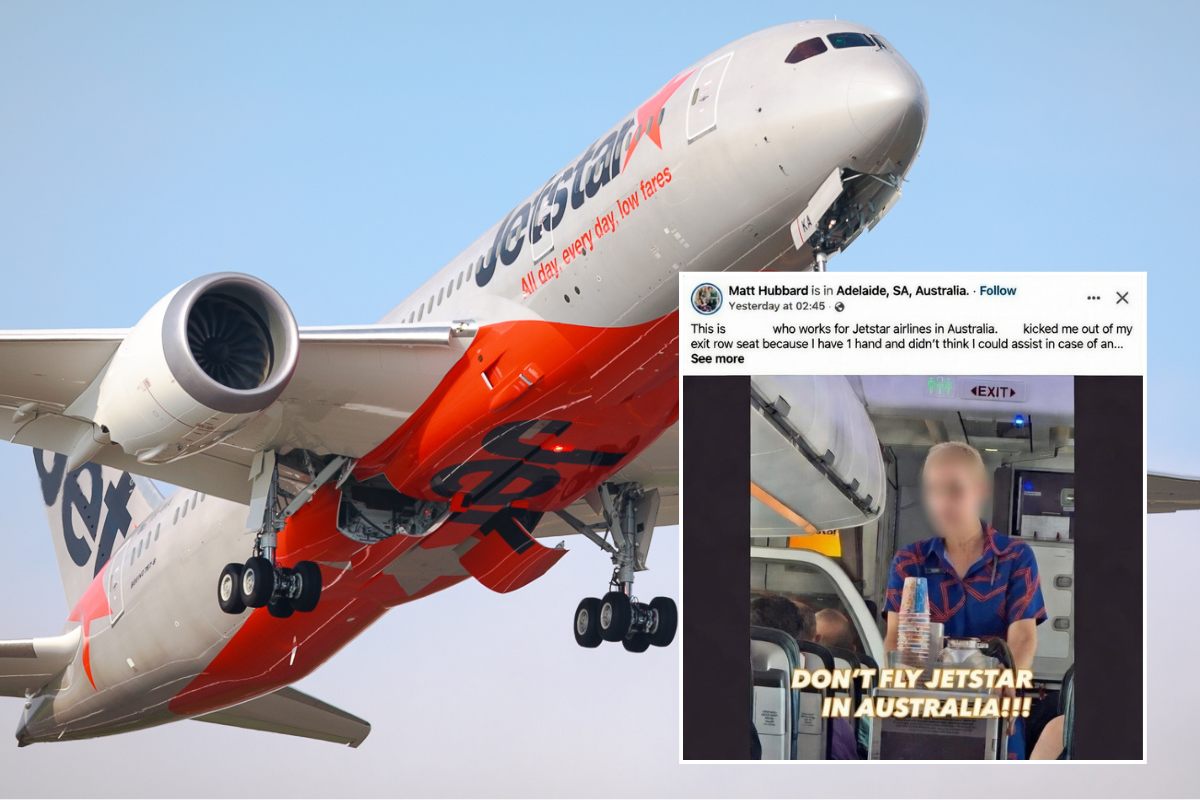
“This is [flight attendant name], who works for Jetstar Airlines in Australia. [flight attendant] kicked me out of my exit row seat because I have 1 hand and didn’t think I could assist in case of an emergency,” Matt wrote in a now-deleted Facebook post which quickly went viral.
A photo of the flight attendant was captioned: “Don’t fly Jetstar in Australia!!!”
Emergency exit rows on single-aisle aircraft like the popular Airbus A320 and Boeing 737 are sometimes referred to as ‘self-help exits’ because, as the name suggests, it is up to passengers to operate the exits with the assistance of a flight attendant in case of an emergency evacuation.
Aviation safety regulators impose strict conditions on what passengers can sit at self-help exits. These regulations were developed after real-world accidents in which passengers struggled to open the self-help exits, resulting in unnecessary deaths.
Self-help exit rules can, however, still vary greatly from one country to the next, and Australian aviation authorities have some of the strictest rules in the world.
Airlines are obliged to comply with these rules, which include a ban on any passenger with an amputated or prosthetic limb.
Self-help exit row passengers must also be at least 15 years old, be in ‘good health’ and uninjured, be willing to assist in an emergency, not require the use of an extension seatbelt, not be visually impaired, and not be traveling with someone who does require assistance.
Australian travelers were quick to side with the Jetstar flight attendant, pointing out that not only was the crew member following her training, but that Matt would have been required to acknowledge he complied with the exit row rules during the check-in process.
A spokesperson for Jetstar later pointed out: “Safety is always our top priority, and like other airlines, we clearly outline the additional requirements for customers to sit in an exit row seat.”
The statement continued: “Our crew member was doing her job enforcing Civil Aviation Safety Authority requirements and we will never tolerate abusive behaviour towards our team members whether in person or online.”
Do the rules need to be updated?
The self-help exit rules were drawn up at a time when operating these exits was a labor-intensive task that required dexterity and mobility. Older models of self-help exit on Airbus A320 series aircraft weigh around 15 kg (33 pounds) and require passengers to grip the exit with both hands and physically throw it out of the plane.
This video shows how an old-style self-help exit operates on Airbus A320 series aircraft:
Modern aircraft on both Airbus and Boeing single-aisle airplanes, however, have updated designs that are much easier to operate – simply pulling down on one handle will automatically open the exit with no other manual intervention involved.
This is a new style exit that can be operated with just one hand:
The self-help exit on Matt’s flight may well have had this type of automatic exit, although there are still thousands of aircraft with older-style manual exits.
Mateusz Maszczynski honed his skills as an international flight attendant at the most prominent airline in the Middle East and has been flying ever since... most recently for a well known European airline. Matt is passionate about the aviation industry and has become an expert in passenger experience and human-centric stories. Always keeping an ear close to the ground, Matt's industry insights, analysis and news coverage is frequently relied upon by some of the biggest names in journalism.
This can’t be the first time the guy has run into this so him acting petulantly and doxxing the FA is intolerable. He deserves a no-fly ban for some years.






This can’t be the first time the guy has run into this so him acting petulantly and doxxing the FA is intolerable. He deserves a no-fly ban for some years.
flight attendant was absolutely correct. end
the FA is correct. no disable on exit row. that is the rule. the world don’t work around you only.