



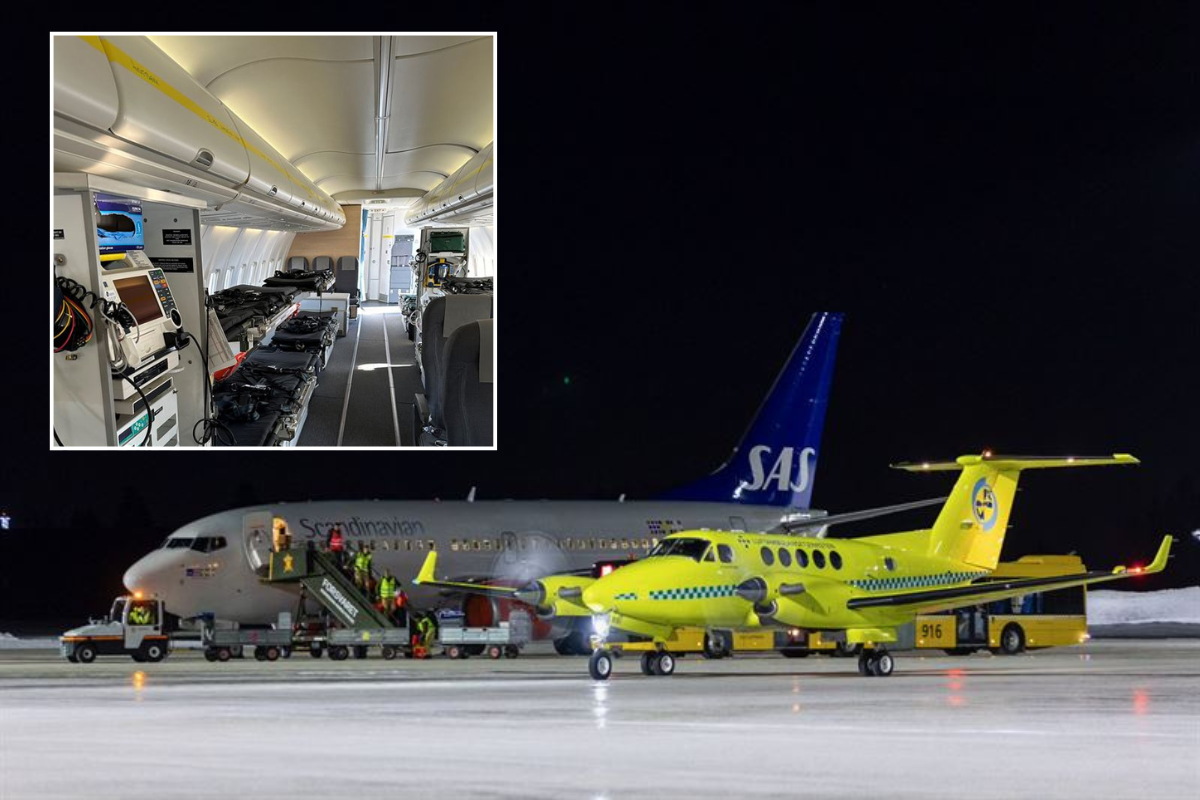
It’s a mission that SAS Scandinavian Airlines has described as the “most important humanitarian operation” in its modern history – since the start of Russia’s full-scale invasion of Ukraine in February 2022, the airline has medevac transported more than 3,500 injured soldiers on a Boeing 737 that has been transformed into a flying hospital.
In normal times, the Boeing 737 would be filled with civilian passengers on regularly scheduled commercial flights, but over the last four years, it has flown nearly weekly evacuation flights, racking up more than 180 missions since early 2022.
Kitted out with 18 hospital beds, three of which are flying intensive care units, along with 39 seats for support staff and companions, the plane forms part of an important public-private partnership between SAS and the Norwegian Armed Forces.
“These missions are unlike most operations in commercial aviation,” commented SAS chief executive Anko van der Werff. “They are built on a civil–military partnership grounded in more than 25 years of cooperation, shared values and trust between SAS and the Norwegian Armed Forces.”
van der Werff continued: “When patients need to be moved safely and quickly across borders, aviation can help. For a national carrier, that responsibility is not abstract.”
“As Scandinavia’s national carrier, SAS carries a commitment to serve society not only in stable times, but when circumstances demand more of us.”
The medevac operations are led by the Norwegian Armed Forces, but last year, 24 of the airline’s employees were awarded the Norwegian Armed Forces’ Medal for International Service for their contributions to the Ukraine Medevac operation.
For now, SAS is using one of its Boeing 737s for these medevac missions, but in 2024, the airline reached a new deal with the Norwegian Armed Forces that could also see one of its Airbus A320 aircraft transformed into a flying hospital.
The agreement means that SAS has committed to developing a flying hospital concept for its newer aircraft for when its aging Boeing 737s need to be retired. For now, SAS has agreed to convert two of its 68-strong fleet of A320neo aircraft into flying hospitals should the need arise.
As well as being used to transport injured Ukrainian soldiers, the SAS flying hospitals have also been used during civilian disasters. Most famously, the Norwegian Armed Forces called upon SAS to help it evacuate injured civilians who were horrifically injured in the 2004 Thailand Tsunami.
Officially known as Scandinavian Airline System, but commonly known by the acronym SAS, the pan-Scandinavian carrier has sometimes been confused with the British elite military unit of the same name.
Last March, British media got very confused when they mistook SAS, the airline for the world-renowned and secretive unit of the British Army, known as the Special Air Service or SAS for short.
The confusion arose when a fire at an electrical substation in West London knocked out power to London Heathrow Airport. As airlines started to process the situation, SAS (the airline) put out a statement to advise passengers that all of its 12 daily flights to the airport had been cancelled.
When the statement hit the news wire services, major media outlets, including Sky News and The Guardian, instantly thought of SAS (the elite military unit) and started to report that the British armed forces had cancelled flights to Heathrow – even though no such flights existed.
SAS (the airline) saw the humorous side of the situation and poked fun at the incorrect media reports, saying in a post on X: “We get it, SkyNews and The Guardian – same initials, both wear uniforms, operate internationally, and move fast.”
“But only one SAS was affected by the Heathrow power outage. Spoiler: it was the one with the free coffee onboard, not the one with parachutes.”