



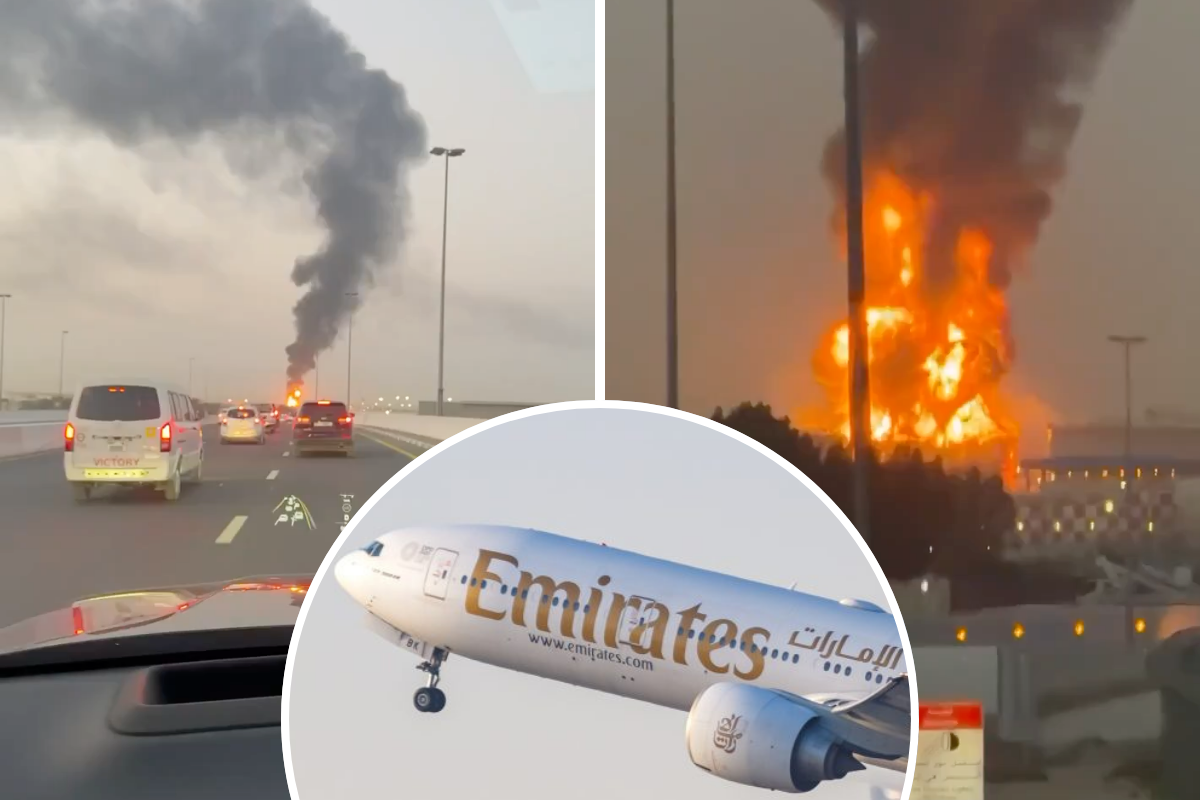
Just hours after an apparent Iranian kamikaze drone slammed into a fuel tank, creating an enormous fire on the edge of Dubai International Airport (DXB) in the early hours of Monday morning, local authorities announced that flights would resume, led by its hometown mega airline, Emirates.
While many international airlines quickly suspended flights from Dubai International Airport at the outset of the Iran War, the Dubai government and Emirates have pushed ahead with an ambitious flight resumption plan despite continuing attacks across the United Arab Emirates.
Smoke rising from an area near the Dubai International Airport is seen through the windshield of a vehicle, after a drone attack hit a fuel tank, according to Dubai authorities, amid the U.S.-Israel conflict with Iran, in Dubai, March 16, 2026, REUTERS/Stringer pic.twitter.com/Whlshu1Ruf
— Idrees Ali (@idreesali114) March 16, 2026
Over the weekend, Emirates had rebuilt its network to around 62% of pre-war levels, with it and sister airline FlyDubai operating 452 flights to and from Dubai on March 13.
Planes arrived in and departed Dubai in large waves throughout Sunday. On the surface, air traffic across the Persian Gulf city looked back to normal, while the atmosphere inside Dubai International Airport was calm and trouble-free.
If it weren’t for the discreet signs politely asking passengers not to sit too close to the expansive windows, you might not know there was any threat at all.
That was, however, until around 3 am on March 16, when what appears to have been an Iranian drone struck a fuel tank on the edge of Dubai International Airport close to the Royal Air Wing, apparently reaching the airfield despite the UAE’s sophisticated air defense systems.
It is morning now in Dubai. And the fuel depot near Dubai International Airport is still burning after last night’s successful drone attack.
— Drop Site (@DropSiteNews) March 16, 2026
All flights in and out have been suspended.
pic.twitter.com/ZbqZTfQXJT
A large fireball erupted into the sky as thick black smoke billowed high above the airport. Civil defense teams rushed to the airport to bring the blaze under control, while in the night sky, air traffic controllers worked even faster to clear the airspace of nearby planes.
At that time in the morning, Dubai International Airport is a hive of activity. Airplanes arrive at the airport from Europe and Asia in what is known in the aviation industry as a ‘bank’ or ‘wave’.
Planes were ordered into holding patterns off the UAE coast as the authorities assessed the damage at DXB. In the end, civil aviation regulators ordered the temporary closure of the airport, and flights were forced to divert to any other available airfield.
Many ended up at Dubai’s second airport, known as Dubai World Central, while others diverted to Al Ain, some planes flew to neighboring Saudi Arabia, and others made hours-long flights to nowhere as they returned to their points of origin.
One Emirates flight from Tokyo even ended up in Karachi, Pakistan, as space filled up at closer airports.
By 10 am on March 16, however, Emirates said it was ready to resume flights from Dubai International, although the airline warned that “some” flights might be cancelled. The airline has remained tight-lipped on how fast it now plans to ramp up its operation.
There would be a good reason for caution. This is not the first time that Dubai International Airport has been seemingly targeted by Iranian projectiles in the last two weeks.
In the early hours of February 29, just hours after the Iran War started, the roof of Terminal 3 was splintered open by a projectile. The airport said there was ‘limited’ damage to the concourse area, and only four people were injured – by this point, the airport had already been cleared of most passengers.
Within days, however, Emirates resumed flights. Cautiously, at first, with a limited number of repatriation flights along what officials described as a ‘safe air corridor.’
Soon followed the resumption of regular flight operations, with passengers allowed to book flights to and from Dubai, as well as transits through the airport.
The pace at which Emirates rebuilt its schedule continued to pick up even as the airport faced further threats. On March 7, Dubai International Airport was targeted by another Iranian drone, which appears to have exploded close to the far end of Terminal 3 and within the vicinity of a parked Emirates airplane.
Again, airspace was temporarily shuttered before being reopened just hours later. Flights continued as if nothing had happened.
And on March 11, debris from an Iranian drone struck a residential high-rise just eight miles from Dubai International Airport. Thankfully, no one was injured, and a blaze was quickly extinguished.
Emirates says that the “safety of our passengers and crew is our highest priority and will never be compromised,” although it’s not hard to understand why both passengers and crew would feel incredibly uneasy flying through Dubai International Airport during these tumultuous times.
If an Iranian drone can evade multiple layers of air defenses and hit a fuel tank at the airport, does it not stand to reason that one could hit a packed passenger plane, or the control tower, or a terminal building?
There is some speculation that a driving force behind Dubai’s determination to keep flights moving despite the ongoing threat is down to just how important the aviation industry is to the city’s economy.
According to Dubai International Airport, the aviation sector is responsible for at least 27% of Dubai’s GDP, providing an economic contribution of US $37.3 billion per year.
For every hour that flights are grounded, the Dubai economy is set to lose $4.25 million.
Of course, simply having planes in the sky is just half the story. While cargo plays an important role in the economic contribution of the aviation sector, an airline like Emirates also needs passengers to fill its planes.
And while there are reports of many Emirates flights operating less than half full, there’s really no way of knowing just how many passengers the airline has already lost, and is set to lose in the coming days, weeks, and months.
Passengers may feel safe transiting through Dubai for a few hours, but the Australian government has explicitly warned its citizens not to take the chance, saying their “safety will be at risk.”
So, given the current situation, would you feel safe flying with Emirates through Dubai?


Smoke rises behind Emirates HQ after a drone strike near Dubai airport. Flights were halted, crews forced to fly in wartime conditions, and people risk jail for filming the truth. The attacks are worsening, not getting better. How many more strikes before it’s too late?
I have complete faith in the government’s of the GCC. These Kingdom has been nothing but good to visitors. They have carrier me through some hard times back home and I will be forever grateful for the blessing to be here. Conflict in the ME has been going on for decades and more. When it was party central in Dubai, no complaints. Now that a couple of flights get grounded and flight plans rerouted, visitors are quick to kick them in the teeth. Who opened their homes to travelers when trouble started? The people of Dubai! Who paid all expenses to travelers? The government of UAE.
But in this article I dont see anyone pointing out that it is the wolve in sheep’s clothing who had caused this tragedy. USA has always acted like they were above reproach. Not excusing the other dog in the fight. But arrogance and self-importance is what caused this. I hope the world will see what is happening and do what is nessasary to support not just this region but the rest of the world from the Hitler 2.0 in the west.