



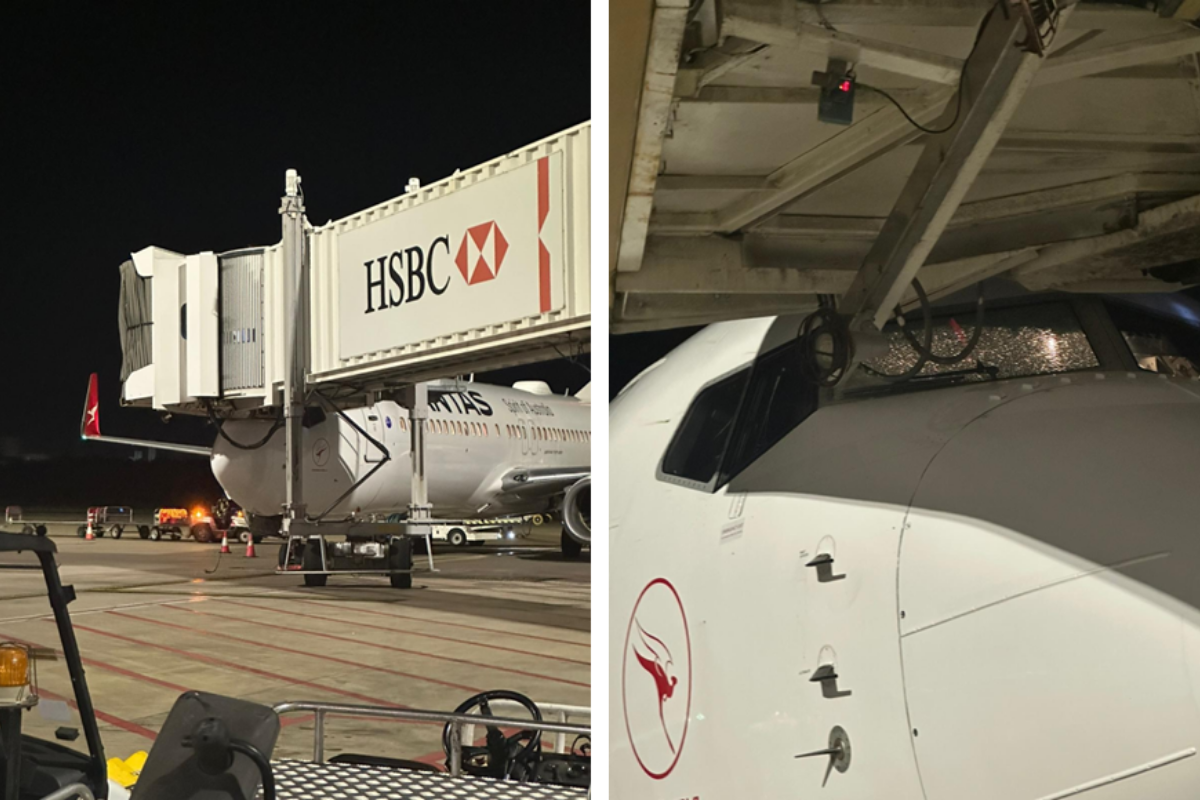
An airbridge at Brisbane International Airport (BNE) crashed into the cockpit of a Boeing 737, sending glass flying towards the pilots on two seperate occasions in the space of little more than a month, safety investigators in Australia have revealed.
Thankfully, none of the pilots were injured, although new safety protocols have been put into place in an attempt to prevent a third incident from occurring… So far, the new protocols appear to be working.
The first incident occurred on June 18, 2025, a short time after a Qantas Boeing 737 had arrived at the gate after flying from Queenstown, New Zealand. The plane parked in the correct position at the gate and then waited for the airbridge to be attached to the forward left-hand door for passengers to deplane.
As the jetbridge was being maneuvered, both the pilots in the cockpit and an engineer on the ramp noticed that it was going to hit the aircraft.
The pilots urgently tried to get in contact with the ground team to alert them to what was happening, while the engineer at ground level raced to activate an emergency stop button on the airbridge.
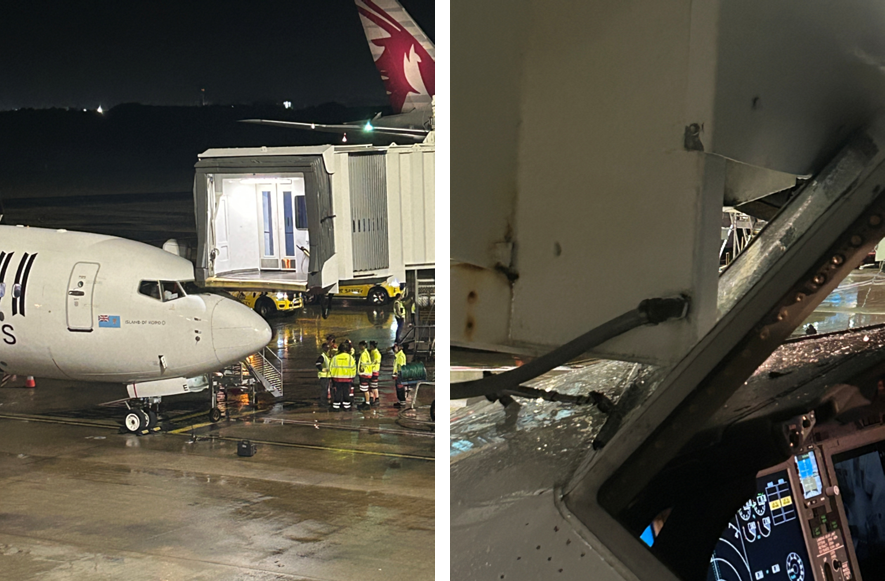
The engineer reached the button at the exact moment the airbridge collided with the right-hand side of the cockpit windscreen, sending shards of glass flying towards the First Officer.
A little more than a month later, on July 26, 2025, a very similar incident occurred when a Boeing 737MAX-8 operated by Fiji Airways arrived at the gate following a flight from Nadi, Fiji.
On that occasion, the pilots again noticed the airbridge getting unusually close to the cockpit as it was being maneuvered to the forward left-hand door. They assumed that the airbridge was going to stop, but it continued going, hitting the left-hand side of the cockpit windscreen.
In this incident, the Captain had just enough time to get out of his seat before the glass was sent flying in the cockpit.
Aircraft accident investigators from the Australian Transport Safety Bureau (ATSB) were called in, and they found that the setup of this particular jetbridge at Gate 82 was a big factor in both accidents.
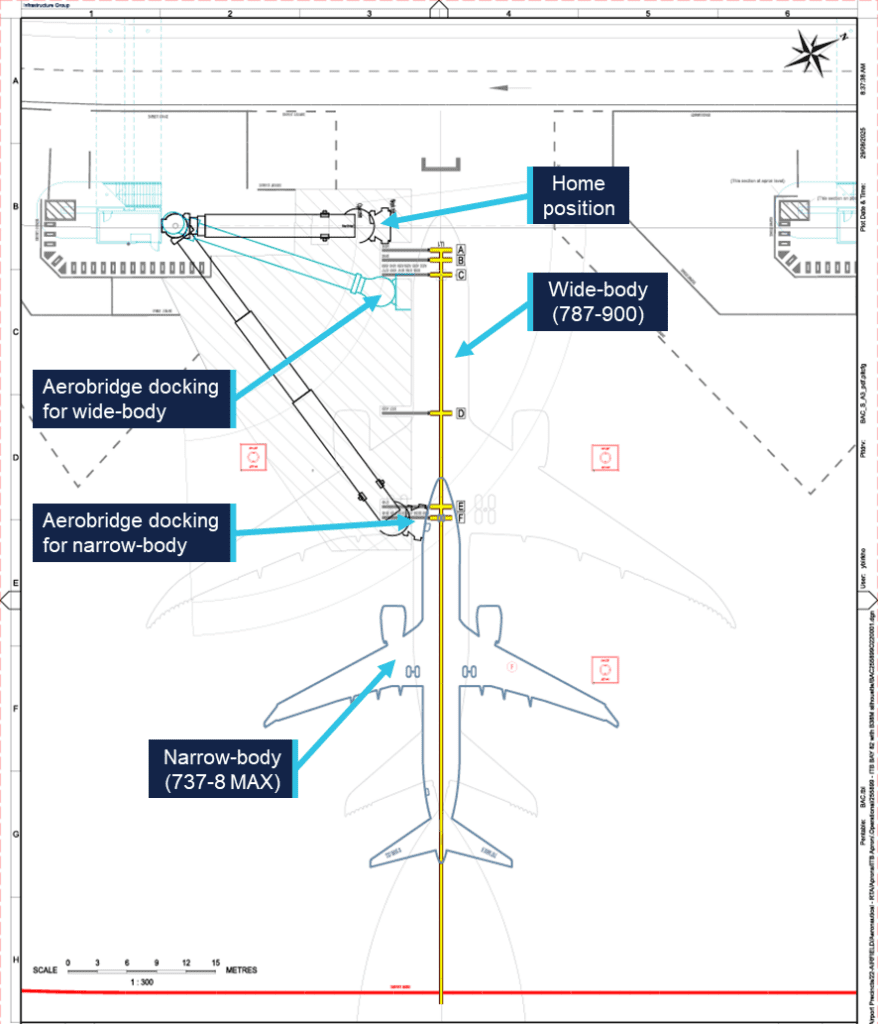
You might be accustomed to seeing the jetbridge always positioned to the left-hand side of an airplane, which was also the case at Gate 82, although there was one big, significant difference.
Because Gate 82 handled both widebody and narrowbody planes, the parking position for narrowbody planes was much further back from the gate in order to reduce the slope that passengers would have to ascend as they deplaned.
As a result, the jetbridge operator had to swing the jetbridge out before positioning it to the side of the plane. Unlike some jetbridges, however, the bridge at Gate 82 didn’t have side viewing windows, so the operator had reduced visibility of the plane they were guiding the bridge towards.
In other words, for portions of the maneuver, the operator was moving the jetbridge without being able to see the aircraft.
Although this is something that had worked on many occasions in the past, last summer, luck ran out, resulting in these two ground collisions.
“The ATSB’s investigation identified safety factors common to both occurrences, finding that both aerobridge operators could not see the parked aircraft when they began to extend the aerobridge,” commented Chief Commissioner Angus Mitchell following the publication of a report into the two accidents.
“Narrow-body aircraft, such as the 737, sit lower to the ground than wide-body aircraft,” Mitchell explained.
“As a result, to minimise the slope of the passenger tunnel, at Gate 82 they park further from the aerobridge home position than would be the case for wide-body aircraft, or at a gate designed only for narrow-body aircraft, such as many domestic terminal gates. This meant the Gate 82 aerobridge had to extend much further, and almost parallel to a narrow-body aircraft, in order to attach to it.”
In both of these accidents, the operator moved the joystick to a 3 o’clock position, unaware that this orientation would change the aerobridge’s direction of travel.
“Consequently, as it extended, the aerobridge moved diagonally towards the aircraft, rather than parallel to it, while the aerobridge operator did not have visual reference,” Mitchell continued.
Since these two accidents, Brisbane Airport has updated its training program for jetbridge operators, and new guidance in the cab of the jetbridge at Gate 82 has prevented any further occurrence.