



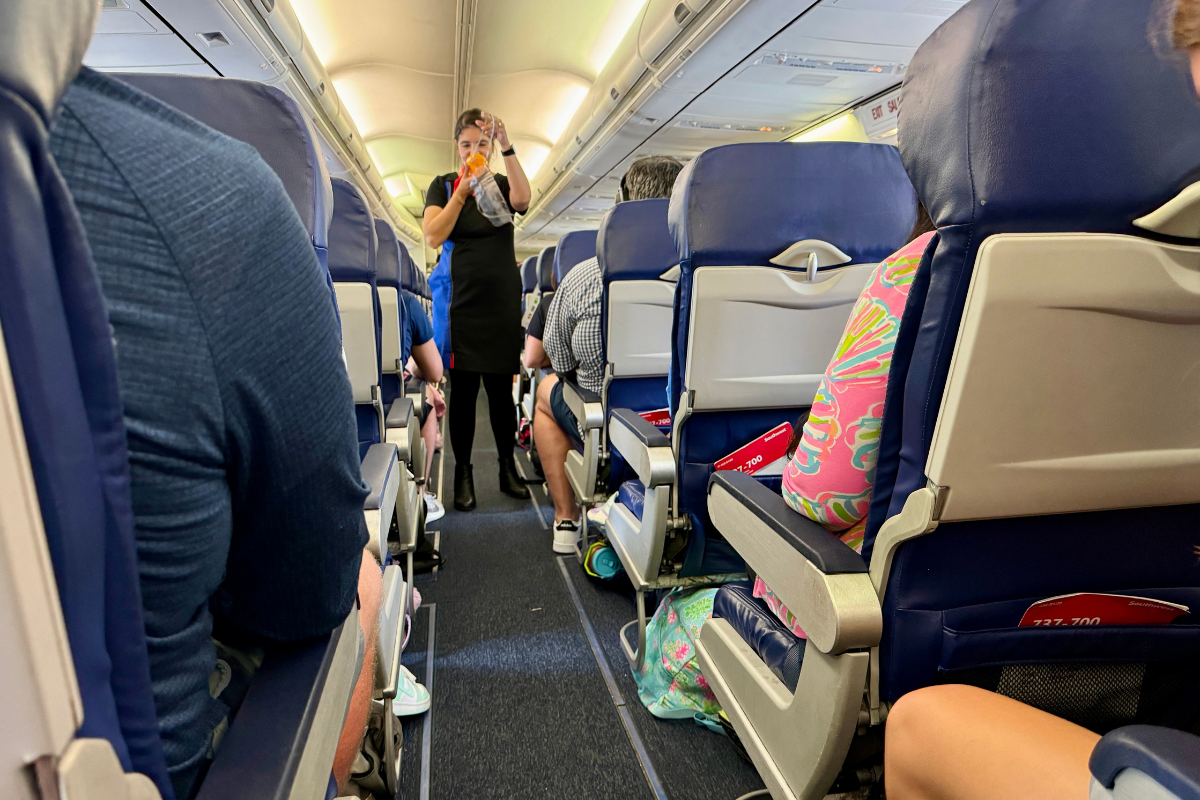
Southwest Airlines is further tightening its in-flight power bank rules, going much further than any other U.S.-based airline with its new mandate that even exceeds recently updated international regulations.
The Dallas-headquartered airline became the first and, so far, the only U.S. carrier to introduce portable power bank rules in May 2025 when it banned passengers from using them to charge other devices when stored in a bag or overhead bin.
From April 20, 2026, however, Southwest will further tighten these regulations, barring passengers from carrying more than one power bank and ordering passengers to keep them in sight at all times, and out of the overhead bins altogether.
The new rules – What you need to know
- Passengers can only bring one portable power bank
- The power bank must be kept in plain sight and must not be stored in the overhead bin.
- Passengers can still use power banks to charge their devices, but they must not use the in-seat power to charge the power bank.
- Power banks must never be placed in checked-in luggage.
Southwest Airlines is introducing the tough new power bank regulations in response to a slew of incidents involving lithium batteries catching fire in-flight, prompting emergency diversions and, on occasion, evacuations onto the runway.
Any device powered by a lithium battery, such as a cellphone, laptop, e-cigarette, or power bank, has the potential to overheat and catch fire, in a process known as ‘thermal runaway.’
The term ‘thermal runaway’ comes from the fact that Lithium batteries are made up of lots of fuel cells. When one cell overheats, this can quickly spread to the next cell and so on until the power bank explodes into flames.

A thermal runaway can cause lots of heat, sparks, fire, and smoke, and can be very difficult to extinguish.
A growing number of international airlines around the world have introduced new power bank rules in response to a January 2025 incident aboard an Airbus A321 airplane operated by Air Busan, which was preparing for departure at Gimhae Airport in South Korea.
A lithium battery caught fire in a passenger’s rucksack during boarding, but no one noticed what was happening as the battery was hidden away in a closed overhead bin.
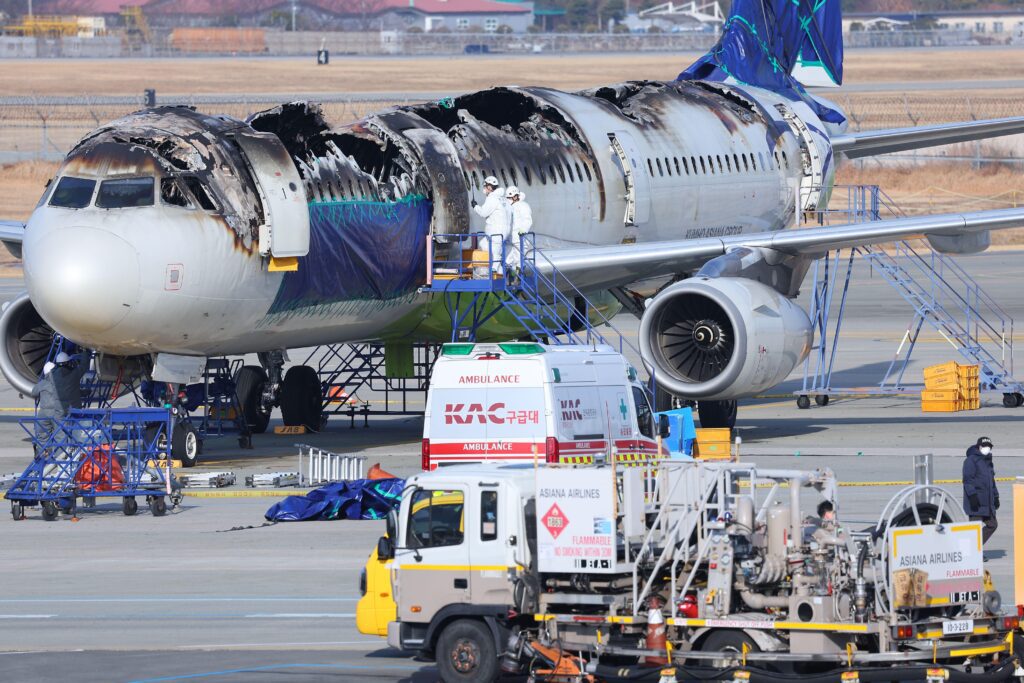
When smoke started to pour out of the overhead locker, flight attendants rushed to extinguish the fire, but it was already too late. The fire was quickly spreading, and an emergency evacuation was ordered. The ensuing blaze engulfed the aircraft, completely gutting the fuselage.
Since then, the International Air Transportation Association (IATA) has carried out a review of power bank rules, as the airline industry believes that these pose the greatest danger.
IATA’s revised regulations limit passengers to two power banks each. Power banks should be kept in sight and cannot be used to charge devices on the plane or charged via the in-seat power supply.
These regulations have also been adopted by the International Civil Aviation Organization (ICAO), although, so far, surprisingly few airlines have adopted these regulations as written.
Some airlines have, however, gone even further: Dubai-based mega carrier, for example, limits passengers to just one power bank each, with all other recommendations adopted as written.
Elsewhere, Australian flag carrier Qantas and the Lufthansa Group have adopted the IATA and ICAO regulations as written. Many more airlines are expected to follow up in the months ahead as they work to integrate the updated regulations into their internal policy documents.