

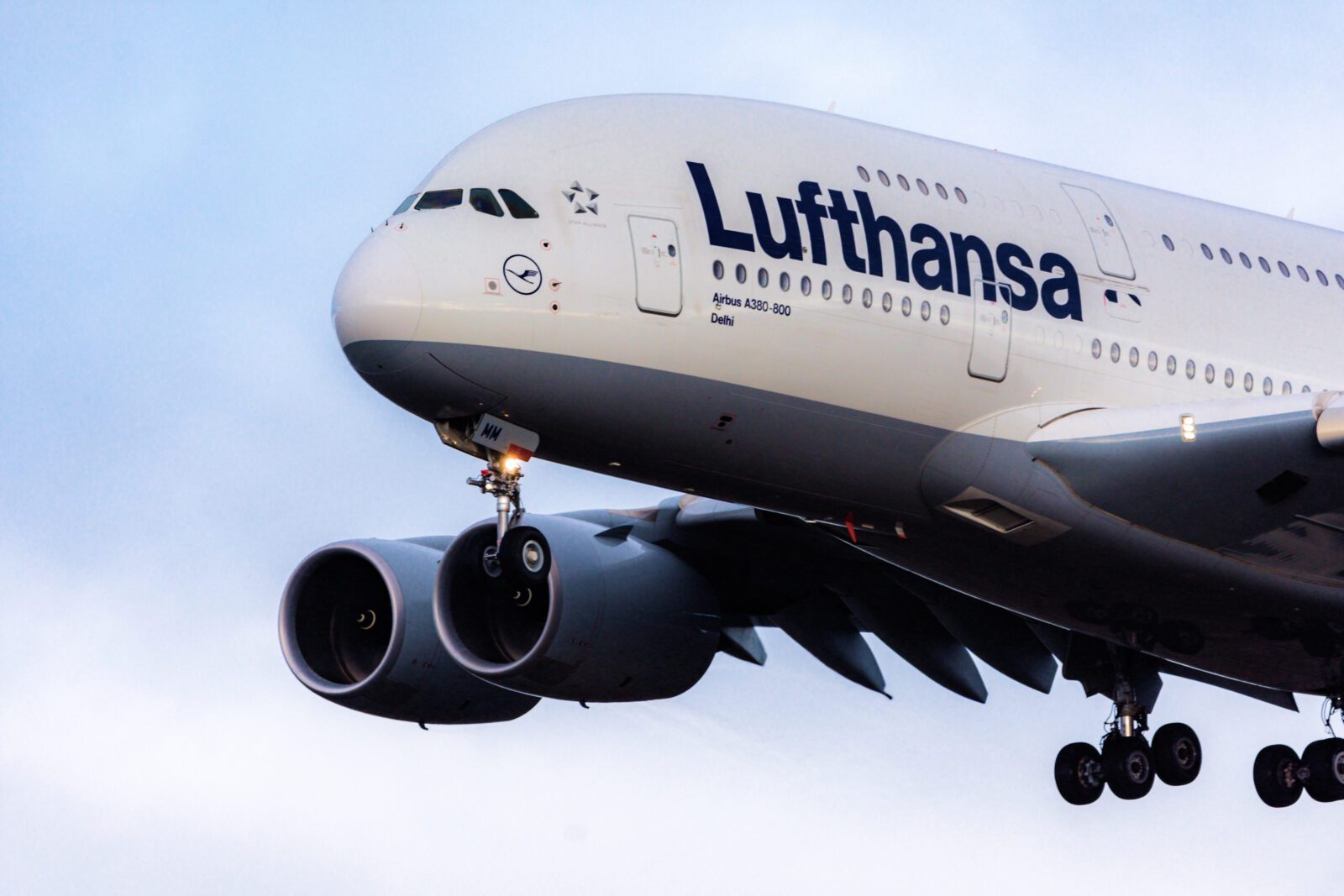
- A Lufthansa A380 carrying 351 passengers struck runway approach lights while landing short of the threshold at Munich Airport, just days after a Vietnam Airlines Boeing 787 suffered a similar collision on the same runway.
- Why landing short of the threshold isn’t the same as missing the runway entirely, and how Munich’s approach markings work.
- How this incident connects to last weekend’s Vietnam Airlines runway overrun, now being investigated by the same German accident bureau.
- What condition the aircraft is in more than 24 hours later, and what damage the landing gear sustained.
- Why the weather forecast at the time of landing makes the cause of the incident unclear.
A Lufthansa Airbus A380 superjumbo with 351 passengers on board smashed into several runway approach lights as it landed at Munich International Airport (MUC) on Monday evening following a 10-hour transatlantic flight from San Francisco (SFO).
The incident occurred just 48 hours after a Vietnam Airlines Boeing 787-9 Dreamliner smashed into the runway approach lights at the opposite end of the same runway while taking off from Munich Airport.
- Flight Number
- LH459
- Aircraft Type
- Airbus A380-800
- Registration
- D-AIML
- Operator
- Lufthansa
- Route
- San Francisco (SFO) to Munich (MUC)
- Runway
- 26L
- Passengers Onboard
- 351
The aircraft involved in this latest accident was a 12-year-old A380 (registration: D-AIML) operating flight LH-459, which departed San Francisco at 10:20 pm on August 16 with a scheduled arrival time of 5:10 pm on August 17.
The plane was vectored in to land on Munich’s southern runway, which is known as 26L, but the pilots landed short of the runway threshold. Given that the aircraft was lower than expected on its final approach, the landing gear swiped the runway approach lights, colliding with several of the lights.
When lining up to land on a runway, pilots will normally ‘glide’ along part of the runway before touching down in a designated area. On Munich’s Runway 26L, there is a chevron area which marks the absolute start of the concreted runway area, then the lined threshold area, before the touchdown area.
That means that while the pilots landed short of the threshold, it’s not like they didn’t land on the concrete runway itself.
The incident is being investigated by Germany’s BFU accident investigation department, who are already probing a serious incident involving a Vietnam Airlines Boeing 787-9 Dreamliner that took off past the end of the concrete runway on Saturday, August 15, from Runway 26L.
In that accident, the landing gear of the plane collided with the runway approach lights on the opposite end of the runway. The aircraft eventually landed on Runway 26R, where it became disabled and had to be towed back to the gate.
Munich Airport had been experiencing some heavy thunderstorms in the hours leading up to the Lufthansa incident on Monday, but at the time the plane landed, the weather forecast was for passing showers and visibility of around 10 km.
The aircraft landed without further issue, and the pilots were able to taxi the double-deck aircraft to the gate under its own power. There were no reports of injuries on board.
More than 24 hours since the incident, and the plane remains grounded. There are reports that the landing gear sustained damage from colliding with the runway approach lights.
Want to see more stories like this? Add PYOK as a preferred source on Google, and we'll show up more often in your searches and Google News.
Add PYOK as a Preferred Source