



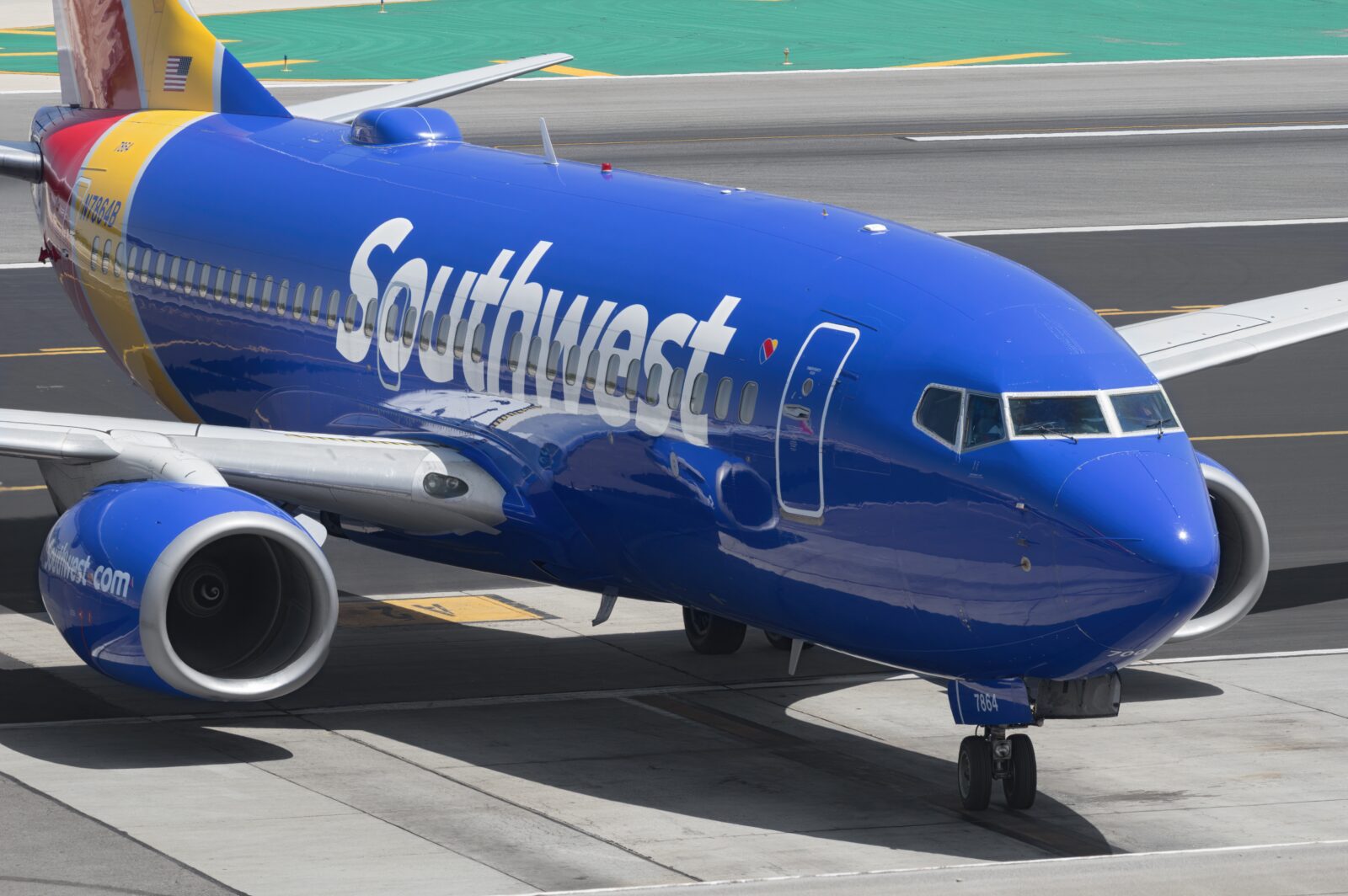
Southwest Airlines is looking to expand its route network to a “number of international destinations” and is now looking to negotiate with the respective unions that represent its pilots and flight attendants over how this might work in practice.
On Wednesday, the TWU 556 union, which represents tens of thousands of flight attendants at the Dallas-based carrier, revealed that Southwest Airlines had invoked a clause in its contract that allows the airline to start discussions about international expansion.
A similar clause has been activated in the contract for pilots, and Southwest is hoping to begin negotiations with the Southwest Airlines Pilots Association (SWAPA) soon.
“Southwest Airlines has notified TWU Local 556 that, in accordance with Article 24.5.D., they wish to engage in discussions regarding a potential Side Letter of Agreement to serve a limited number of new International destinations not currently covered by our Collective Bargaining Agreement (CBA),” the union informed its members on August 20.
Southwest only started flying internationally in 2014. This marked a massive shift for the carrier, given that it had been solely a domestic airline for 40 years, but even now, Southwest’s international footprint is remarkably small.
The contract covering flight attendants at Southwest is mainly focused on its domestic operations, but there are provisions for its limited international network, which only covers Mexico, Central America, and the Caribbean.
Any further international expansion will require new negotiations with aircrew, which will cover working conditions such as maximum flying and duty hours, minimum rest requirements, and potentially incentive pay for flying to certain destinations.
We already know that Southwest plans to start non-stop flights to Iceland in 2026, although chief executive Bob Jordan has revealed that the airline is eyeing a much larger international network across Europe, and Latin America, with even Africa and Asia in consideration as well.
Southwest has already submitted paperwork to the US Department of Transportation (DOT) seeking permission to fly to any country that has a so-called Open Skies agreement with the United States.
An Open Skies agreement is a treaty between two countries that removes the hurdles and red tape that once made it so hard for airlines to enter a new international market.
The United States has Open Skies agreements with dozens of countries around the world, including all of the European Union and the United Kingdom, as well as India, Japan, Thailand, Australia, and South Korea, to name but a few.
The obvious issue that is holding Southwest back, however, is that its current fleet of Boeing 737s isn’t suitable for long-haul international flying.
That’s not to say that certain destinations can’t be reached between the East Coast and some destinations in Europe, but, realistically, if Southwest is serious about building an international network, it will need to review its aircraft fleet with the potential for widebody aircraft to come.
All of this is being spearheaded by activist investor Elliott, which is pushing Southwest to completely overhaul the business strategy that made the airline what it is… or, what it was.
Elliott won a battle to place its pick of directors on the Southwest board and now exerts massive influence over the airline. The investment group believes that in order to thrive, Southwest has to start acting much like any other big airline in the United States.
To that end, the airline has already ditched its ‘Bags Fly Free’ policy, while open seating will disappear early next year. The airline is also forging partnerships with international carriers, although this is currently limited to Icelandair and China Airlines.
These partnerships include interline agreements that allow international passengers on these partner airlines to connect onto a Southwest flight on a single booking.