



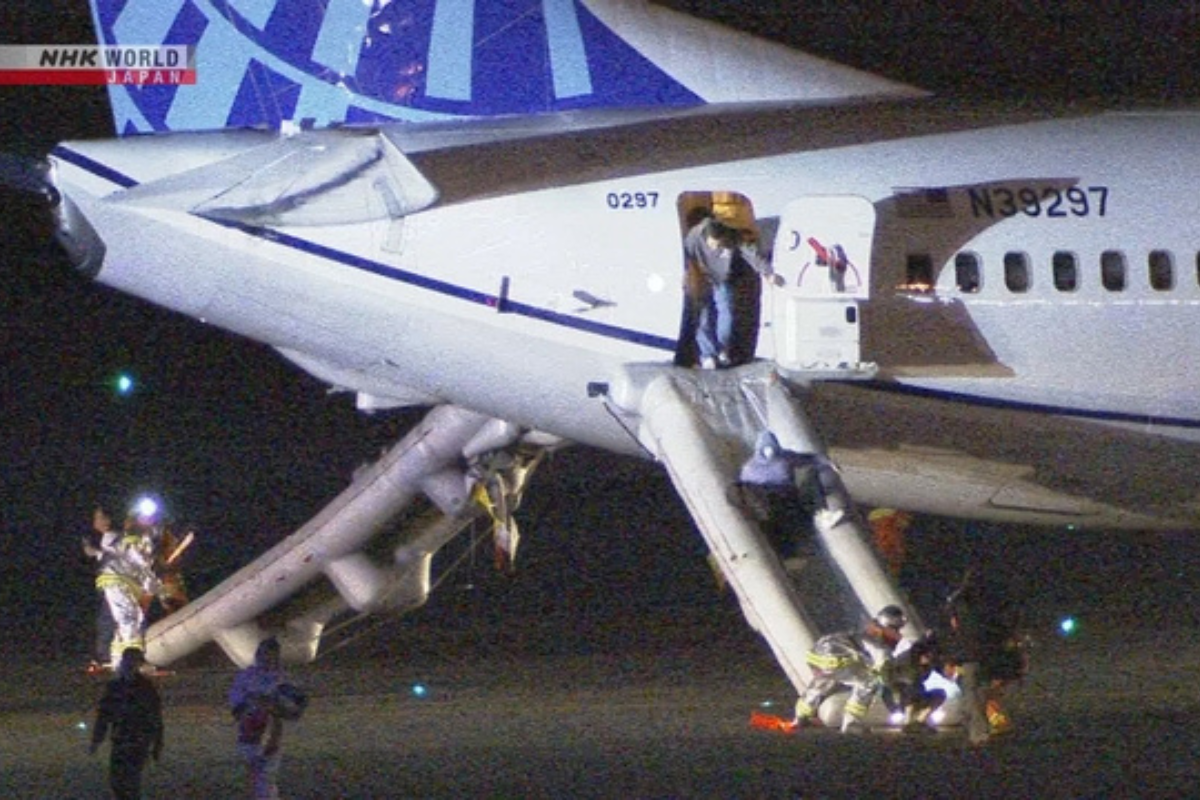
A United Airlines Boeing 737 made an emergency diversion to Kansai International Airport in Osaka, Japan, on Friday evening after the pilots received a cockpit alert warning them of a fire in the cargo hold.
United flight UA-32 departed Tokyo at around 5:40 pm (Japan Standard Time) on September 12 for the four-hour flight to Cebu, Philippines. The aircraft climbed to a cruising altitude of around 34,000 feet and then started heading southeast towards the Philippines.
Flight and aircraft details
- Flight Number: United Airlines UA32
- Route: Tokyo Narita (NRT) – Cebu (CEB)
- Aircraft: Boeing 737-800
- Registration: N39297
- Occupants: 135 passengers / 7 crew
- Injured: Two passengers were transported to the hospital
Just 40 minutes later, however, the pilots suddenly diverted north, back towards Japan, as they declared an emergency due to a cargo hold fire indication.
The plane landed without incident at Kansai Airport in Osaka at around 7:30 pm, and an evacuation using emergency escape slides was ordered. Of the 135 passengers and seven crew members onboard, two passengers were injured in the evacuation and were transported to a local hospital.
In a statement, a spokesperson for United Airlines said that an initial inspection of the aircraft revealed no evidence of an actual fire in the cargo hold.
Kansai Airport was briefly closed due to the unavailability of the fire service, although one of the airport’s two runways has since reopened. The aircraft remains stranded on the other runway.
What is a United Airlines Boeing 737 doing in Japan?
A Boeing 737 does not have the range to fly all the way from the United States to Japan, so you might be wondering what a United Airlines 737 is doing in Japan in the first place.
The aircraft is one of a small number of 737s that United has stationed in the region to operate so-called tag flights, connecting hubs in the United States to regional destinations that don’t have the demand for a non-stop flight.
This particular flight (Tokyo to Cebu) is a continuation of United flight 32, which starts off in Los Angeles and is operated by a Boeing 787 Dreamliner to Tokyo.
Once in Tokyo, passengers with through tickets to Cebu transfer onto the smaller Boeing 737 to get them to their final destination. United also operates tag flights from Tokyo Narita to Taipei in Taiwan, Guam, Saipan, and Ulaanbaatar.
The tragic case of Saudia flight 163
45 years ago, on August 19, 1980, Saudi Arabia’s flag carrier Saudia suffered one of the worst aviation disasters in modern history when all 301 passengers and crew died when a fire erupted in the cargo hold of the Lockheed L-1011 Tristar shortly after takeoff from Riyadh for what should have been a routine flight to Jeddah.
Accident investigators were never able to fully explain the exact cause of the fire, but a leading theory is that butane gas tanks being carried in the cargo hold caught fire, and this quickly resulted in a raging fire that broke through the floor of the passenger cabin.
Flight attendants desperately tried to put the fire out with the onboard extinguishers, but their efforts were in vain as the flames and smoke continued to spread throughout the cabin.
Despite the seriousness of what was unfolding in the passenger cabin, inside the cockpit, the pilots initially delayed diverting back to Riyadh, and when they did eventually land, the plane rolled down the entire length of the runway for two minutes and forty seconds.
When the aircraft finally came to a stop, firefighters waited on the tarmac for the doors to open and the evacuation slides to deploy, but none of the doors were ever opened.
The flames burned through the roof of the plane and gutted the entire aircraft. All of the passengers and crew perished inside.
Why Saudia flight 163 is still such an important lesson for the aviation industry
No one will ever fully understand why the pilots delayed diverting back to Riyadh or why they didn’t perform an emergency stop on the runway so that the doors could be opened straight away, but these decisions still inform today’s pilots about how they should deal with a cargo fire indication.
In essence, even without evidence of smoke or fire, a cargo hold fire is an emergency that requires diverting to the nearest airport and, in most cases, an evacuation onto the tarmac.
Although modern aircraft are fitted with cargo hold fire suppression systems, there is no way to know whether these have been effective until the aircraft is on the ground, so it’s essential to land as quickly as possible.