



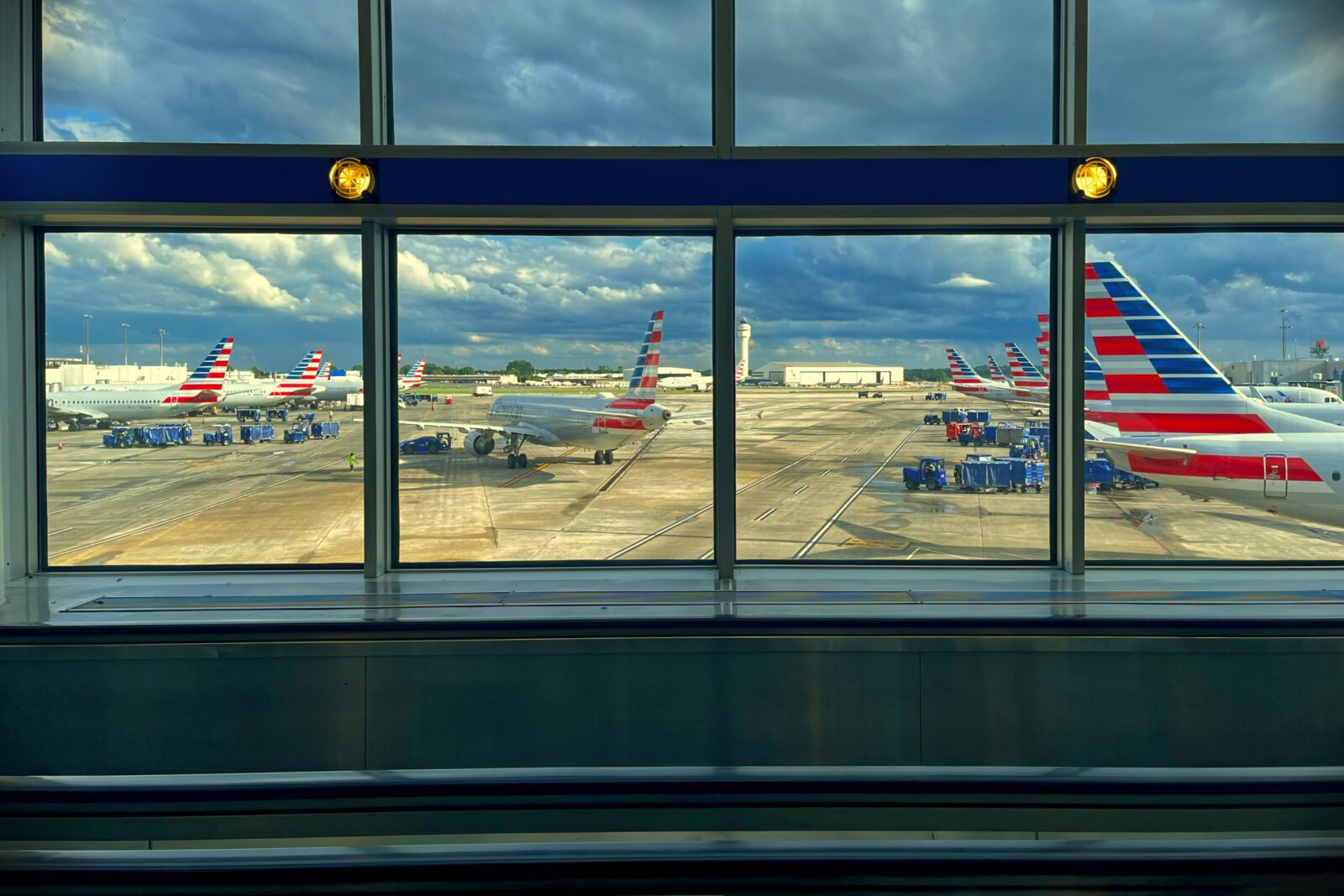
Air travel is set to get a lot harder from this Friday unless the Trump administration can get the federal government reopened. Flights to and from 40 major US air markets are set to be slashed by as much as 10% in an attempt to relieve pressure on stretched air traffic control services.
Airlines have been ordered by the Department of Transportation (DOT) to “meaningfully reduce their schedules,” and they’ve been given little more than 48 hours’ notice to make seismic changes to their complicated flight plans.

The dramatic decision to axe tens of thousands of flights across the United States was announced by under pressure Transportation Secretary Sean Duffy on Wednesday, who said his sole aim was to keep Americans safe.
Your questions answered at the bottom of the article.
“Our sole role is to make sure we keep this airspace as safe as possible… There is going to be a 10% reduction in capacity at 40 of our locations. This is data-based. This is not based on what airline has more flights out of what location. This is about ‘where is the pressure and how do we relieve the pressure.'”
The pressure is primarily coming from a stretched and overworked air traffic control service, which is facing mounting staffing shortages as the record-breaking government shutdown continues without any sign of being resolved.
Controllers are being ordered to work unpaid for the foreseeable future, relying on food handouts from airlines and airports, but an increasing number of these unpaid federal workers aren’t showing up for their shifts as planned.
The issue, though, is that it’s not very easy to predict where these staffing shortages are going to occur. One day, a major airport like Newark might have enough air traffic controllers on duty to deal with a packed schedule, but the next day, too many controllers have called out and flights need to be canceled.
The Federal Aviation Administration (FAA) hopes that reducing flights in and out of major US airports will relieve pressure across the entire National Airspace System, although that seems pretty simplistic.
Major airports with significant ATC staffing shortages will need to cut capacity by far more than the planned 10%, although it will be hard to predict when these cuts will have to be made until the controllers on any given shift fail to turn up for work.
Then there’s the sheer magnitude of the logistics involved in how most US airlines plan to alter their flying schedules. Carriers like American or United can’t just trim 10% of flights in and out of major hubs without a ripple effect across their entire schedule, with pilots, flight attendants, and airplanes out of position.
In a statement, United Airlines said it planned to make rolling updates to its schedule and hoped to give affected customers at least a few days’ notice of their flight being delayed or canceled.
Meanwhile, American Airlines said it still anticipated that the “vast majority” of passengers would be able to travel as planned. The airline added: “We continue to urge leaders in Washington to reach an immediate resolution to end the shutdown.”
Although Duffy and the FAA were unable to provide a list of the 40 affected airports at their news conference on Wednesday, the list has now leaked:
- ANC Anchorage
- ATL Atlanta Hartsfield
- BOS Boston Logan
- BWI Baltimore/Washington
- CLT Charlotte Douglas
- CVG Cincinnati/Northern Kentucky
- DAL Dallas Love Field
- DCA Ronald Reagan Washington National
- DEN Denver
- DFW Dallas/Fort Worth
- DTW Detroit Metropolitan Wayne County
- EWR Newark Liberty
- FLL Fort Lauderdale/Hollywood
- HNL Honolulu
- HOU Houston Hobby
- IAD Washington Dulles
- IAH George Bush Houston
- IND Indianapolis
- JFK New York John F Kennedy
- LAS Las Vegas McCarran
- LAX Los Angeles
- LGA New York LaGuardia
- MCO Orlando
- MDW Chicago Midway
- MEM Memphis
- MIA Miami
- MSP Minneapolis/St Paul
- OAK Oakland
- ONT Ontario
- ORD Chicago O’Hare
- PDX Portland
- PHL Philadelphia
- PHX Phoenix Sky Harbor
- SAN San Diego
- SDF Louisville
- SEA Seattle/Tacoma
- SFO San Francisco
- SLC Salt Lake City
- TEB Teterboro
- TPA Tampa
Will my flight be safe if I’m not flying to or from one of these airports?
It’s too soon to say how widespread the disruption will be, but there’s no guarantee that just because your flight isn’t between one of these 40 airports, it will go ahead as planned due to the disruption caused by the capacity reduction.
Many US airlines operate as ‘network carriers’, which means that their airplanes don’t start and end in the same airport every day. An airplane, along with its crew, will move from one city to the next, as part of a complicated schedule that might not make any sense to the casual observer.
When there’s a disruption in one part of the network, it can have ripple effects across the entire network. Given that capacity cuts are being made at major hubs for all three Big US airlines, along with Southwest and Alaska, expect disruption to be widespread.
That being said, the FAA plans to safeguard flights between major hubs, while regional flights will be harder hit.
Are international flights going ahead as planned?
The capacity reductions are mainly aimed at relieving pressure on air traffic controllers dealing with domestic and regional, rather than long-haul international flights.
At the moment, United Airlines says it plans to operate its long-haul international schedule as planned.
What does a 10% reduction mean in real terms?
Some estimates suggest that a 10% reduction in capacity could equate to between 4,000 and 5,000 flights per day across the United States being axed. Of course, that’s without any additional capacity cuts due to local staffing shortages, as well as ‘downline’ cancellations.
It’s also been revealed that the 10% reduction won’t be introduced straight away. On Friday, November 7, the capacity reduction will start at 4% and then progressively works up to the 10% cut.


You mean Friday November 7th NOT Friday October 7th!