



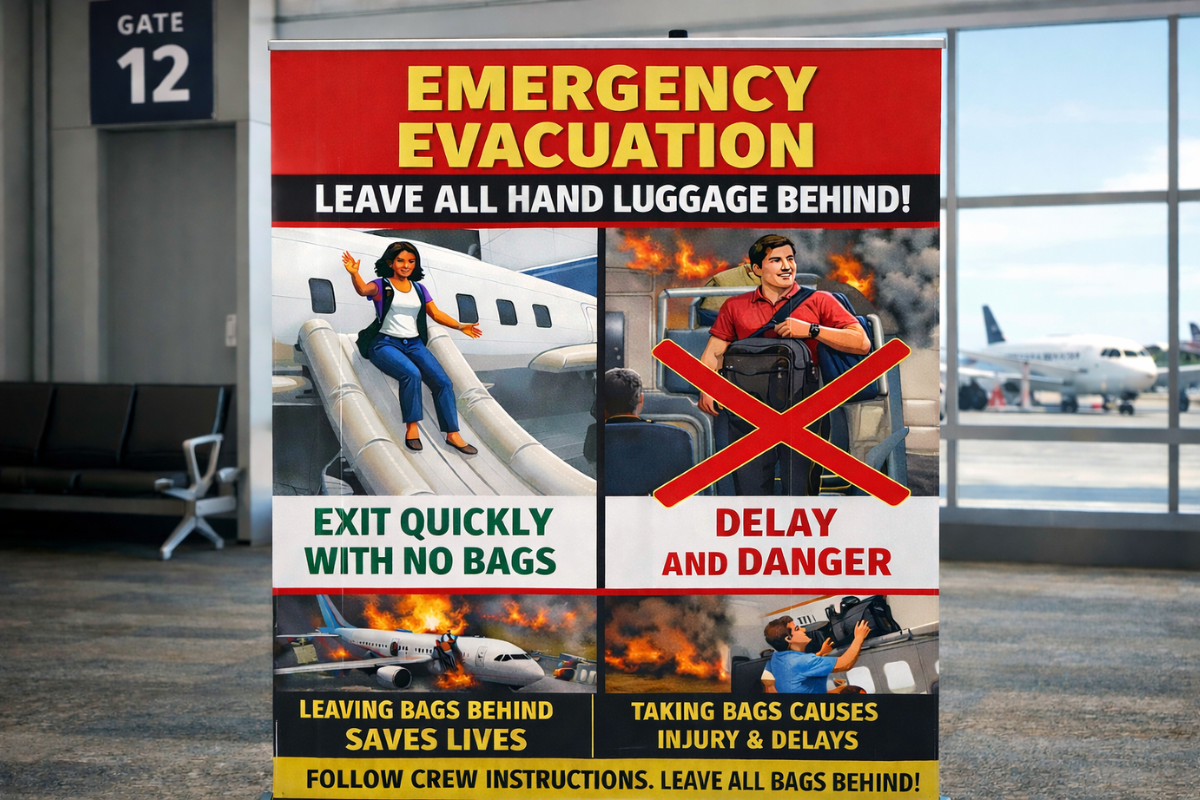
Airlines are being implored to put up posters at airport gate areas warning passengers of the dangers of stopping to take their hand luggage with them in the event of an emergency evacuation.
The suggestion from the Federal Aviation Administration (FAA) is in response to a worrying increase in the number of evacuations that have been significantly delayed by passengers dragging large rollaboards and holdalls off the plane.
Thankfully, in the United States, at least, this alarming trend hasn’t resulted in any serious injuries or loss of life, but the aviation industry and regulators are becoming increasingly concerned that it’s only a matter of time before passengers delaying an evacuation leads to a catastrophe.
Towards the end of 2025, the FAA sent what is known as a “Safety Alert to Operators’ or SAFO to U.S. commercial airlines, urging them to take action to ensure passenger compliance with evacuation rules.
“Operational data, post-event analyses, and safety reports have identified a recurring safety hazard: passenger attempts to retrieve carry-on items during evacuations,” the SAFO warned.
“This behavior directly affects safety by undermining evacuation efficiency. It has been cited as a contributing factor in delayed evacuations, increased injury rates, and compromised survivability during time-critical emergencies involving smoke, fire, or structural damage.”
While the FAA stopped short of mandatory action, the agency is pushing airlines to implement a slew of recommendations, which include:
- A thorough review of emergency evacuation procedures, crew training, commands, and emergency announcements to press home to passengers that they must leave all hand baggage behind.
- Update pre-flight safety briefings to make it clear to passengers what to do in an emergency, using standardized and concise messaging to make it clear that hand luggage must be left behind with no exceptions.
- Display posters and other visual content in airport terminals, demonstrating appropriate evacuation behavior and consequences of non-compliance with crewmember commands.
The FAA also provides more details on how airlines are expected to educate passengers, telling carriers that they should use messaging that appeals to “collective responsibility” and which normalizes expected behavior that everyone leaves their luggage behind.
For example, the FAA suggests that airlines use slogans like: “Help everyone get out safely—leave your bags.” The agency also recommends that airlines use pictures and symbols that properly convey the message across language barriers.
Aircraft are designed to be evacuated in just 90 seconds with only half of the emergency exits operational, but recent real-life evacuations have exceeded that strict time limit by a long way.
Aircraft manufacturers would commonly simulate evacuations in mockup planes with volunteers, but these simulations never accounted for passengers delaying the evacuation by opening overhead bins to drag their heavy bags out with them.
Later this year, the International Air Transportation Association (IATA), a trade body that represents the vast majority of global airlines, plans to commence a major study investigating the psychology behind why passengers not only risk their own lives, but the lives of other people, by stopping to get their luggage in an evacuation.
“Looking at this from a psychological perspective is going to be really important in understanding whether this is a behaviour that we can change, and if it is, what do we need to do to appeal to people to do the right thing?” commented IATA’s head of safety, Nick Careen.
“It’s something that’s become noticeable. Luckily, it hasn’t resulted in deaths, but what we’re trying to do is avoid that,” Careen added.
If previous studies are anything to go by, the airline industry has its work cut out to change passenger behavior.
In 2018, for example, a study commissioned by the Royal Aeronautical Society (RAeS) in the United Kingdom revealed that:
- As many as 75% of Britons would stop to retrieve their luggage in an evacuation if they believed there was no immediate risk to their own safety.
- More worringly, 35% of respondents said they would still stop to get their bags, even if they thought there was an immediate risk to their safety.
The study also looked at why passengers might ignore safety instructions, and found:
- Nearly two-thirds of respondents claimed they would have an instinctive reaction to retrieve their belongings
- Around half said they didn’t trust the airlines to return their belongings.
- Around a third said they didn’t want the ‘hassle’ of replacing their belongings.
- Just over a third claimed their personal belongings were ‘too valuable’ to replace…. yes, apparently even more valuable than their life.
Bottom line
In a world where airlines increasingly turn safety briefings into comedy skits and destination infomercials, it might be a big ask of the FAA to expect airlines to get on board with its latest recommendations.