



A Federal Aviation Administration (FAA) safety inspector has filed an extraordinary lawsuit against United Airlines, claiming the Chicago-based carrier retaliated against him when he raised a safety issue aboard a May 2022 flight.
United Airlines allegedly imposed a lifetime ban on the inspector and filed an official complaint with the FAA against him, knowing that he had been investigating the airline over alleged safety violations of its Boeing 737MAX fleet.
FAA safety inspector sues United Airlines
Paul Asmus, an aviation safety inspector for the FAA, has filed an incredibly unusual lawsuit against United Airlines, accusing the carrier of defamation, tortious interference with employment, fraudulent misrepresentation, and civil extortion, amongst a slew of other allegations.
A lengthy 76-page civil complaint was filed in a San Jose district court last week, which provides painstaking detail alleging that United’s “conduct sends a clear and dangerous message: those who report safety hazards risk punishment, removal, and financial sanction.
United Airlines branded inspector a threat to employees
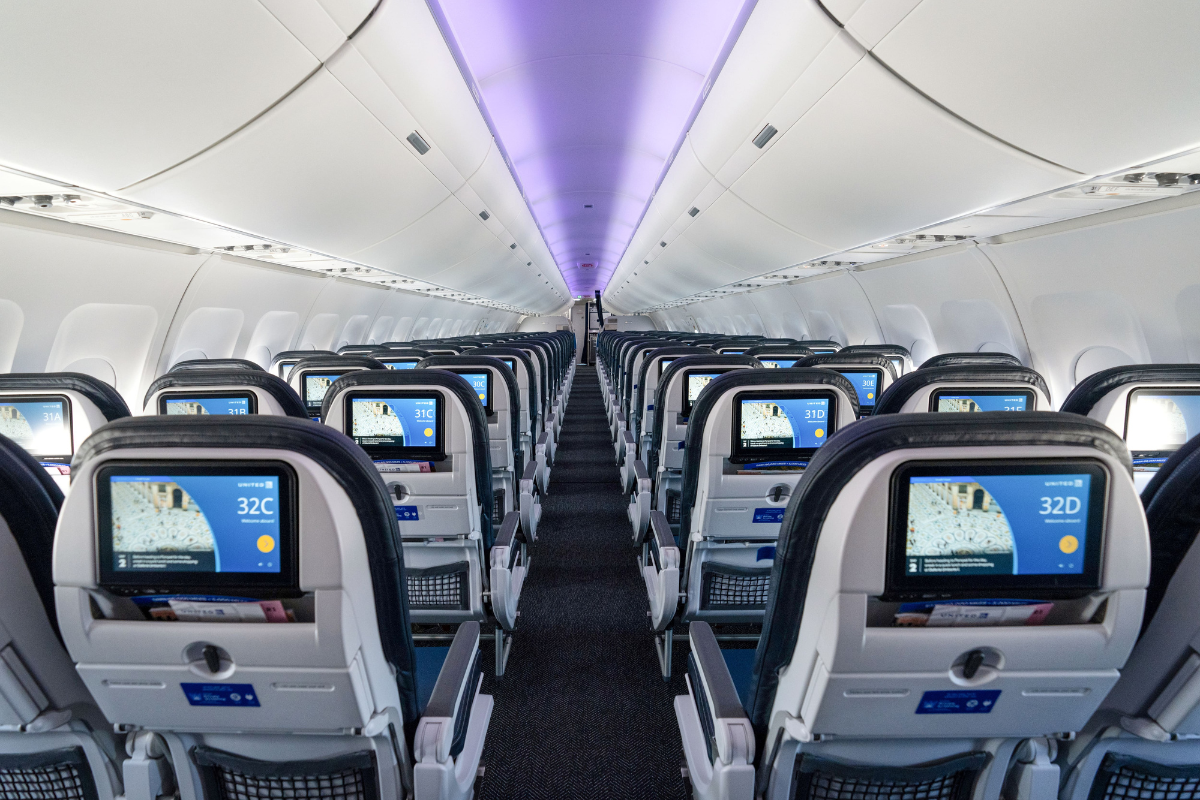
Asmus was traveling off-duty on a United Airlines flight on May 12, 2022. Upon boarding, he noticed that the seat back pocket at his assigned seat was torn. Although off-duty, Asmus says he was duty-bound to report this potential breach of FAA safety regulations, as the torn pocket “impaired the ability to secure and access the emergency briefing card.”
He took a photo of the seatback pocket, along with another photo of a passenger standing in the aisle during pushback, which is strictly forbidden.
The crew, however, allegedly accused Asmus of taking photos of them and accused him of being combative when he reported his safety concerns, accusing him of trying to get a free seat reassignment.
The Captain then allegedly demanded that Asmus show the photos he had taken or the plane would return to the gate. Asmus complied with the request, proving that he hadn’t taken a photo of the crew members, but the plane still headed back to the gate, where he was deplaned.
United demanded more than $3,000 in restitution
Following his removal, Asmus claims United “knowingly portrayed a Federal Aviation Safety Inspector as a disruptive customer motivated by greed, rather than a regulator motivated by safety compliance.”
United quickly worked out that Asmus was indeed a bona fide FAA safety inspector and set about investigating whether he had booked a discounted airfare. Asmus alleges that this was all part of a plot to “build a case of character assassination.”
The airline imposed a travel ban on Asmus, demanded $3,153 in restitution from him for the return of the aircraft to the gate, and filed a complaint to the FAA, who, in turn, commenced a civil penalty enforcement action against him.
Inspector is moved off active investigation into United 737MAX jets
After Asmus was put under investigation, he was removed from oversight duties involving United Airlines, and specifically, an active investigation into the airline’s Boeing 737MAX fleet.
Asmus alleges that it was United’s aim all along to have him removed from this investigation.
Administrative law judge dismisses enforcement case against inspector
But when the civil enforcement case went before a Department of Transportation administrative law judge last June, the court ruled that United’s witnesses were unreliable, and the case against Asmus was dismissed.
The FAA chose not to appeal the verdict, so the findings of the judge are final and binding.
‘Chilling effect’ on safety reporting
In its ruling, the court wrote: “If passengers face interference charges for reporting concerns, ‘then no passenger would ever wish to tell the flight attendants about any safety problems,’ which would inevitably ‘impact the safety of the aircraft and the lives of all passengers on board.'”
The ruling further warned that “punishing safety reporting would chill aviation safety.”
Inspector demands $12.75 million from United
Following the court’s findings, Asmus wrote to United to have his travel ban lifted, but the airline has refused to do so.
Following that decision, Asmus is now suing United for $12.75 million, which includes $10 million in punitive damages, $2.5 million in general damages, and $250,000 in special economic damages. Asmus is seeking a jury trial.
United Airlines has yet to respond to the lawsuit. The allegations remain unproven.


Wait, he was originally going to complain about a torn seat back pocket? Because in the critical seconds of an accident, passengers would fumble to get the emergency card out and then (checks notes) have to read it to figure out what to do?
This screams disgruntled federal employee looking to point a finger at anyone but himself.
United didn’t ban the entire FAA. Whatever this guy did went way beyond reporting an issue. I am sure the FAA appointed someone else, and that person didn’t cause a big scene on the airplane. The FAA still has to provide oversight on all airplane types. It takes something really huge to get out on a lifetime ban list. I think United has a valid point, since the guy was not on duty and then made a scene that was bad enough for the pilot to go all the way back to the gate to have him removed.
This is a situation that escalated further than it should have. Multiple hot heads between the FAA inspector and the crew who just continued escalating the situation off each other. There was no immediate safety risk from the seat back pocket ESPECIALLY if there was a safety card present, even if it wasn’t top his liking. It could have waited until the end of the flight and he could have inquired with the captain as for the standing passenger, did he observe a flight attendant notice the standing passenger and did nothing or is it something he observed and the other passengers in his immediate vicinity? One is negligent and the other obviousness. Airlines can’t physically restrain the travelling public against their free will for obvious legal reasons.
I have an FAA ASI friend who has observed more egregious, but still minor and rare, safety errors than this on his personal travels, but they never rose, in his opinion, to the point of halting a flight. He waited until the end of the flight and all passengers deplaned and had a discussion with the offending crew member(s) in private. All off the record. Such conversations were always enough to correct small mistakes and errors. He recognizes human error is a real thing and hopes to bring renewed awareness to an individual.
I believe the person in this article created this hostile situation and I am willing to bet he went on a power trip. I have had the “pleasure” of working with ASI’s like this and the routine and baseless Letters of Investigation I received in the mail. My initial assumption was it was this individual. Surprisingly, it was someone else.
If a torn backseat pocket is the biggest issue this guy had I have a list. These airplanes are ancient and have not been taken care of. Period. Airline CEOs have pocketed their profits for decades and raised prices over and over. Anyone who is defending united or any other airline clearly has no concern or regard for their safety or that of anyone else on the plane. Stop defending elites. Stop defending the rich. When there is loss of life, they send their thoughts and prayers and forget about you the next day to check their stock options. We all know that Boeing has had major safety recalls and not enough has been done about it. The same planes that were in the sky in 1970 are in the sky right now. The only thing they have done is added more seats.
Robby is right.
It’s really a shame that the author hasn’t seen the actual 45 page judgement issued by the U.S. Administrative Law Judge. It totally exonerates the ASI and tells the FAA and United that they are completely off base.
There are six points in the final summary that are causing the FAA to revise their On vs. Off-Duty responsibilities of the ASI workforce and refute the testimony of the United flight crew.
To all you wannabe inspectors and aviation experts, you might want to reserve your commentary until you know the facts of the case. This ASI was simply pointing out a defect in the aircraft equipment. The protruding pocket frame wire that could injure a passenger seems to have been conveniently left out of all reports as was the testimony of the off-duty Captain sitting in the seat with the defect.
Here’s a little excerpt from the 45 page document:
“First, it is not intimidation or interference behavior for a passenger to orally report a
potential violation of aviation safety. Rather, it is every person’s regulatory duty, including
aviation passengers, to report aviation safety concerns. 14 C.F.R. 13.2. It is also well established
that ensuring safety and compliance with aviation safety regulations is part of the flight crew’s
normal job flight responsibilities. Part of these required flight crew safety-related duties is to
listen to a passenger (or other person’s) report of aircraft damage and/or safety concerns, and to
relay such reports to the Captain for logbook entry and action. Second, it should not matter
whether Mr. (ASI) was an FAA employee or an off-duty FAA Safety Inspector, or just an
anonymous traveler. Any passenger on any regulated aircraft should be able to report any
perceived potential safety violations without fear of dismissal, reprisal, public criticism, or
personal vilification.”
“As an FAA Inspector, Mr. (ASI) was “required”
to document “any safety-related issues” that he observed, whether on duty or off duty.”
“Sixth and finally, this case reveals certain discord between: 1) the broad scope of the
FAA’s mission to ensure safety in aviation; 2) its directive to its employees (and others) to report
air carrier regulatory safety violations whenever observed; 3) its commitment to work
collaboratively with its commercial, regulated air carriers; and 4) United Airlines expectations,
as a regulated air carrier, for formal notice and partnership collaboration when the FAA engages
in safety inspections, investigations, and regulatory enforcement actions.”
“IT IS HEREBY ORDERED:
1. The FAA failed to prove, by a preponderance of the evidence, that on May 12, 2022, Mr.
(ASI) committed a violation of the Interference Rule (14 C.F.R. § 121.580)
either by intimidating or interfering with a crewmember in the performance of the
crewmember’s duties.
2. The Interference Rule charge (14 C.F.R. § 121.580) against Mr.(ASI) is
dismissed with prejudice.
3. Pursuant to 14 C.F.R. § 13.232(d), this Initial Decision shall be considered a final order
unless either party files a notice of appeal within 10 days of service of this Initial
Decision pursuant to 14 C.F.R. § 13.233.”
No appeal to the judgement has been filed