



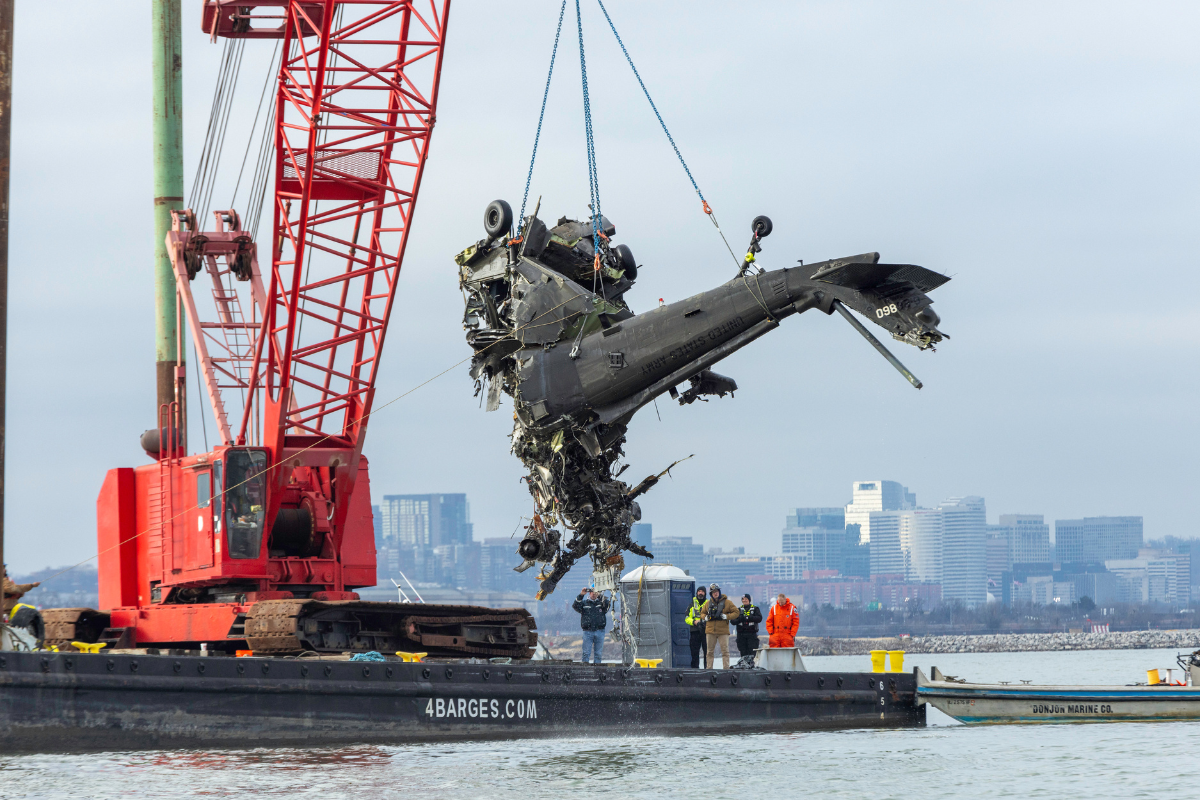
The family of a 16‑year‑old figure skater from Annandale, Virginia, who was one of 67 people tragically killed in the mid-air collision between an American Eagle regional jet and a US military Blackhawk helicopter on January 29, 2025, at Washington National Airport, are latest to have filed a lawsuit against American Airlines.
Cory Haynos was a “rising talent” in the figure skating world who had dreams of qualifying for the U.S. Figure Skating Championship before his untimely death last January.
He was one of 28 people on board American flight AA-5342, who were returning home after a successful outing at a national development camp held in conjunction with the U.S. Figure Skating Championships in Wichita, Kansas.
Not long before the accident, Cory had won a bronze medal at the 2025 Eastern Sectional Singles Final, and, like many of the 10 other skaters on board who were aged just 11 to 16, had a promising career ahead in the ultra-competitive world of figure skating.
In a new lawsuit filed in the District Court for the District of Columbia, Cory’s family is joining a master complaint filed by other relatives of the deceased, which accuses the US government, American Airlines, and its wholly owned regional subsidiary, PSA Airlines, which was operating the flight, of wrongful death and negligence.
On Thursday, Jennifer Homendy, chairwoman of the National Transportation Safety Board (NTSB), provided testimony to the House Committee on Commerce, Science, & Transportation, which has been reviewing the final report into the accident.
Homendy told the families of the deceased who attended the hearing in person that the accident had been “100% preventable” and that safety recommendations that the NTSB had made over a period of decades to prevent just this kind of tragedy had been repeatedly “rejected, sidelined, or just plain ignored.”
In her oral testimony, Homendy explained how a safety system known as Automatic Dependent Surveillance-Broadcast or ADS-B for short could have saved the lives of everyone onboard the CRJ regional jet and the Blackhawk helicopter.
ADS-B technology is made up of two parts:
- ADS-B out – which broadcasts the exact location of an aircraft
- ADB-B in – which receives the information about the location of aircraft in the vicinity
In conjunction, they would have alerted the pilots of the Blackhawk helicopter and the regional jet that they were on a collision course and given them ample warning to take corrective action.
Neither the Blackhawk helicopter nor the regional jet, however, had ADS-B in installed.
“With ADS-B In, the helicopter pilots would have gotten an audible alert (if it was in their headset) at 48 seconds prior to collision over Hains Point; they got nothing,” Homendy explained. “The CRJ, 59 seconds; instead, they had just 19.5. What we’re talking about here is lifesaving information for pilots.”
It’s been more than 18 years since the NTSB urged the Federal Aviation Administration (FAA) to mandate the use of ADS-B , but while ADS-B out was mandated in 2020, ADS-B in remains optional. In this case, the FAA hadn’t even approved the use of ADS-B in on CRJ-700 regional jets.
Homendy suggests the lack of action from the FAA is unfathomable. When given the option, airlines install ADS-B in. American Airlines has the technology on more than 300 Airbus A321 aircraft, Homendy says, even the oldest aircraft could be kitted out with ADS-B in for a few hundred dollars – all it would require is a smartphone iPad, a headset, and a receiver.
“The FAA has had multiple opportunities to implement NTSB recommendations and time after time has declined,” Homendy slammed.
“Now we need action — whether that’s through the FAA, Army, Department of War, or an Act of Congress. We cannot accept having to be here five years from now lamenting yet more inaction.”


The Army helicopter crashed into the regional jet and the family sues American Airlines.
What a sick, greedy country this is.
And the US government! Very important to note!