



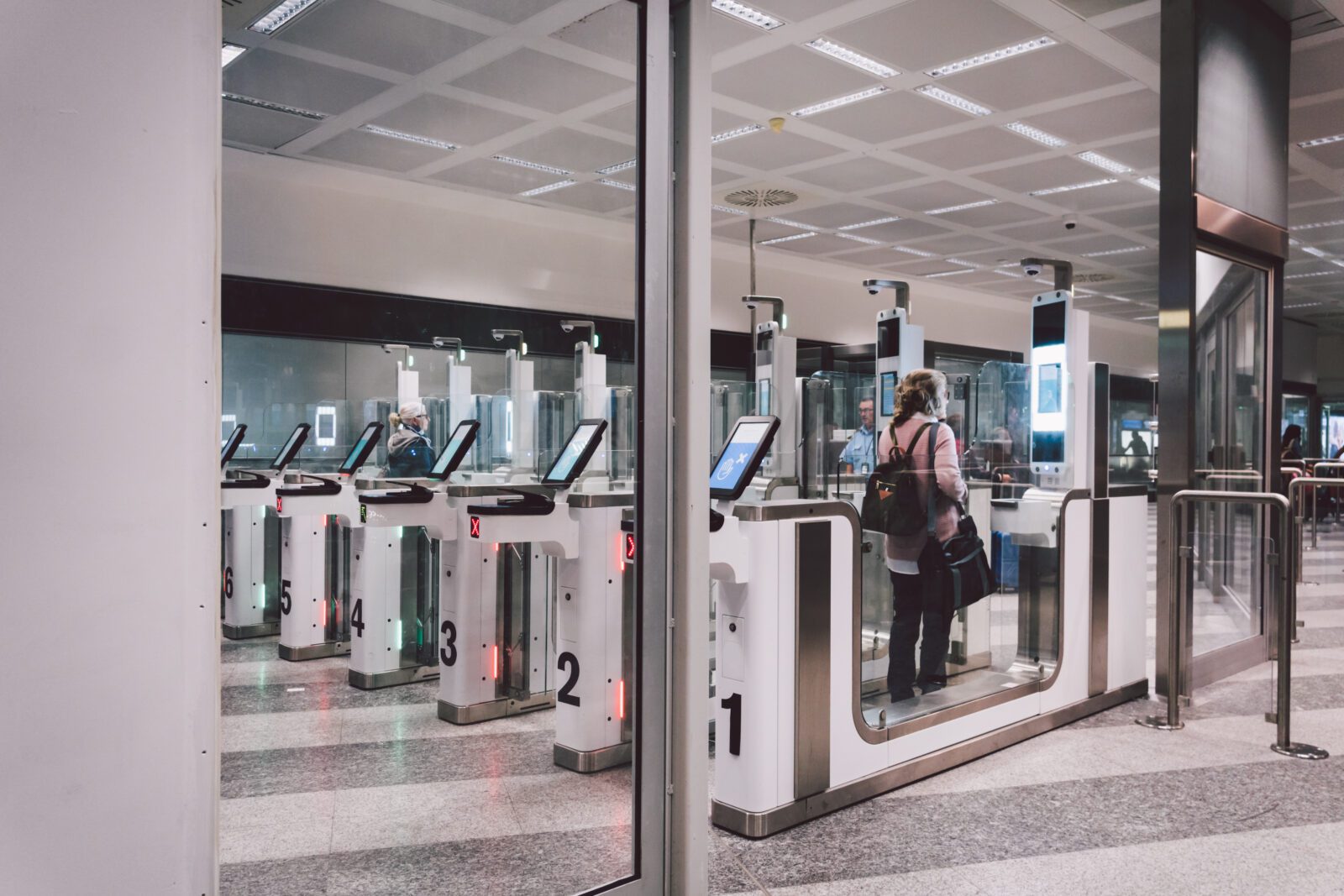
Passengers face chaos at airports across Europe, amidst agonizing waits of more than three hours just to get through immigration, if lawmakers push ahead with fumbled plans to fingerprint and photograph every single visitor from outside the EU.
That’s the warning from Airports Council International, the body that represents airports across Europe, which has warned that the new rules have already increased immigration processing times by more than 70% and a wider rollout of the rules will throw airports into disarray.

What is the EES system?
The European Commission finally started to introduce its so-called ‘Entry/Exit System’ (EES) on October 12 after years of delays and setbacks.
EES brings together the border controls of 29 European countries into a single computer system, which aims to replace the continent’s antiquated passport stamp system to track how long ‘third country’ nationals have spent in the European Union.
On their first entry into an EU airport, third-country nationals must have their biometrics captured, like fingerprints and a photograph of their face, before being allowed to cross the border.
Lawmakers realized that suddenly collecting the biometrics of every third-country national entering the EU would significantly increase processing times, so they decided to progressively roll out EES to ease the burden on airports and immigration authorities.
Who is affected?
EES rules apply to third-country nationals, which are essentially any citizen of a state that is not a member of the EU, nor a citizen of Iceland, Liechtenstein, Norway, or Switzerland.
That means that if you are from countries like the United States, Canada, the United Kingdom, and Australia, the EES rules apply to you.
How has the rollout gone so far?
On the official go-live date, only a handful of airports across the EU decided to actually start using EES, and even then, the aim was to capture the biometrics of just 10% of arriving third-country nationals.
Despite these safeguards, however, the rollout has been less than smooth.
Airports Council International says passengers are facing waits of more than three hours at peak times to cross the border at airports that have implemented EES. Delays are especially bad in France, Germany, Greece, Iceland, Italy, Portugal, and Spain.
The airport lobby group claims the EES system is beset with problems, including frequent IT outages, broken self-service kiosks, faulty e-gates, and a pre-registration mobile app that doesn’t work.
All of these problems are compounded by the fact that EU governments are failing to staff their borders with nearly enough immigration officers to deal with the massive increase in the workload of processing third-country nationals.
What are the next steps in the rollout?
In January, the European Commission expects member states to increase EES registration to 35% of all arrivals, quickly increasing that level until the system becomes fully operational at all European airports by April 10, 2026.
Once EES is fully rolled out, passport stamps will be phased out as the entry and exit of third-country nationals will be tracked via the EES computer system.
As more and more third-country nationals have had their biometrics collected, the idea is that delays will quickly dissipate. Once registered, visitors should eventually be allowed to utilize automated e-gates that will verify their biometrics and immigration status, without any human involvement.
Airports tell the EU to pump the brakes on EES
Airports across Europe say they understand the reason for EES and support its introduction, but are desperately calling on lawmakers to delay the rollout until teething issues are urgently addressed.
“Significant discomfort is already being inflicted upon travelers, and airport operations impacted with the current threshold for registering third country nationals set at only 10%,” commented Olivier Jankovec, Director General of ACI EUROPE.
“Unless all the operational issues we are raising today are fully resolved within the coming weeks, increasing this registration threshold to 35% as of 9 January — as required by the EES implementation calendar — will inevitably result in much more severe congestion and systemic disruption for airports and airlines. This will possibly involve serious safety hazards,” Jankovec continued.
What’s the difference between EES and ETIAS?
EES isn’t the only major change that Europe is making to its immigration border controls. In late 2026, the continent is also slated to introduce its ETIAS travel authorization program.
ETIAS will apply to third-country nationals who don’t currently need to get a visa to visit the European Union.
Before traveling to the EU, third-country nationals will need to apply for and pay for an ETIAS. It will be valid for three years or until the traveler’s passport expires. Obtaining an ETIAS will be a mandatory requirement to travel to the EU, but it does not guarantee entry, and a final decision will still be taken by immigration officials in the first entry country.
ETIAS was meant to be introduced earlier this year, but, just like EES, it has been beset by delays and isn’t now due to be introduced until the last quarter of 2026.
Bottom line
Passengers from outside the EU are facing severe delays in clearing immigration at European airports due to the introduction of a new biometric entry and exit system. There’s already mayhem at some airports despite the fact that only 10% of third-country nationals are being required to register their biometrics.
European airports have warned that those delays are likely to get much worse in the New Year if the EU sticks to its current timeline to fully roll out the system by April 2026.
Have you been stuck in an EES line at a European airport? Share you experience in the comments below…


I have been through twice, first in Bologna and then Oslo. Bologna was easy as I was first off the plane but all the information was captured twice by two separate machines which seemed daft. Then in Oslo there was a 1 hour queue and no attempt to distinguish between those who had already had their information captured and those who had not. It’s quite clear that the implementation is a shambles.
I’m all for border control, but they get to scan your passport, which they can also capture, and they take your photo as you walk through the airport, at gates, etc. They can even require a quick fingerprint scan, which is nothing new, so why should it take so long?