



A transatlantic United Airlines flight from Newark to Palma de Mallorca made an emergency diversion back to New York on Saturday night because a Bluetooth speaker carried by a teen passenger on the flight had been named ‘BOMB.’
United flight UA-236 had departed nearly two hours late at around 6:08 pm on May 30 due to a technical issue with the Boeing 767 used for the service, but this turned out to be a minor drama compared to what was to come next.
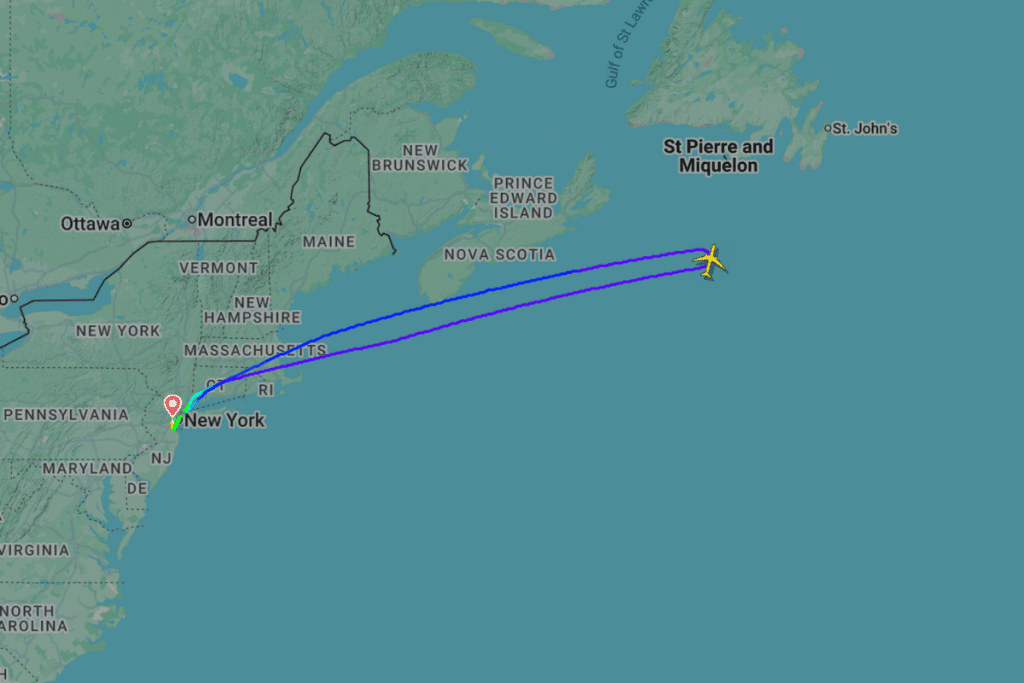
According to data supplied by Flight Radar 24, the aircraft took off from Newark and climbed out over the Atlantic Ocean in a north-easterly direction, passing the coast of Nova Scotia, before the pilots suddenly performed a 180-degree turn and started heading back towards New York.
It quickly emerged that on board the packed airliner that was meant to be taking passengers to the popular Balearic Island of Mallorca, a potential terror threat against the aircraft was unfolding.
Passengers were first alerted to the fact that something was amiss when the crew made several announcements over the public address system ordering everyone on board to switch off any Bluetooth devices.
Most of the passengers immediately complied, but several devices still appeared visible. The passengers were then warned that if all Bluetooth devices weren’t switched off, the aircraft would return to Newark.
When two devices remained visible even after this final warning, the plane started turning and headed back towards Newark.
It turns out that an eagle-eyed passenger had seen a Bluetooth device listed with the name ‘BOMB’ and alerted the flight attendants. They, in turn, contacted United’s operations center in Chicago, which gave specific instructions on how to deal with the issue.
In the end, it appears that the call to divert the plane was made by the airline in Chicago, which also contacted local enforcement to meet the plane once it had landed.
On the ground, the pilots were ordered to taxi the plane to a remote part of the airfield where passengers were deplaned via mobile airstairs and put in buses back to the terminal building, where they had to undergo TSA rescreening.
It remains unclear whether the Bluetooth device was named ‘BOMB’ as part of a deliberate prank, although reports indicate that a teenage passenger later admitted to being the owner of the device.
Surprisingly, after the plane was searched by the police, it was handed back to the control of United, and passengers were allowed to reboard for the flight to continue to Mallorca.
According to United Airlines, the flight is now expected to land nine and a half hours later than scheduled, at around 3:50 pm on May 31.
This incident occurred just days after another United Airlines pilot threatened to call the FBI and have passengers’ phones searched after people noticed an antisemitic Wi-Fi hotspot name during a recent flight.
The hotspot named read ‘Free Palestine, F Zionists,’ prompted a stern announcement from the pilot, giving the culprit just 30 seconds to switch off the hotspot or face the plane being diverted and the FBI being called.
This isn’t the first time that Bluetooth and Wi-Fi hotspot names have caused major security issues for airlines.
In January, for example, a Turkish Airlines flight to Barcelona was intercepted by fighter jets after a bomb threat was posted as a Wi-Fi hotspot name.
Turkish Airlines flight TK-1853 was in its initial descent to land in Barcelona when a passenger noticed an alarming network name in the list of available Wi-Fi connections, which read: “I HAVE A BOMB. EVERYONE WILL DIE.”
The flight crew was immediately alerted, and the pilots declared an emergency, advising air traffic control of a possible bomb threat against the plane. After being ordered into a holding pattern off the coast of Barcelona, the pilots were cleared to land, and the plane was then directed to a remote part of the airfield where Spain’s Guardia Civil police service swarmed the aircraft.
A thorough search was carried out of the aircraft, but no threat was detected. Turkish Airlines, however, vowed to try to find the culprit.


This piece is wrong to call the message “Free Palestine, F Zionists” antisemitic.
There’s a lot of conflation — much of it deliberate — of principled opposition to zionism with bigotry toward Jewish people. This is not only intellectually dishonest but also weakens the fight against the real problem of antisemitism. Mistakes like the one Mateusz Maszczynski makes here, even if it was a good-faith error, contribute to the problem.
That was also my biggest takeaway from.the whole article.
Little reject should be held financially responsible for the entire cost of the incident to the airline, all the passengers on board, and passengers who missed connecting flights (if any). Let him/her sit out _THAT_ wage garnishment for a while…
The kid who did that should’ve faced consequences. I can’t believe he was that stupid.