


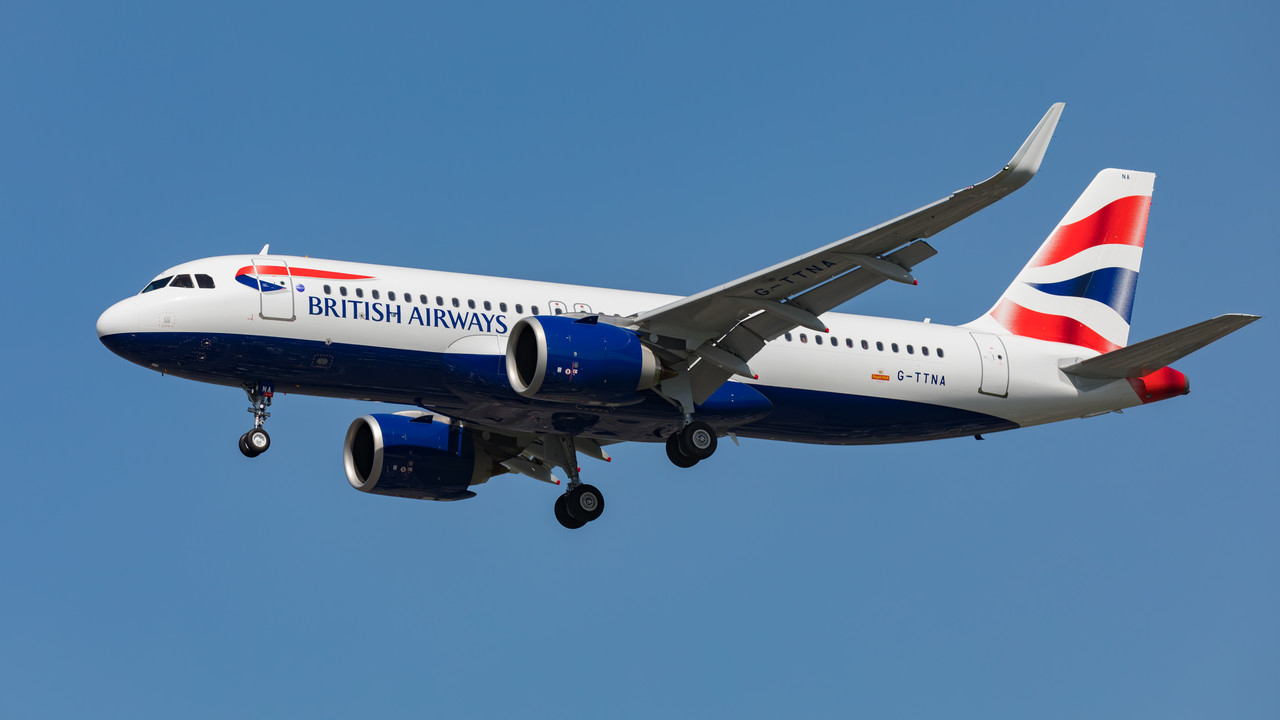
A British Airways pilot is reportedly on paid sick leave after he had to take the highly unusual step of intervening after a packed Airbus A320 plane went into a stall over Central London, due to a failure of one of the on-board systems.
The incident involved British Airways flight BA-919, which was nearing the end of a short flight from Düsseldorf, Germany, on July 6. Details are, however, only now emerging after news of the near miss was leaked to tabloid newspaper The Sun.
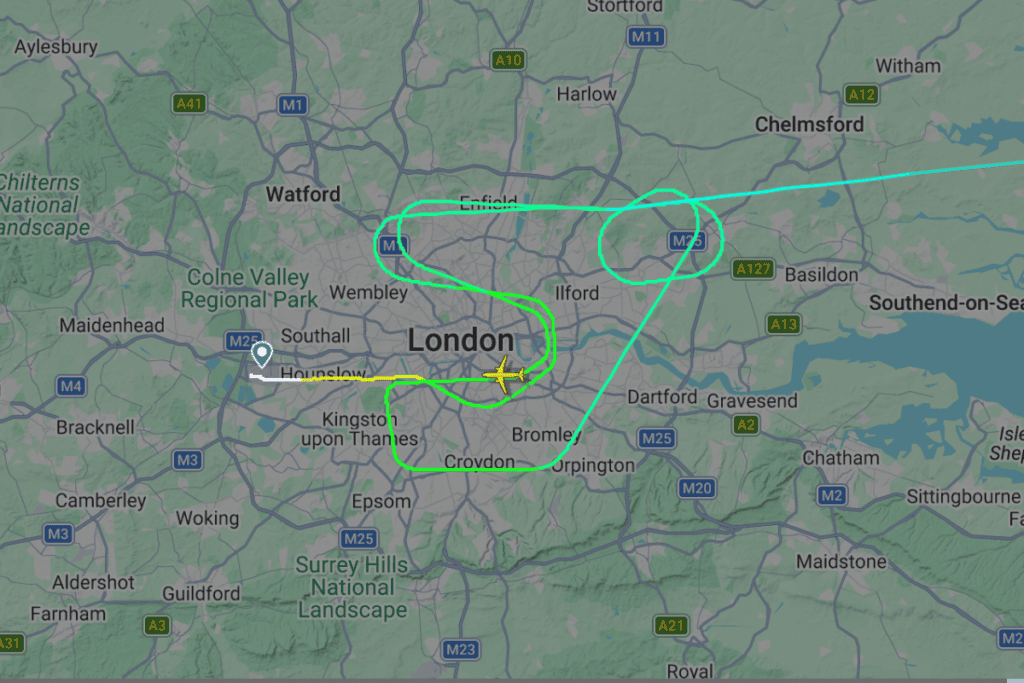
Data supplied by Flight Radar 24 shows that the 23-year-old narrowbody aircraft (registration: G-EUUN) was on its initial approach to London Heathrow Airport (LHR), entering a short S-shaped holding pattern over Essex before being cleared for final approach over Central London.
As the aircraft, which has a maximum capacity of 180 passengers, flew at just 3,900 feet above Putney, the Captain discontinued the approach, making a sharp left-hand turn, before climbing to around 8,000 feet and entering another holding pattern over Essex.
On the second attempt, the aircraft was once again cleared by Air Traffic Control to land, this time, flying over Central London without incident, and landing safely on Runway 27L.
Details of what exactly occurred in the cockpit remain sketchy, but The Sun reports that one of the air data systems failed as the plane was flying over Canary Wharf. The First Officer, who was the pilot flying the plane, wasn’t able to recover the situation, so the Captain had to take charge and rescue the situation.
Sources quoted by The Sun say the incident was “The most serious ‘near miss’ in the UK in years” and that to “recover from this position is difficult, especially so low to the ground.”
In very simple terms, a stall occurs when an aircraft’s wings are no longer producing enough lift to keep the plane in the air. Speed can be a contributing factor in causing a stall, but the underlying reason is the so-called ‘angle of attack’ that the pilot chooses.
Stalls are most dangerous during takeoff and landing, because there is very little altitude to recover from the situation. To recover from a stall, pilots will reduce the angle of attack, in other words, lower the nose, while increasing power from the engines.
According to The Sun, the Air Accidents Investigation Branch (AAIB) is investigating the near-miss with the loss of flight control being initially labelled as ‘pilot-induced.’
In a statement, the AAIB confirmed the investigation, saying: “The AAIB is investigating a serious incident involving a commercial aircraft which occurred on 6 July on approach to Heathrow airport.”
A spokesperson noted that the agency could not speculate on the causes at this point or give any further details.
Meanwhile, British Airways said it is “assisting the AAIB with its investigation and is legally unable to comment further at this stage.”
British Airways has a point. Last week, Ryanair’s chief executive, Michael O’Leary, was warned by the U.S. National Transportation Safety Board (NTSB) not to make any further comments about the window implosion on a flight from Thessaloniki (SKG) to the German town of Memmingen (FMM) in Bavaria, which partially sucked a passenger out of the plane.
O’Leary said during a recent earnings call that “initial indications would suggest it looks like a foreign object damage to the engine,” and that the accident was not the result of the aircraft’s age or servicing.
The NTSB’s chairwoman, Jennifer Homendy, reminded O’Leary of Ryanair’s responsibility under Annex 13 of the International Civil Aviation Organization (ICAO), which deals specifically with aircraft accident investigations.
Under Annex 13, Ryanair has been designated as an accredited representative and technical adviser in the investigation, which is being led by the NTSB. One of the requirements of being an accredited representative or technical advisor in an official aviation accident is that information cannot be released without the express permission of the investigating authority
Want to see more stories like this? Add PYOK as a preferred source on Google, and we'll show up more often in your searches and Google News.
Add PYOK as a Preferred Source