



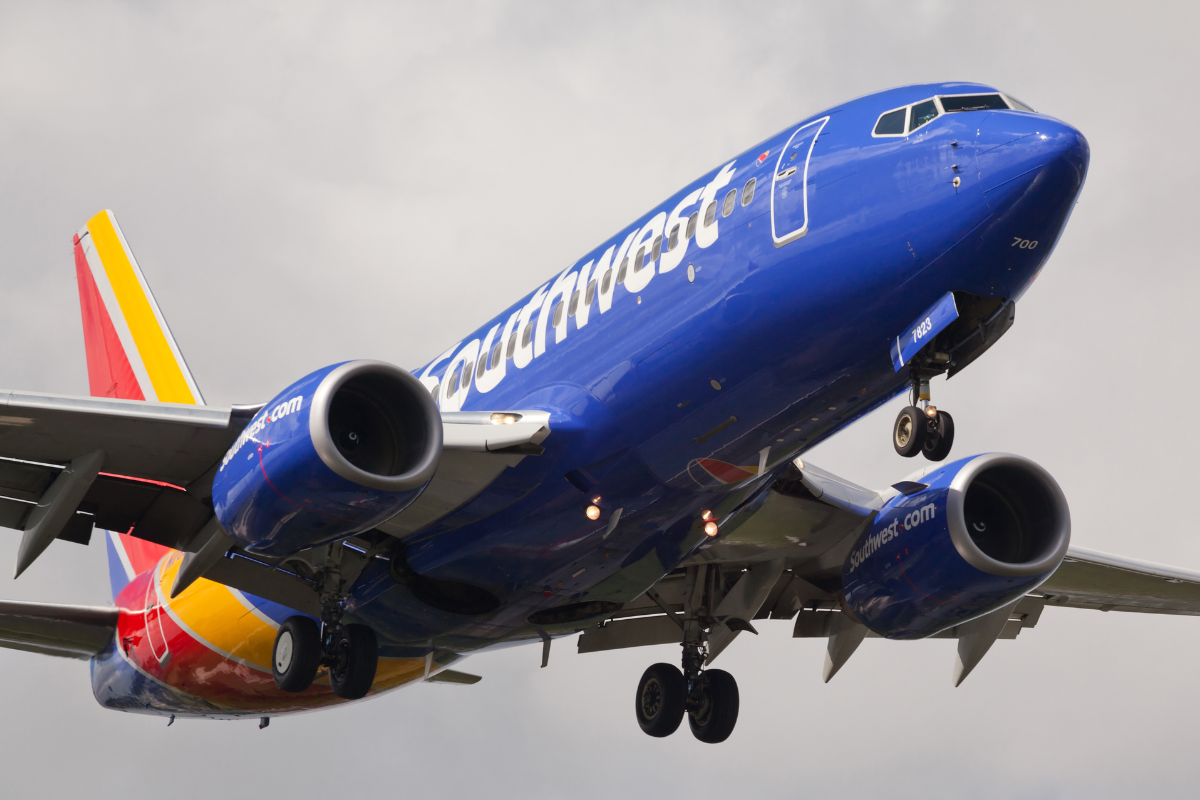
A Southwest Airlines Boeing 737 diverted back to Austin–Bergstrom International Airport on Thursday after the pilots reported problems with the right-hand engine of the 21-year-old aircraft.
Southwest flight WN-375 departed Austin at around 11:53 am on June 4 for a regularly scheduled flight to Phoenix, but after climbing to just 13,000 feet, the pilots requested a diversion back to Austin.
The pilots reportedly told air traffic control that they were experiencing issues with the right-hand engine, although their return to Austin had to be delayed due to weather in the local area.
According to the flight tracking website, Flight Radar 24, the aircraft descended to around 5,000 feet as it briefly circled to the north of Austin before it was cleared for approach to land.
The aviation accident reporting site, Aviation Herald, notes that the plane landed safely back at Austin–Bergstrom around 40 minutes after departure, but was briefly held on the runway as the airport fire service inspected the airplane.
After being given the all-clear, the plane was allowed to taxi on its own power back to the terminal building, where the passengers were deplaned.
A more detailed inspection revealed what the Federal Aviation Administration (FAA) has described as “metal debris and damage to the right engine.”
During the incident, the pilots told air traffic control that they hadn’t received an engine fire warning, but clearly, whatever was happening in the cockpit was enough to cause the pilots enough alarm to divert the plane and request emergency services to meet the plane.
The aircraft has not flown since, and the cause of the metal debris remains a mystery.
In 2018, Southwest Airlines flight WN-1380 from LaGuardia to Dallas Love Field suffered a major engine failure as the Boeing 737 was flying at high altitude over Pennsylvania.
The engine failure damaged the cowling of the engine (the outer engine cover), which sent fragments flying towards the fuselage. One of those fragments penetrated a passenger window, causing an explosive depressurization that partially sucked out one of the passengers.
Tragically, the passenger was killed in the incident, and eight others sustained minor injuries.
The National Transportation Safety Board (NTSB) concluded that the engine failure occurred when one of the fan blades separated from the rest of the engine and hit the engine cowling.
The FAA has ordered airlines operating Boeing 737NG aircraft to implement design changes to the engine cowlings of affected airplanes to minimize the risk of the detached fan blade being able to penetrate the cowling. Airlines are not, however, required to complete this work until 2028.
Want to see more stories like this? Add PYOK as a preferred source on Google, and we'll show up more often in your searches and Google News.
Add PYOK as a Preferred Source