



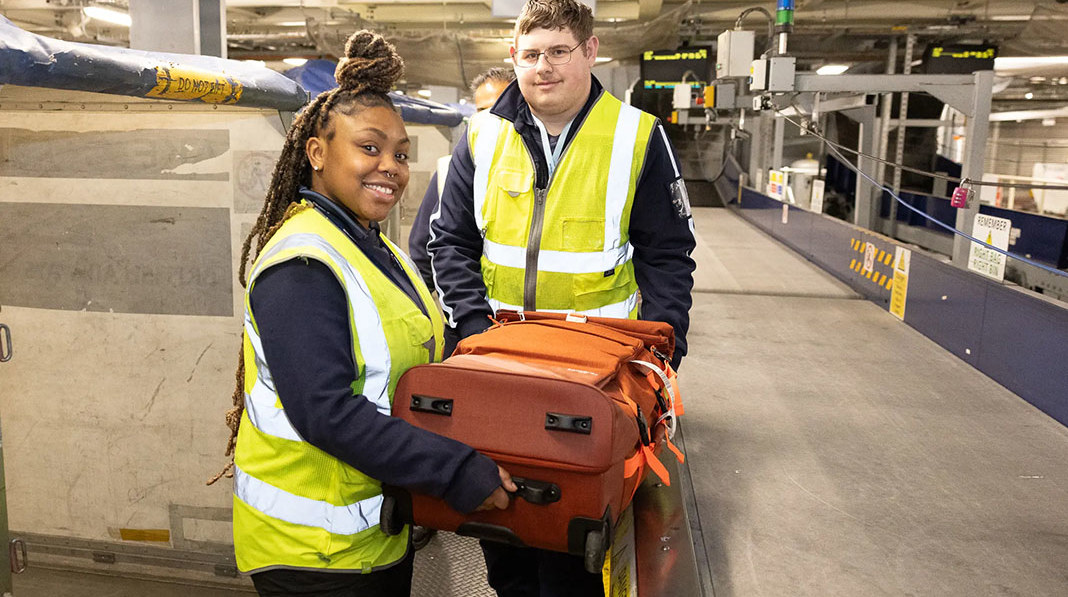
The parent company of British Airways and the Spanish flag carrier Iberia has made a strategic investment in a ‘wearable robotics’ startup, which has developed a so-called exosuit that is designed to reduce the risk of baggage handlers being injured.
Founded in 2020 by Spanish entrepreneur Ignacio Galiana and based on research conducted at Harvard University since 2012, Verve Motion has already developed an exosuit that is used by warehouse workers at several big-name brands to significantly reduce workplace injuries.
Verve Motion is now developing an exosuit specifically for the aviation industry, and this work piqued the interest of IAG, the Anglo-Spanish parent company of British Airways and Iberia, along with Ireland’s Aer Lingus and Spain’s Vueling and LEVEL airlines.
IAG has agreed to partially fund Verve Motion and, in return, it will get to trial the new aviation-specific exosuit. The first trials will focus on whether the suits can provide shoulder support for baggage handlers.
“Verve Motion is exactly the kind of company we want to back through IAGi Ventures – a business applying innovative technology to solve real operational challenges,” commented Nacho Tovar, IAG’s Group Innovation Director.
“Led by an outstanding Spanish entrepreneur, the team has developed a compelling solution with clear potential for aviation,” Tovar added.
“This partnership gives us the opportunity to test and shape the technology in a live operating environment, helping us understand how it could improve the day-to-day experience of colleagues carrying out physically demanding work while also supporting more efficient operations.”
In other environments where Verve Motion’s exosuits have already been deployed, some companies have reported impressive results, with workers less likely to be injured.
At one distribution center, back and hip injuries plummeted 61% during a 12 month period. A leading grocery store tested the exosuits in a warehouse and compared the rate of injuries among the exosuit wearers against other workers who weren’t kitted up with the tech. The exosuit wearers saw a 5x lower injury rate.
The suit looks like a backpack rather than some sort of metal robot that you might see imagined in a sci-fi movie. The idea is that Verve Motion’s exosuits are lightweight, comfortable, and easily deployable.
Despite major advances in technology, baggage handling remains a physically demanding job, which requires workers to manually handle hundreds of heavy suitcases every day.
Elsewhere, however, some airlines are wondering if humans can be removed from the equation altogether. Last month, Japan Airlines announced that it had begun trialling the use of humanoid robots at its Tokyo Haneda hub.
The robots will initially be deployed to load and unload cargo containers as part of a two-year trial.
Want to see more stories like this? Add PYOK as a preferred source on Google, and we'll show up more often in your searches and Google News.
Add PYOK as a Preferred Source